Clear Sky Science · en
A GIS and statistical based approach to assessing citizen awareness of the energy transition and climate change across algerian climatic zones
Why everyday choices under different skies matter
From the cool Mediterranean coast to the scorching Sahara, Algerians live with very different kinds of weather. This study asks a simple but crucial question: do people living in these contrasting climates think and act differently when it comes to climate change and the shift away from fossil fuels? By combining a nationwide survey with detailed climate maps and advanced statistics, the authors show how daily experience, social conditions, and personal choices shape citizens’ readiness to engage in the energy transition.
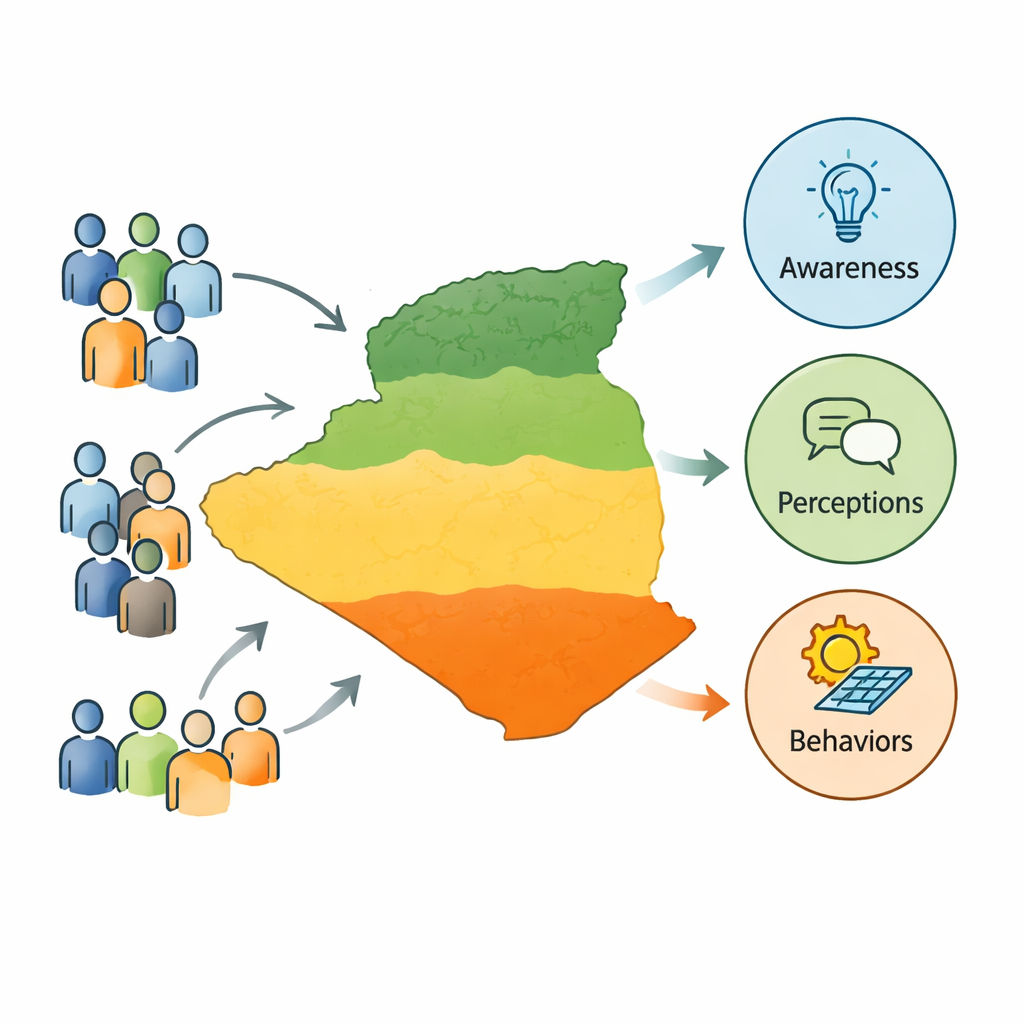
Looking at awareness beyond simple knowledge
Rather than treating awareness as just knowing a few facts, the researchers break it into three tightly linked pieces: what people do in their everyday lives (behaviour), how they see and feel about climate and energy issues (perception), and how informed and concerned they believe they are (awareness). Over 1,200 adults across Algeria answered questions about energy use, transport, waste, climate concerns, and social background. Using statistical tools to reduce dozens of questions into core patterns, the team found that most of the variation in answers could be captured by these three dimensions. This means that saving water, sorting waste, supporting clean transport, and following national energy plans tend to move together, forming a coherent picture of how citizens relate to the energy transition.
One country, three climate realities
To understand how context matters, the study divides Algeria into three broad climate zones using an established dryness index. The narrow northern belt is relatively moist, the central plateaus are semi-arid, and the vast southern areas are arid desert. Each survey participant is linked to one of these zones based on where they live. This spatial lens reveals that climate is not just a backdrop; it helps shape how people experience and interpret energy and environmental issues. For example, frequent drought or heat waves can make climate change feel immediate, while milder conditions may keep impacts less visible in daily life, even if they are no less serious in the long term.
How actions and beliefs reinforce each other
Across all zones, awareness, perception, and behaviour form a feedback loop: people who feel more informed tend to see the transition more clearly and are more likely to adopt eco-friendly habits, while acting sustainably can, in turn, sharpen their understanding and concern. Yet the balance among these elements shifts with climate. In arid and semi-arid regions, concrete actions such as saving water, reducing waste, or choosing efficient appliances play the strongest role in shaping awareness. Here, harsh conditions and economic pressures make energy and climate issues very tangible, so practice often comes before theory. In the wetter semi-humid north, awareness is driven more by perception—how people interpret information from school, media, and public debate—while behaviour still matters but plays a more modest part. In this setting, climate impacts are less immediately felt, and understanding tends to grow through ideas and discussion rather than direct environmental stress.
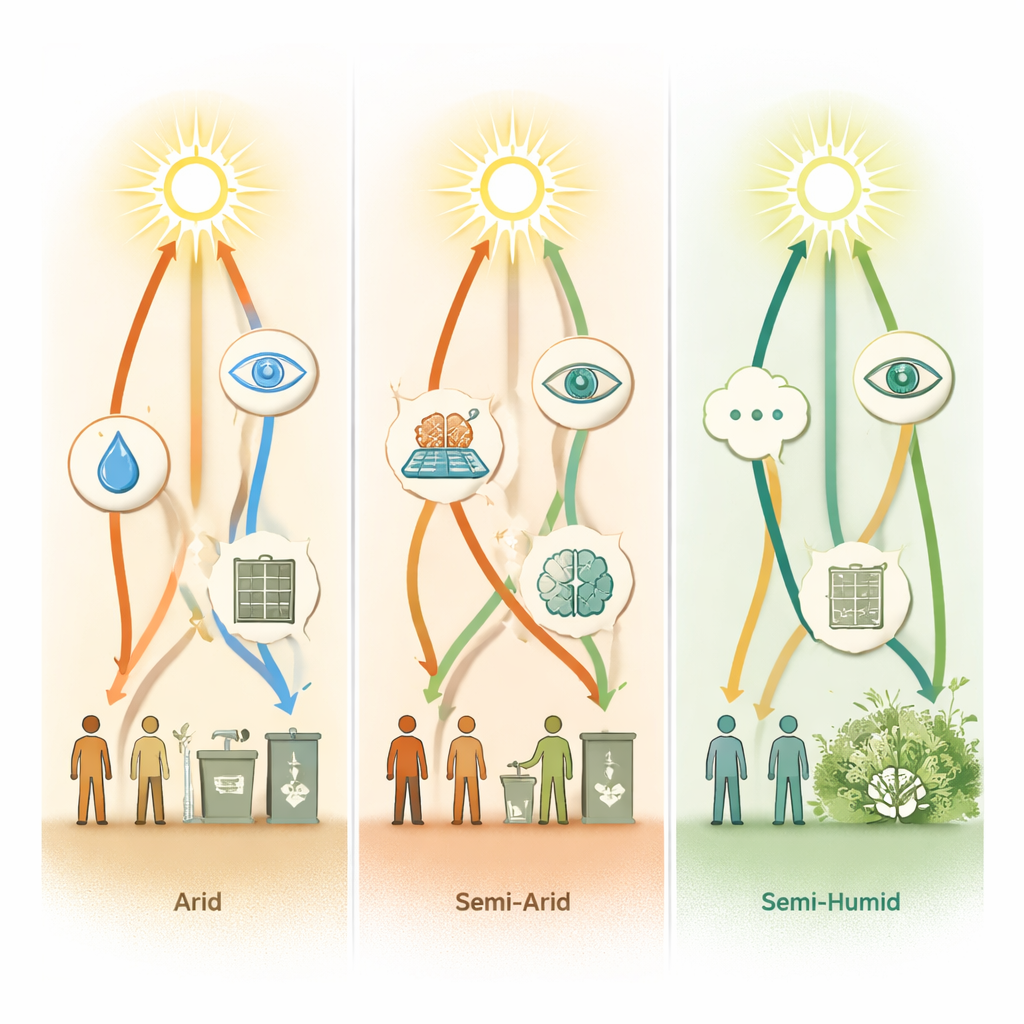
Social gaps and territorial fairness
The study also shows that social and economic disparities subtly tilt the playing field. Younger and better-educated respondents generally report more sustainable habits and greater openness to the energy transition. Lower incomes and more precarious jobs are linked to weaker engagement, especially in drier zones where resources are already strained. In some arid areas, higher socio-economic pressure even appears to dampen people’s willingness to think deeply about climate and energy policies, simply because more urgent worries compete for their attention. These patterns suggest that successful climate and energy strategies cannot ignore income, education, housing type, or family responsibilities; they must be designed so that participation is possible for all, not just for those with time and money to spare.
What this means for future energy choices
Overall, the research shows that citizen awareness in Algeria is a moving target shaped by where people live, how they live, and what they know. There is no single message or policy that will work equally well in a coastal city and a Saharan town. In drier regions, strengthening and rewarding the practical efforts people already make—like using less water or improving home efficiency—can deepen awareness and buy-in. In the more temperate north, clear, accessible information and education that connect everyday habits to long-term climate risks are especially important. By tailoring communication and support to each climate zone and social group, Algeria can build a fairer, more effective path toward a cleaner energy future in which citizens are not just passive consumers but informed partners in change.
Citation: Ouazar, K., Mansour, L.A., Eveno, E. et al. A GIS and statistical based approach to assessing citizen awareness of the energy transition and climate change across algerian climatic zones. Sci Rep 16, 13463 (2026). https://doi.org/10.1038/s41598-026-43948-0
Keywords: energy transition, climate change awareness, citizen behaviour, Algeria, climatic zones