Clear Sky Science · en
Human lateral occipital complex is invariant for position and size transformations at the single-neuron level
How Your Brain Knows a Chair Is a Chair
Whether a chair is close or far, high on the wall or low by the floor, you still recognize it instantly. This everyday skill hides a hard problem for the brain: the image hitting your eyes can change dramatically, yet your perception of the object stays the same. This study peeks into individual brain cells in a key human vision area to see how they pull off this trick, revealing how our brains keep object identity stable while the world (and our viewpoint) keeps shifting.
A Rare Look Inside the Human Visual Brain
Most of what we know about how single brain cells recognize objects comes from monkey research, because directly recording from individual neurons in people is rarely possible. Here, doctors and scientists took advantage of a special medical situation: a woman with difficult-to-treat epilepsy who needed temporary implanted electrodes. Alongside her clinical monitoring, the team added two tiny grids of microelectrodes into a region at the back of her brain called the lateral occipital complex, or LO, known to be crucial for seeing shapes and objects. These grids allowed them to listen to the electrical spikes of dozens of single neurons while she looked at pictures on a screen.

Neurons That Care Deeply About Shape
The researchers first mapped where each neuron “looked” on the screen by flashing a single body shape in many positions across a 28-by-28 degree patch of visual space. This mapping revealed that LO cells had receptive fields—areas of the visual field they respond to—that were smaller than some earlier estimates but often stretched across both sides of space and favored the side opposite the implanted hemisphere. Next, they tested how picky these neurons were about shape. In one grid, they showed 64 simple white shapes; in the other, a set of detailed headless body images. Many neurons fired strongly to just a few preferred shapes and hardly at all to others, indicating sharp shape tuning rather than a general response to “anything on the screen.”
Same Preference, Wherever the Object Appears
Recognizing a mug as “the same mug” even when it moves means the brain must keep its shape preference stable across locations. To test this, the team identified each neuron’s favorite stimulus at its best screen position, then asked: does that ranking of shapes stay similar when the same images appear elsewhere within its receptive field? Using time-resolved correlation analyses, they found that the pattern of responses at preferred and non-preferred locations became strongly linked within about 80–90 milliseconds after stimulus onset. In other words, the same shapes tended to be best and worst no matter where they appeared within the zone that each neuron could see, a hallmark of position invariance.
Holding Steady Across Big Changes in Size
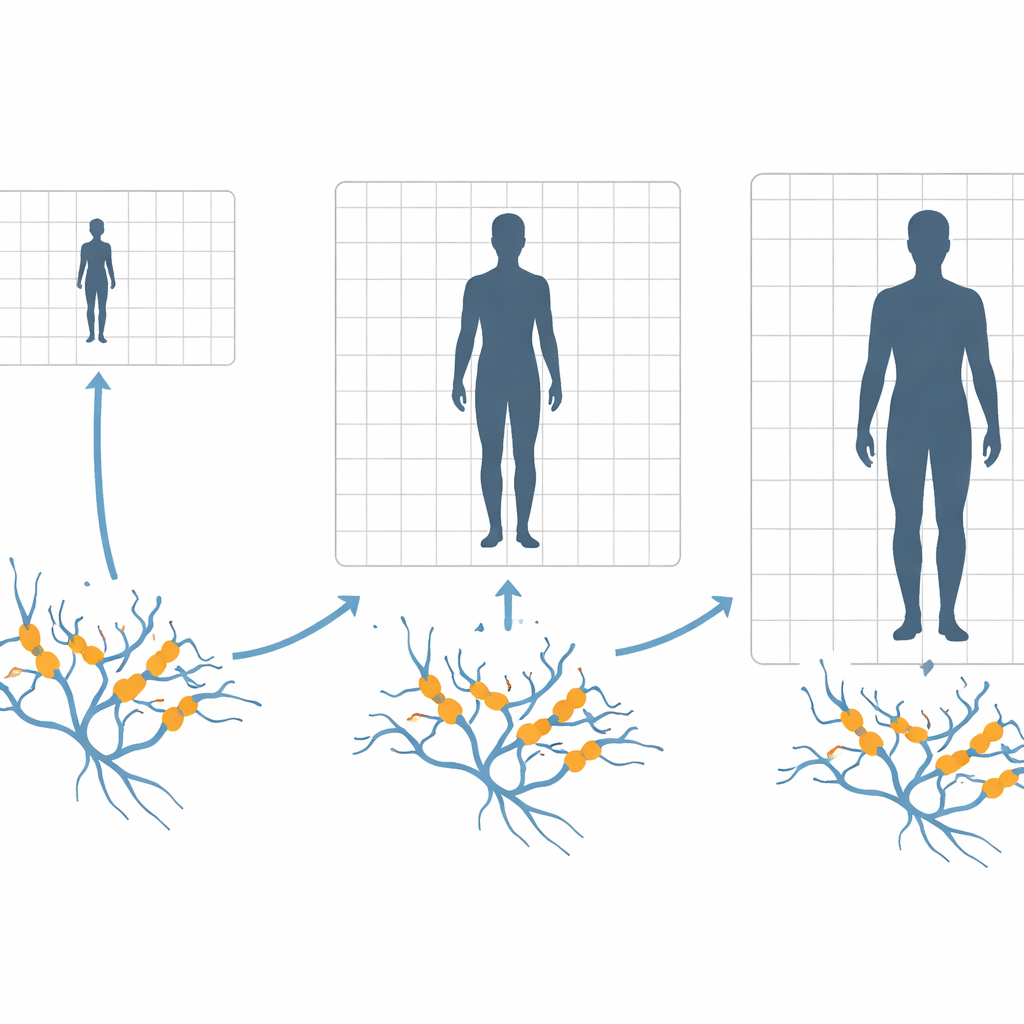
The brain must also cope with objects that grow or shrink in our visual field as they move closer or farther away. In a separate experiment, the researchers showed 20 body images at three sizes spanning two “octaves” (a fourfold change, from small to large) within the receptive field of one array. Some neurons responded only to the biggest bodies, but a subset fired reliably across multiple sizes. When the team compared response patterns, they found that the ordering of preferred versus non-preferred bodies was partly preserved between small, medium, and large versions. Statistical measures and regression analyses showed significantly consistent tuning across these size changes, demonstrating size invariance at the population level, even though the overall strength of firing could still vary with size.
What This Means for Seeing the World
This work provides the first direct evidence that single neurons in human LO keep their shape preferences stable even when objects move around or change size, much like neurons in the monkey inferotemporal cortex. Despite being based on a single patient, the results show that this brain area houses cells whose activity is both finely tuned to shape and surprisingly tolerant to common visual transformations. For everyday life, that means when you glance around a cluttered room, the neurons in your LO help you recognize people and objects quickly and reliably, no matter where they are or how big they appear on your retina.
Citation: Michaël, V., Peter, J. & Tom, T. Human lateral occipital complex is invariant for position and size transformations at the single-neuron level. Sci Rep 16, 13222 (2026). https://doi.org/10.1038/s41598-026-43946-2
Keywords: object recognition, visual cortex, lateral occipital complex, neural invariance, single-neuron recordings