Clear Sky Science · en
Genetical analysis for wheat genotypes using a half-diallel model under different sowing conditions
Why planting time matters for your daily bread
Wheat is the backbone of many people’s diets, but it is increasingly threatened by rising temperatures and shifting seasons. Farmers often sow wheat later than ideal because earlier fields are still occupied by other crops, exposing young plants to chilly beginnings and then intense heat during flowering and grain filling. This study asks a practical question with big implications for food security: can plant breeders create wheat varieties that still produce strong harvests even when sowing is delayed and the plants face more heat stress?
Testing wheat families in two planting seasons
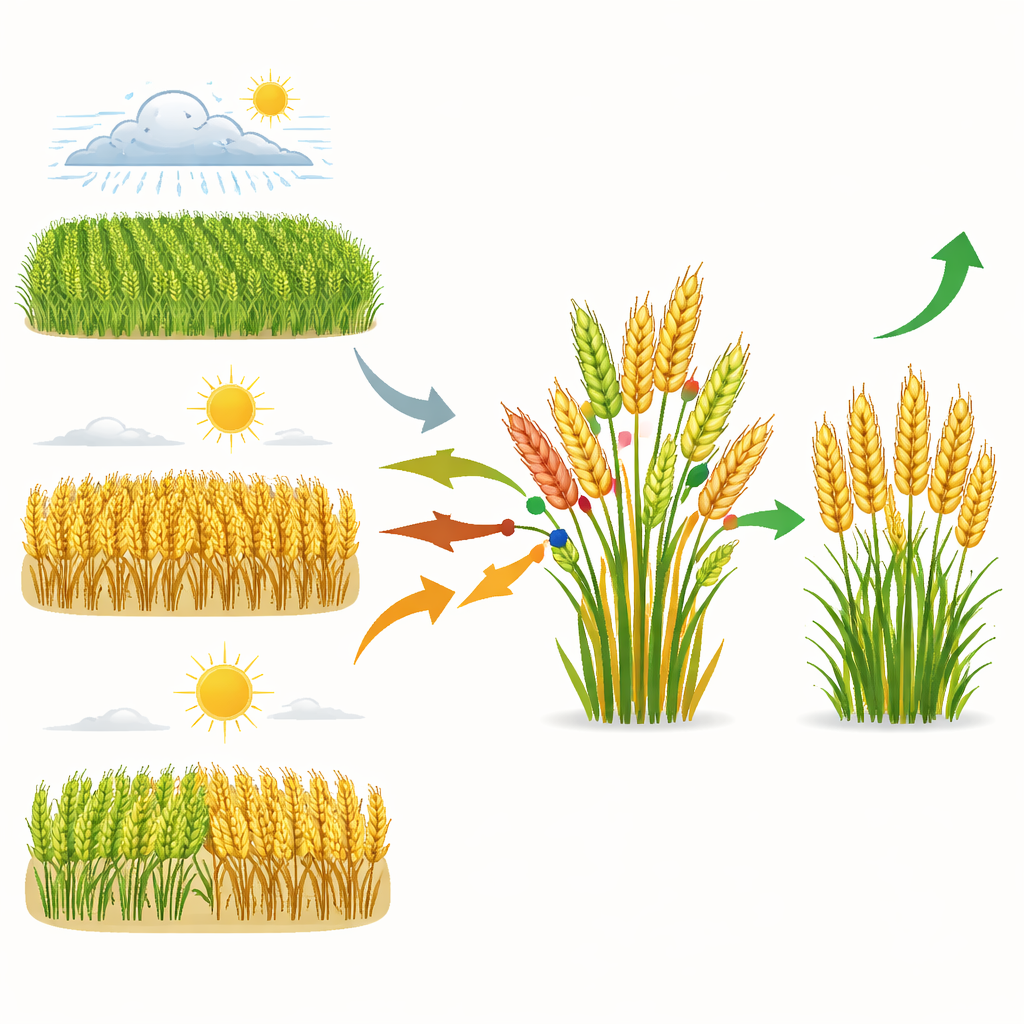
To explore this, researchers worked with six different bread wheat types that varied in maturity and yield characteristics. They crossed every possible pair (without reciprocals), creating 15 hybrid families, and then grew the original parents and all their hybrids in Egypt over two seasons. In the first season they made the crosses; in the second, they tested all 21 lines under two real-world sowing dates: an optimal mid-November date and a late mid-December date. Apart from planting time, all field practices—fertilization, irrigation, spacing, and other care—were kept the same so that differences in performance could be tied mainly to genetics and sowing date.
How scientists measure “good parents” and “good crosses”
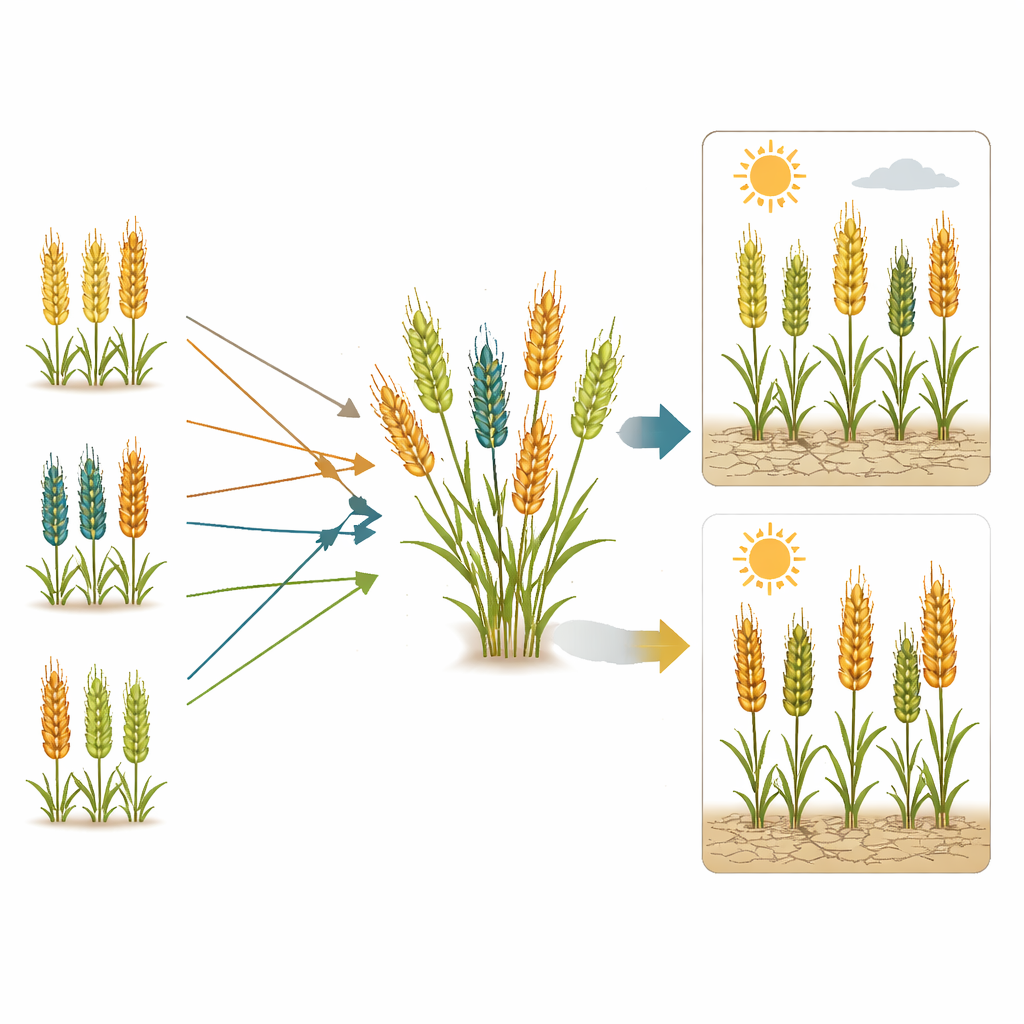
Rather than just eyeballing which plants looked best, the team used a classic breeding approach called a half-diallel analysis. In simple terms, they asked two questions. First, which parents tend to make good offspring no matter whom they are crossed with? This overall potential is called general combining ability and mainly reflects genes that have steady, additive effects. Second, which specific pairs of parents produce especially outstanding or disappointing children, beyond what their average performance would predict? This is specific combining ability and reflects more complex gene interactions behind hybrid vigor, or heterosis, where a cross outperforms its parents.
What late sowing and heat did to the plants
As expected, planting wheat late exposed it to more stressful conditions. The timing change significantly altered most traits, such as the number of spikes per plant, the number of spikelets and kernels per spike, spike length, and the weight of kernels on a spike. These are all building blocks of final yield. Interestingly, overall grain yield per plant did not show a strong sowing-date effect in the combined analysis, but the way individual genotypes handled early versus late planting differed sharply. In other words, some families managed the late, hotter finish much better than others, which is exactly what breeders need to know when designing climate-ready varieties.
Finding star parents and standout hybrids
The genetic analysis showed that both steady, additive genes and more complex interactions mattered for most traits. For spikelets per spike, kernels per spike, spike length, and grain yield, additive effects were especially important, meaning that selection can work efficiently, even in early breeding generations. Among the six parents, one line, Sakha 95, consistently behaved as a strong general donor for grain yield under both sowing dates. When specific crosses were examined, some combinations stood out. For example, the hybrid between Line 1 and Misr 3 gave particularly promising grain yields across planting times, and several crosses—such as those involving Sids 14, Sakha 94, Giza 168, and Misr 3—showed notable hybrid vigor for yield-related traits under both normal and late sowing.
What this means for future wheat fields
The study concludes that meaningful genetic gains for late-sown, heat-challenged wheat are achievable. Because many key yield components are controlled largely by additive genes, breeders can reliably improve them by selecting from these promising hybrids through successive generations, aiming to fix the desirable combinations into stable pure lines. The authors recommend continuing to advance hybrids such as those derived from Sakha 95 and the Line 1 × Misr 3 cross until at least the fifth generation. The goal is to deliver wheat varieties that ripen early, produce high grain yields with good quality, and remain productive even when planting is delayed and the season ends in intense heat. For consumers, this translates to a better chance that bread and other wheat-based foods will remain plentiful in a warming, less predictable climate.
Citation: Elsherbini, N.Y., Alomran, M.M., Al-Shammari, W. et al. Genetical analysis for wheat genotypes using a half-diallel model under different sowing conditions. Sci Rep 16, 13916 (2026). https://doi.org/10.1038/s41598-026-43922-w
Keywords: wheat breeding, heat stress, sowing date, hybrid vigor, grain yield