Clear Sky Science · en
An adaptive multi-scale lightweight network for long-distance small traffic sign detection
Why tiny road signs matter
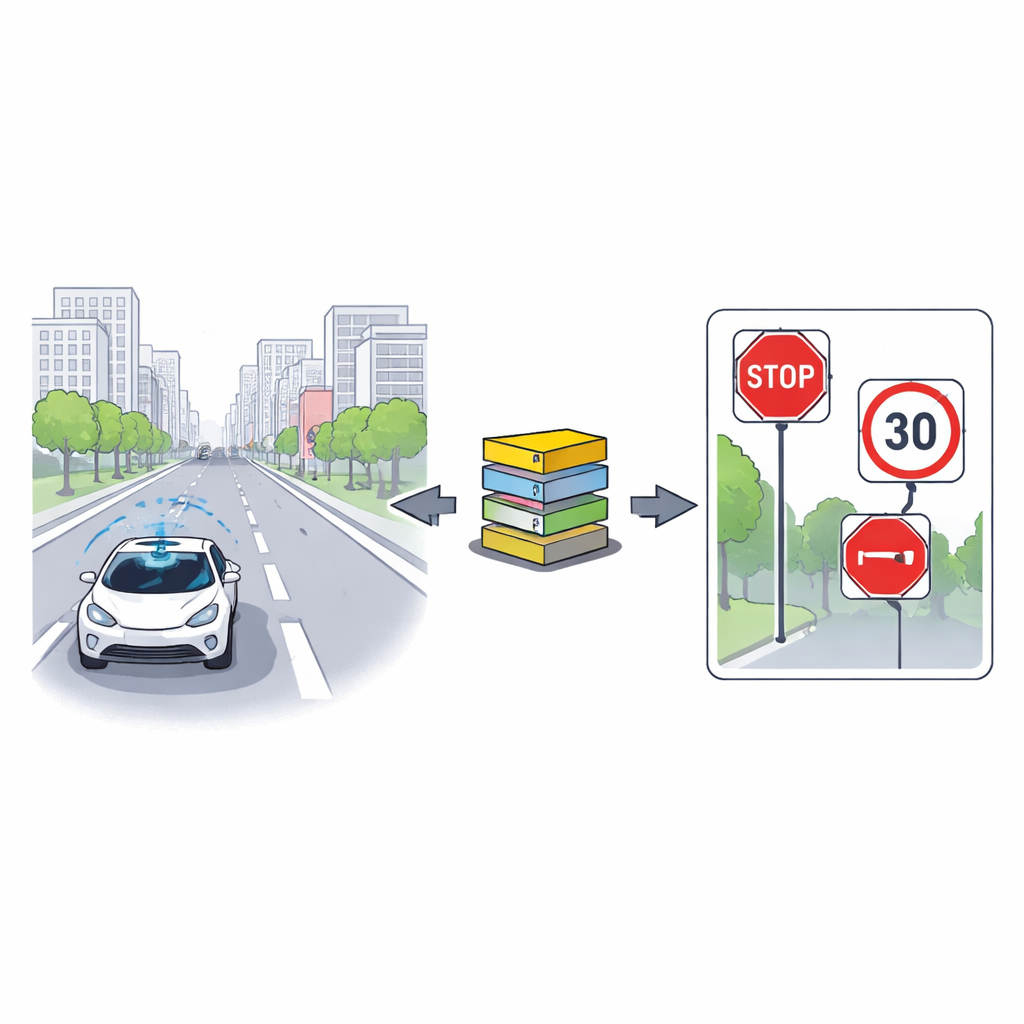
Modern driver-assistance and self-driving cars depend on spotting traffic signs quickly and reliably, even when those signs are tiny specks far down the road. Missing a small speed‑limit sign or misreading a warning can mean late or unsafe decisions. Yet on-board computers have limited processing power, and distant signs are easily drowned out by buildings, trees, and glare. This paper introduces YOLO‑AML, a streamlined vision system designed to pick out long‑distance, small traffic signs in real time, helping cars "see" better without demanding heavy hardware.
The challenge of seeing small signs
In real traffic scenes, the same type of sign can appear huge when close and occupy less than a thousandth of the image when far away. Weather, shadows, and obstacles further blur or hide these signs, while dashboards and roadside clutter create distracting patterns. Traditional computer-vision methods relied on hand-crafted color and edge cues, which struggle when lighting changes. Newer deep-learning systems, such as the widely used YOLO family of detectors, are faster and more accurate, but they still lose fine details when they shrink images to process them efficiently, and they often need more computing muscle than in-vehicle devices can spare.
A lighter network that keeps the details
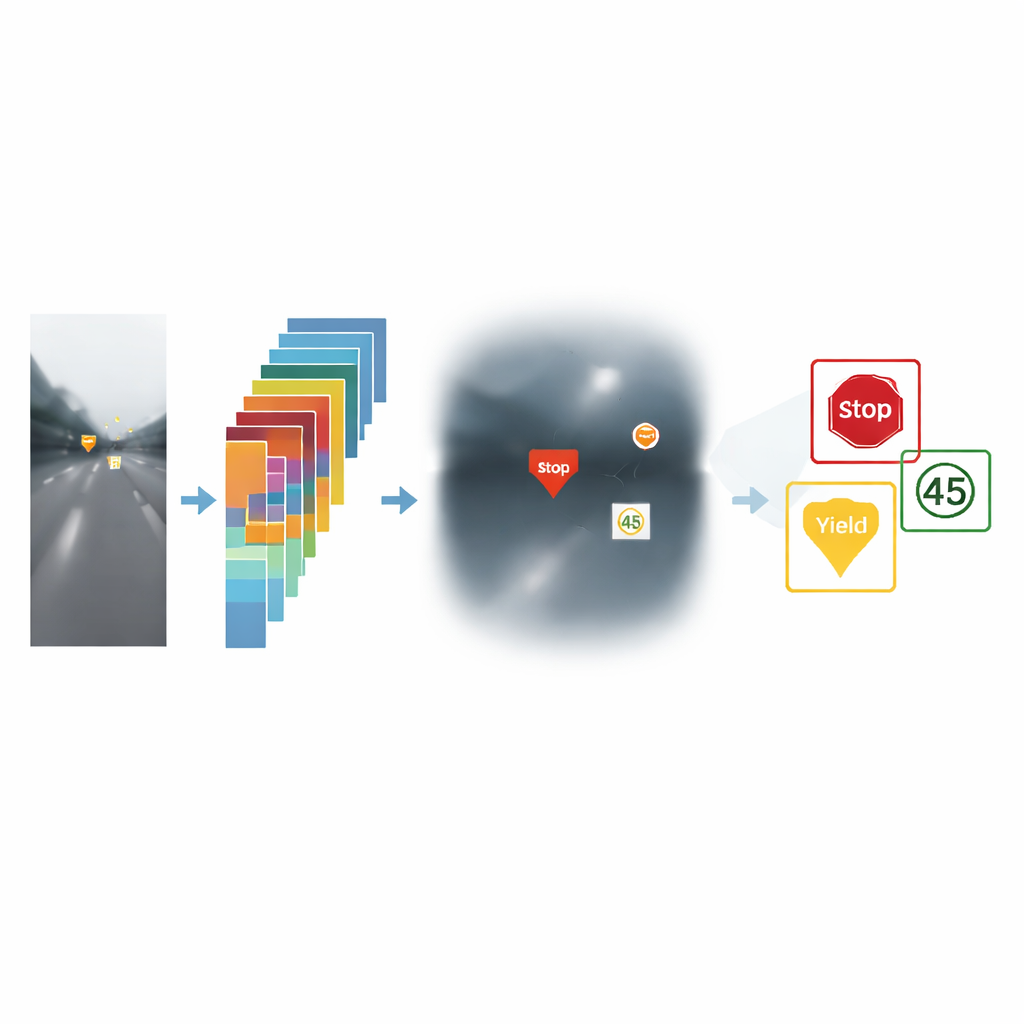
YOLO‑AML starts from a recent YOLO design and reshapes its internal layers to be both lighter and more careful with small details. Instead of using standard operations that throw away pixels as they shrink the image, the system uses a "space‑to‑depth" step that rearranges those pixels into extra channels. This keeps the original information while still reducing the width and height of the data, lowering computation but preserving the texture of tiny signs. A redesigned backbone module called CLSKA uses large yet economical filter patterns to look at both local edges and broader surroundings, so the network can connect a faint bit of red or yellow to the road context around it without exploding in size.
Tuning attention and measuring boxes more wisely
Simply preserving detail is not enough, because distant scenes are filled with trees, buildings, lamp posts, and road markings that can confuse the detector. To tackle this, YOLO‑AML adds an attention block named NAST that quietly reuses existing normalization values inside the network as a guide for what to ignore. Channels and pixels that behave like background are downplayed, while those that resemble potential signs are boosted, all without adding extra heavy layers. At the output stage, the system also changes how it learns to draw bounding boxes around signs. Instead of relying on an overlap score that can abruptly drop to zero when a tiny box shifts by a few pixels, it treats each box as a soft blob and measures how similar these blobs are using a smooth distance measure. This gives the model stable training signals even when signs are extremely small.
Putting the system to the test
The authors evaluate YOLO‑AML on a large Chinese road-sign dataset and a separate European benchmark, covering thousands of urban and highway scenes. Compared with a strong baseline and several popular YOLO variants, the new system detects a higher fraction of true signs while running faster and using fewer parameters. On the main dataset, it cuts the model size by about one sixth and speeds up processing, yet still improves accuracy, especially for distant and partially hidden signs. Visual "heatmaps" confirm that the network concentrates more tightly on actual signs and is less distracted by irrelevant textures and shadows. Tests on a low-power Jetson Nano board show that the method still works under tight memory and speed limits, underscoring its suitability for embedded use.
What this means for future cars
In everyday terms, YOLO‑AML is like giving a car sharper long‑distance eyesight and better focus while keeping its brain small and efficient. By preserving tiny image details, steering attention away from clutter, and using a more forgiving way to judge box positions, the system can spot small traffic signs earlier and more reliably. This combination of accuracy, speed, and light weight makes it a promising building block for future driver‑assistance and autonomous driving platforms, where every millisecond and every watt of computing power matter.
Citation: Liang, R., Qu, W. & Li, S. An adaptive multi-scale lightweight network for long-distance small traffic sign detection. Sci Rep 16, 13459 (2026). https://doi.org/10.1038/s41598-026-43920-y
Keywords: autonomous driving, traffic sign detection, small object detection, lightweight neural networks, YOLO