Clear Sky Science · en
Clinical prediction of the mortality for acute kidney injury in decompensated cirrhosis
Why this matters for patients with liver disease
People living with serious liver disease often face sudden kidney problems that can quickly turn life threatening. Doctors need simple ways to spot which patients are at highest risk of dying in the short term so that they can act fast, focus care on those in greatest danger, and use scarce hospital resources wisely. This study explores whether everyday blood tests can be woven into a practical tool that helps predict survival for these vulnerable patients.
The double burden of sick liver and sick kidneys
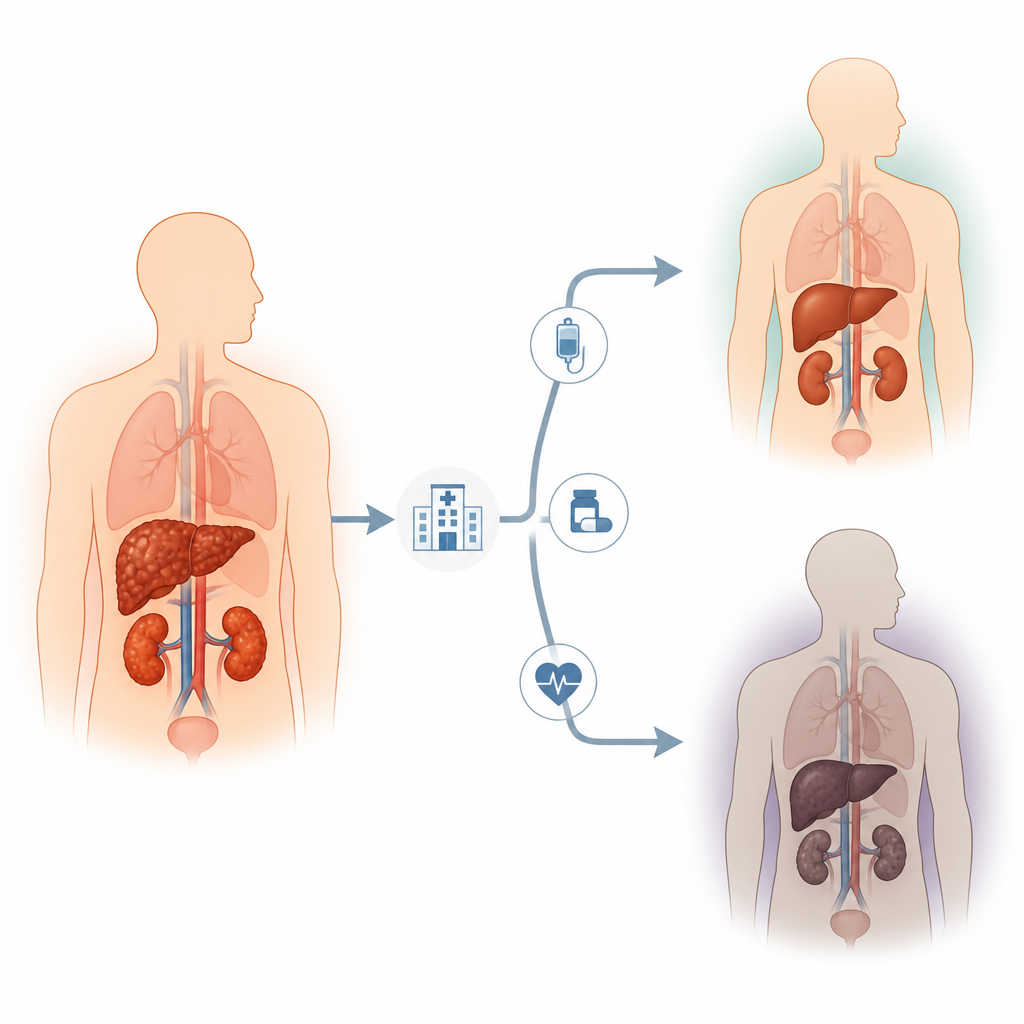
Liver cirrhosis is a long term scarring of the liver. When it worsens and complications like fluid buildup in the belly or confusion appear, it is called decompensated cirrhosis. In this setting, the kidneys are especially fragile. A sudden drop in kidney function, known as acute kidney injury, is common and linked with more hospital visits, long term kidney damage, and a much higher chance of death. The authors set out to understand which routine measurements best signal danger in patients with decompensated cirrhosis who develop acute kidney injury, and to build a clear way to estimate their short term risk of dying.
How the researchers studied hospital patients
The team reviewed records from 487 adults admitted with cirrhosis at two hospitals in China between 2022 and 2024. They separated them into those with compensated cirrhosis, who had no major complications, and those with decompensated cirrhosis, who already had serious problems such as abdominal fluid, bleeding from swollen veins, or brain fog from liver toxins. They found that acute kidney injury was far more common in the decompensated group, affecting nearly half of these patients compared with about one in six in the compensated group. Among decompensated patients, those with kidney injury were much more likely to die within 28 days than those whose kidneys remained stable.
Finding four key warning signs in the blood
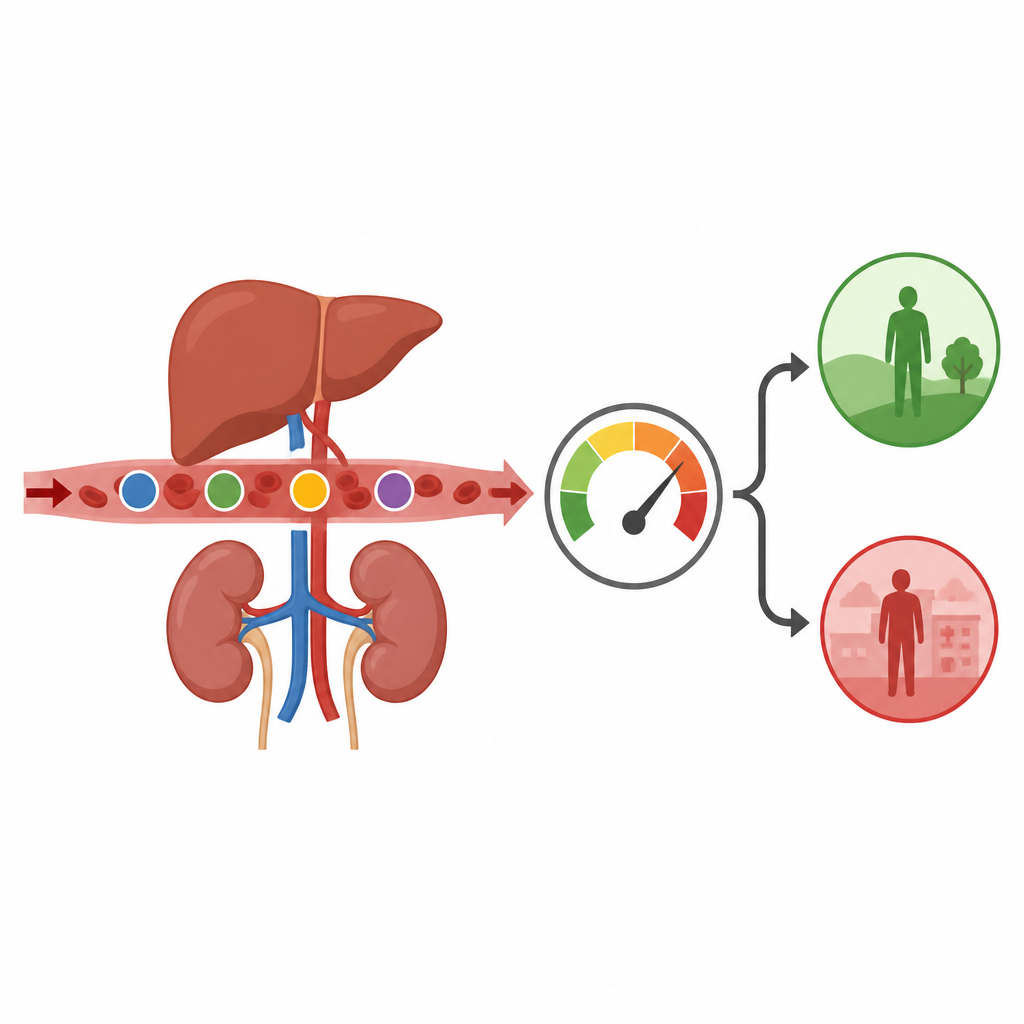
To sift through a large set of clinical and laboratory data, the researchers turned to three machine learning methods, which look for patterns that might be hard to spot by eye alone. Across all three approaches, four blood test results kept showing up as strongly tied to whether patients with decompensated cirrhosis and acute kidney injury survived: activated partial thromboplastin time, which reflects how well blood clots; alkaline phosphatase, an enzyme linked to bile flow; total bilirubin, a pigment that rises when the liver struggles to clear waste; and the highest level of creatinine, a marker of how well the kidneys filter the blood. In general, patients with longer clotting times, higher bilirubin, and higher peak creatinine fared worse.
Building a simple tool to estimate short term risk
Using these four markers, the team created a mathematical model that estimates the chance of dying within 28 days for decompensated cirrhosis patients who develop acute kidney injury. The model showed strong ability to distinguish between survivors and non survivors in the original group, and it performed just as well when tested in an independent set of 61 similar patients from another hospital. The researchers then combined the four marker score with well known illness scales that doctors already use at the bedside, displaying everything in a visual chart called a nomogram. This chart lets clinicians add up points for each factor to obtain an individualized risk estimate.
What this means for care today and tomorrow
For people with advanced cirrhosis, the study suggests that four routine blood test results can provide an early warning of who is most likely to die soon after acute kidney injury develops. While the work is based on past records from a limited number of centers, and does not yet guide specific treatments, it offers a practical risk tool that could help doctors decide who needs closer monitoring, aggressive support, or referral to specialized care. Future studies in larger and more diverse groups of patients will be needed to refine this approach, but it points toward a more tailored way to manage one of the most dangerous complications of severe liver disease.
Citation: Pan, Xy., Yang, Hl., Du, T. et al. Clinical prediction of the mortality for acute kidney injury in decompensated cirrhosis. Sci Rep 16, 14924 (2026). https://doi.org/10.1038/s41598-026-43918-6
Keywords: cirrhosis, acute kidney injury, mortality risk, clinical prediction model, liver and kidney failure