Clear Sky Science · en
The hydrogen, methane and ammonia biosphere on early Earth
Why this ancient Earth story matters
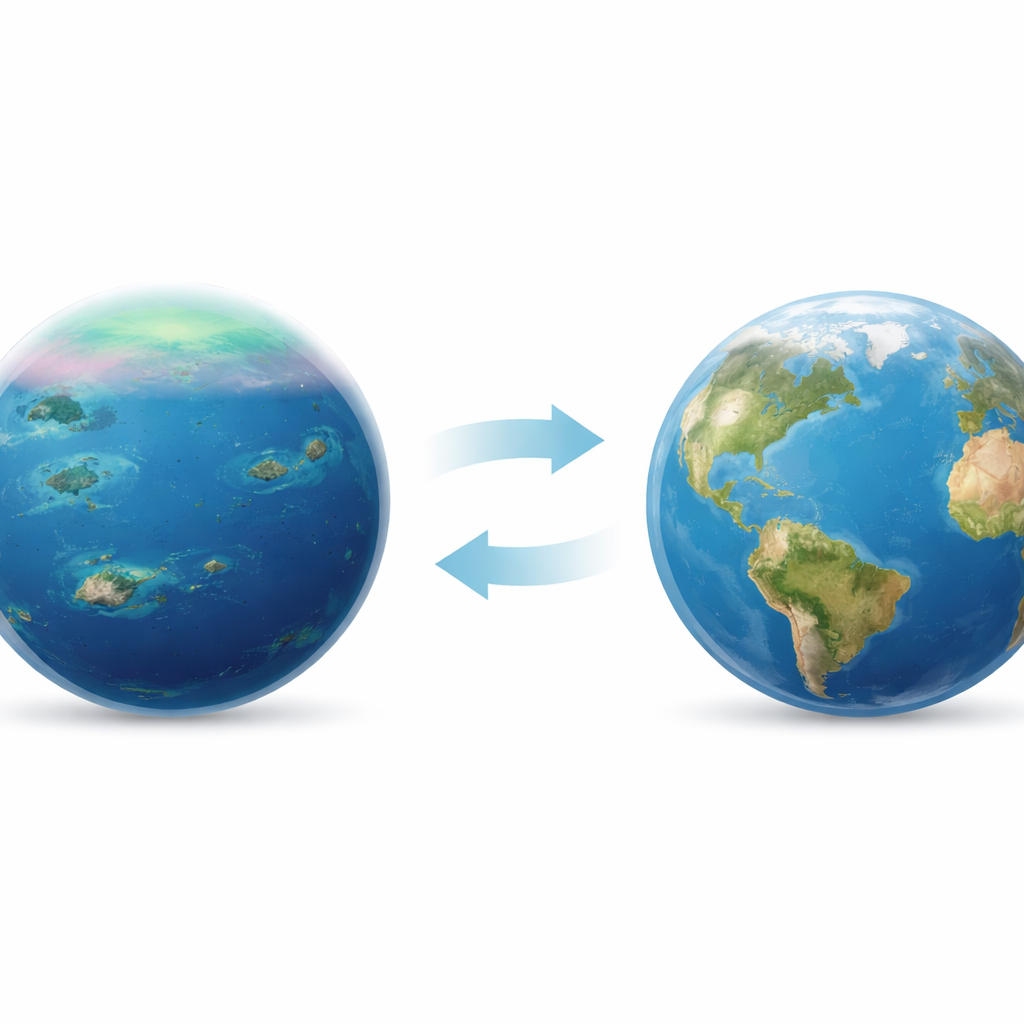
When we picture Earth’s earliest days, we often imagine a choking sky of carbon dioxide and a lifeless ocean waiting for biology to begin. This paper turns that familiar picture on its head. Using geologic evidence and chemical modeling, the authors argue that our planet’s first habitable atmosphere looked less like modern Earth and more like a gentle version of Jupiter: rich in hydrogen, methane, and ammonia, with almost no carbon dioxide. In that alien setting, they propose that early life and even the machinery of photosynthesis took shape in sunlit, shallow waters on tiny islands.
A new look at Earth’s first air
Conventional models assume that early volcanic gases created an atmosphere dominated by carbon dioxide (CO2) and nitrogen (N2). Ohmoto and Ferry instead re-evaluate how gases would have behaved as the young planet’s magma ocean cooled and as seawater circulated through the oceanic crust. They show that, given a very low oxygen state in the early mantle and the presence of minerals like graphite and iron sulfide, volcanic gases would have shifted toward reduced forms: hydrogen (H2), methane (CH4), and ammonia (NH3). Submarine hot springs, not towering volcanoes, likely did most of the degassing because Earth’s surface was almost entirely covered by deep oceans. Their calculations suggest that by about 4.5–4.0 billion years ago, the atmosphere above those oceans was strongly reducing and chemically similar, in broad outline, to today’s Jovian-type gas envelopes.
Strange seas and a gentle chemical shield
The oceans beneath this sky were also very different from what we know today. With virtually no dissolved carbon dioxide, the water would not have been mildly acidic but instead strongly alkaline, with a pH around 10. Contrary to many earlier ideas, the authors find that these seas were poor in dissolved iron and sulfide, because those elements were tied up in solid minerals formed during reactions between seawater and ultramafic rocks in the crust. In a hydrogen–methane–ammonia atmosphere strongly exposed to ultraviolet light from a younger, more active Sun, methane and ammonia would have been broken apart and rearranged into a complex organic haze and oily films of “proto-petroleum.” This haze, much like the smoggy blanket seen around Saturn’s moon Titan, could have acted as both a greenhouse blanket to keep the planet warm and a sunscreen to shield fragile molecules and microbes from harmful UV radiation.
Islands of light as cradles of life
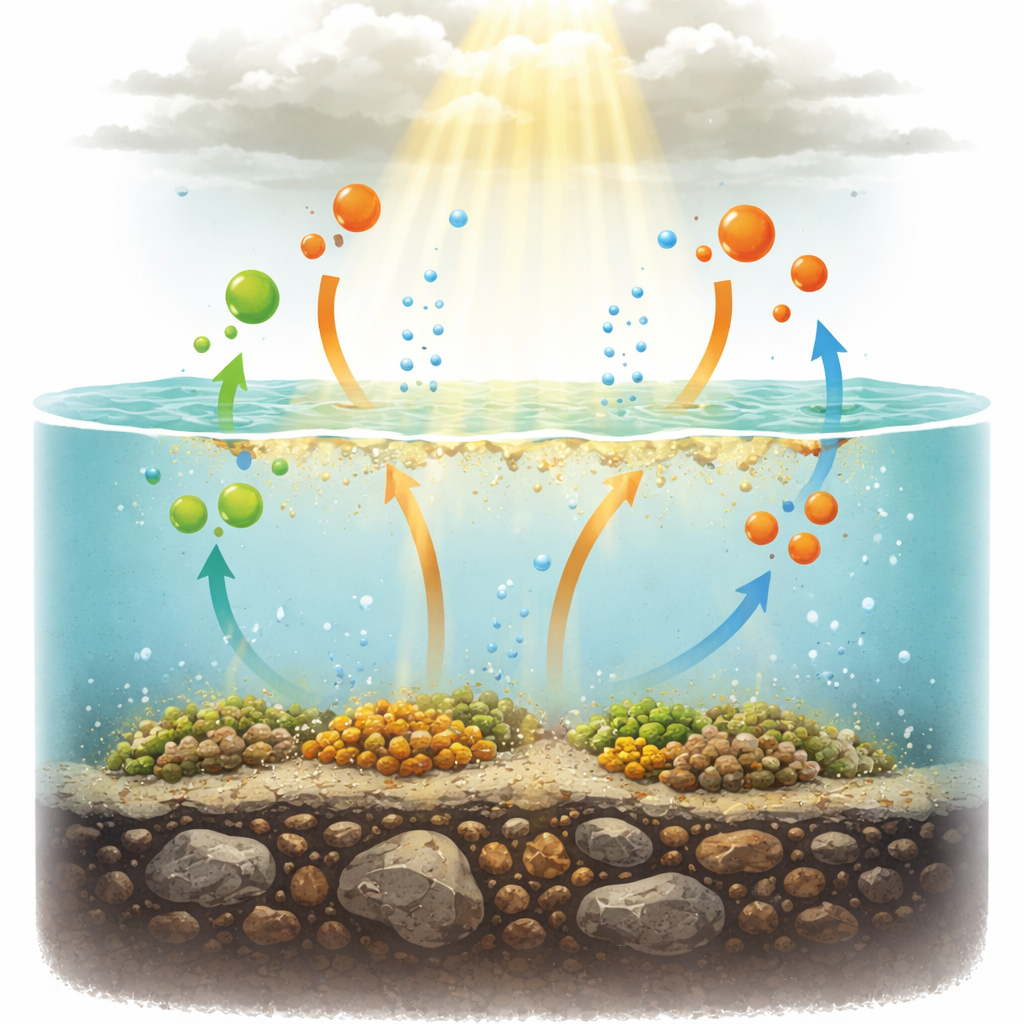
On scattered ocean islands built from ultramafic rocks, the authors envision the true cradles of life: shallow lagoons lined with grains of naturally light-sensitive minerals such as titanium oxide, iron sulfide, and serpentine. Under intense ultraviolet sunshine and in alkaline water, these minerals act as photocatalysts, helping sunlight split water into hydrogen and oxygen at their surfaces. Because hydrogen escapes into space more readily than oxygen, thin “micro-aerobic” skins—zones with a slight excess of oxygen—would have formed just above the mineral grains. In these millimeter-scale layers, methane and ammonia from the atmosphere, dissolved in the water, could have been transformed into a rich variety of organic molecules, including simple carbohydrates and amino acids, without the need for a CO2-dominated sky.
Rethinking the first living communities
Given this environment, the authors argue that the earliest microbes were not classic hydrogen- or sulfur-feeding anaerobes living in dark vents, but methane-eating phototrophs living in the light. They focus on methanotrophs—organisms that use methane as both fuel and building material. Modern relatives include bacteria that carry parts of the same light-harvesting machinery found in plants and cyanobacteria. Ohmoto and Ferry propose that ancestral methanotrophs in these shallow lagoons used light-driven systems resembling today’s Photosystem II to split water, generate small amounts of oxygen, and immediately use that oxygen to oxidize methane. In parallel, other microbes may have evolved light-harvesting systems similar to Photosystem I, allowing them to use hydrogen and carbon dioxide. Together, these communities could have built layered mats on mineral surfaces, cycling methane, hydrogen, and newly formed carbon dioxide in tight symbioses.
From methane world to modern Earth
Over time, the combined action of photocatalytic minerals and early microbes would have slowly converted the hydrogen–methane–ammonia atmosphere into one richer in carbon dioxide and nitrogen, while leaking oxygen into the oceans and eventually the sky. Yet this gradual shift required help from solid Earth processes as well. As plate tectonics progressed, ocean volume decreased, more land rose above sea level, and oxidized oceanic crust was dragged into the mantle. These changes pushed volcanic gases toward more oxidized compositions, reinforcing the transition to a CO2–N2–O2 world by about 3.9 billion years ago. Geological clues—such as certain iron-rich rocks, unusual sulfur isotope patterns, and evidence for early oxidative weathering—are consistent with an oxygen-influenced surface environment far earlier than traditionally thought. In this view, the famous Oparin–Urey–Miller picture of a reducing atmosphere regains center stage, but the players are reorganized: early life thrives not beneath a CO2 sky, but in island lagoons under a methane-and-ammonia haze, setting the stage for the modern biosphere and guiding where we might best search for life on planets beyond our own.
Citation: Ohmoto, H., Ferry, J.G. The hydrogen, methane and ammonia biosphere on early Earth. Sci Rep 16, 14017 (2026). https://doi.org/10.1038/s41598-026-43917-7
Keywords: early Earth atmosphere, methane biosphere, origin of life, photocatalytic minerals, methanotrophic microbes