Clear Sky Science · en
24-week multidimensional predictors of return to play post-ACLR in high-sports demanders: a randomized trial
Why this matters to active people
For anyone who loves running, cutting, or jumping sports, a torn anterior cruciate ligament (ACL) can feel like the end of the game. Surgery to rebuild the ligament is only the first step; the real question is whether you can safely get back to your old level of play—and how soon you can know that. This study followed non-professional but highly active athletes after ACL reconstruction to see whether tests done about six months after surgery can reliably forecast who will be back on the field by about one year, and which type of rehabilitation gives them the best chance.
A tough road back after knee ligament surgery
ACL tears are among the most common serious knee injuries in sport. Even with modern surgical techniques, only about half of people return to exactly the same level of sport they enjoyed before, and many who do make it back suffer another ACL injury. The problem is that current return-to-play decisions often rely on simple rules such as “wait 6–9 months” or a single strength or hop test. These blunt tools do not reflect the many physical and psychological hurdles that stand between surgery and a confident return to cutting, pivoting, and jumping. The authors focused on “high-sports demanders”: non-professional athletes who train or compete at least three times a week in intense, direction-changing sports, and who face especially high stakes if they return too soon or not fully prepared.
Two rehab paths and a key mid-point checkup
In this randomized trial, 64 such athletes who had ACL reconstruction were assigned to one of two 24-week rehabilitation programs. The traditional program moved patients through fixed time-based phases focused on range of motion, basic strength, and gradual functional exercises. The functional program instead advanced people only when they met specific performance milestones, and it built in more neuromuscular training, balance work, sport-like drills, and structured psychological support. At 24 weeks—roughly six months after surgery—everyone underwent a thorough battery of tests measuring leg strength, hopping ability, dynamic balance, knee position sense, and mental readiness to return to sport. Then, at 48 weeks (about one year), the researchers checked who had truly returned to their previous level of sport under strict criteria combining objective tests, mental readiness, time since surgery, and self-report. 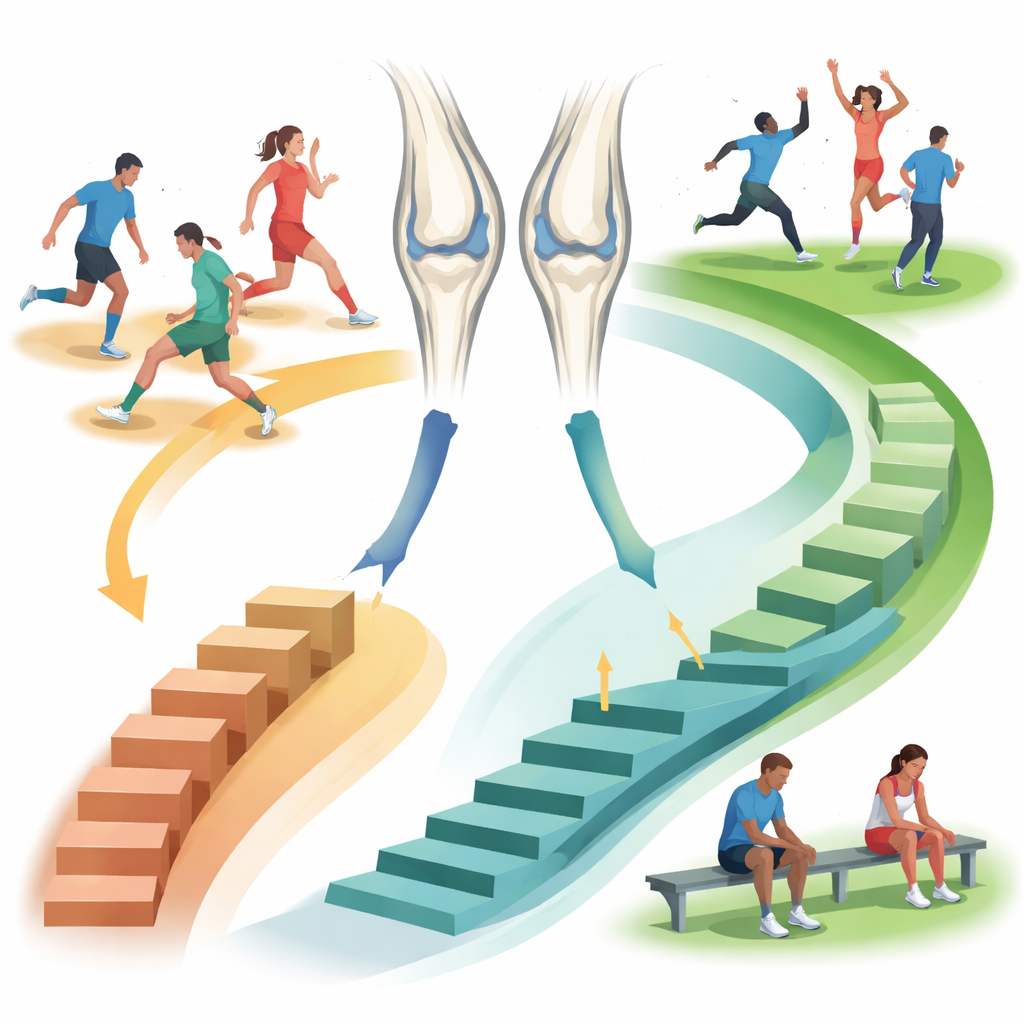
What predicted getting back in the game
By 48 weeks, about three out of four athletes had successfully returned to play, but those in the functional rehabilitation group did much better than those in traditional rehab (about 89% versus 62%). Using statistical modeling, the team found six mid-rehabilitation factors that together predicted later success. Athletes were more likely to return if they were in the functional rehab program, if the operated leg’s thigh muscle strength was closer to the healthy side, if they could hop farther on one leg, if they scored higher on a questionnaire about confidence and lack of fear, if they reached farther in a challenging balance test, and if their knee joint position sense was more accurate. A model combining these six elements distinguished future returners from non-returners with notably high accuracy, even after conservative internal checks to guard against over-optimism.
From complex data to a simple score
To make these findings usable in day-to-day clinical practice, the authors built a simple scoring tool based on the six predictors. Each factor contributes one or two points depending on its strength of association with successful return. The total score, ranging from zero to eight, sorts patients into low, medium, or high likelihood of returning to sport. Someone in the high range has strong performance across strength, hopping, balance, joint awareness, and mental readiness, usually after functional rehab; such an athlete might begin more advanced sport-specific training with confidence. A low score points to multiple weak areas; for these athletes, the recommendation is to extend rehab, emphasize targeted physical and psychological work, and delay any serious return-to-play decision. 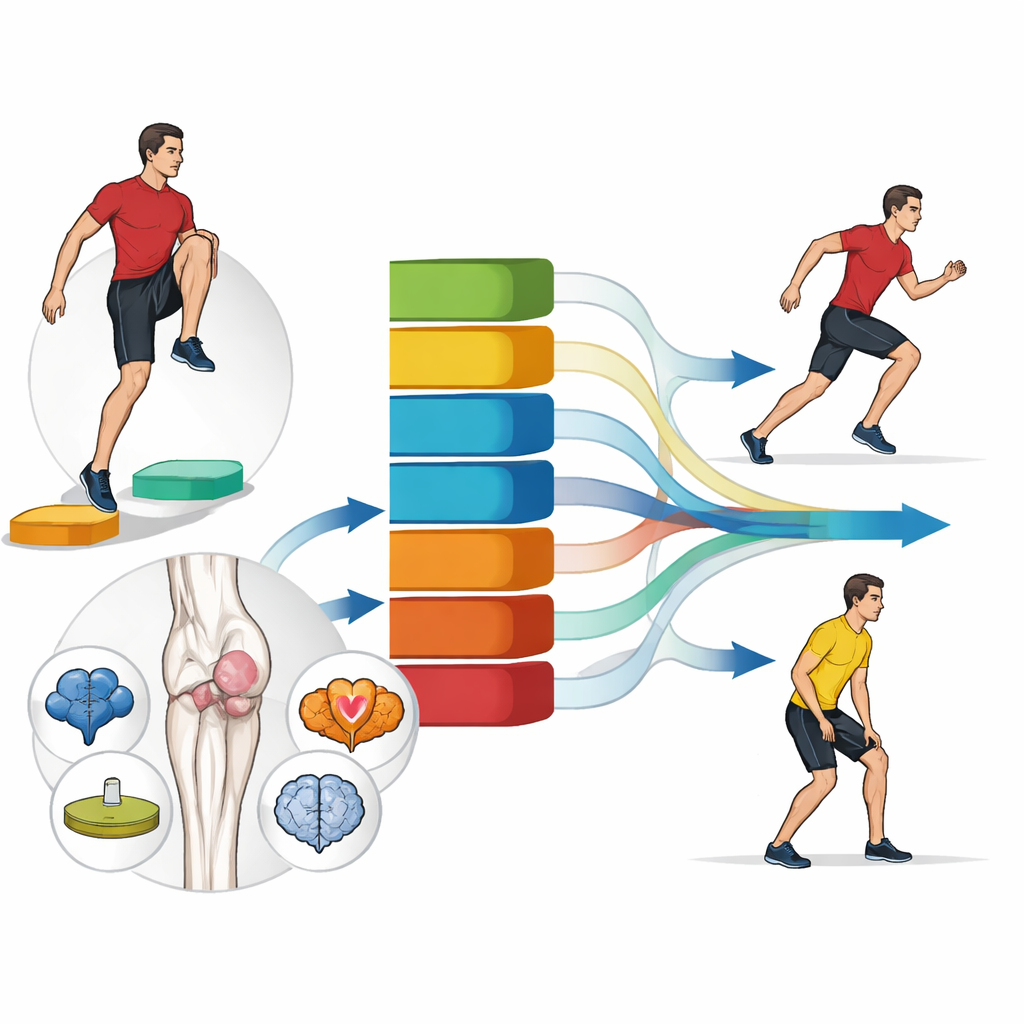
What this means for injured athletes
For active people recovering from ACL reconstruction, this study offers hopeful but measured guidance. It suggests that a rehab program built around functional milestones, rich balance and coordination work, and deliberate confidence-building may substantially improve the odds of a safe return to sport. It also shows that a careful six-month checkup—looking at strength, hop distance, balance reach, joint sense, and fear of re-injury—can provide a realistic early forecast of where you will be at around one year. The authors caution that their tool predicts associations rather than proving cause and has so far been tested in a single center; it needs confirmation in larger, more diverse groups. Still, it moves the field toward clearer, more personalized decisions, helping athletes and clinicians replace guesswork with structured information when planning the long journey back to the game.
Citation: Hao, F., Yuhong, N., Xuyuan, Y. et al. 24-week multidimensional predictors of return to play post-ACLR in high-sports demanders: a randomized trial. Sci Rep 16, 13049 (2026). https://doi.org/10.1038/s41598-026-43911-z
Keywords: ACL reconstruction, return to sport, knee rehabilitation, sports injury recovery, predictive assessment