Clear Sky Science · en
Transfer learning enhanced deep neural network surrogate model for rapid multiphysics simulation of alkaline water electrolyzers
Why Faster Hydrogen Technology Matters
Producing hydrogen from water using clean electricity is one of the most promising ways to decarbonize heavy industry and transport. Among several technologies, alkaline water electrolyzers are currently the workhorses for large-scale hydrogen production, but designing and optimizing them is painfully slow because detailed computer simulations take hours or even days. This paper introduces a way to replace those heavy calculations with a smart shortcut: a deep learning model that can mimic complex physics in milliseconds, potentially reshaping how quickly engineers can improve green hydrogen systems.
How Alkaline Devices Make Hydrogen
Alkaline water electrolyzers split water into hydrogen and oxygen inside a liquid solution of potassium hydroxide. Water molecules at one metal electrode are turned into hydrogen gas and charged particles, while at the opposite electrode oxygen gas is formed. Inside the cell, many processes happen at once: electric currents flow through plates and liquid, dissolved chemicals move and mix, heat is generated and removed, and gas bubbles grow and rise through narrow channels. These intertwined effects control how efficiently the device turns electricity into hydrogen and how long the equipment lasts before it degrades.
Why Classic Simulations Are Too Slow
For years, engineers have relied on numerical techniques such as the finite element and finite volume methods to make sense of all this complexity. These methods break the device into tiny pieces and solve the governing equations of electricity, heat, and fluid flow on each piece. While accurate, they are computationally expensive: a full three-dimensional model with all the coupled physics can take several hours to compute a single operating point, and running many such cases for design optimization or control is unrealistic. The authors estimate that achieving truly practical, near real-time predictions would require speedups of more than a thousand-fold compared with traditional tools.
A Learning Shortcut: Surrogate Models With Memory
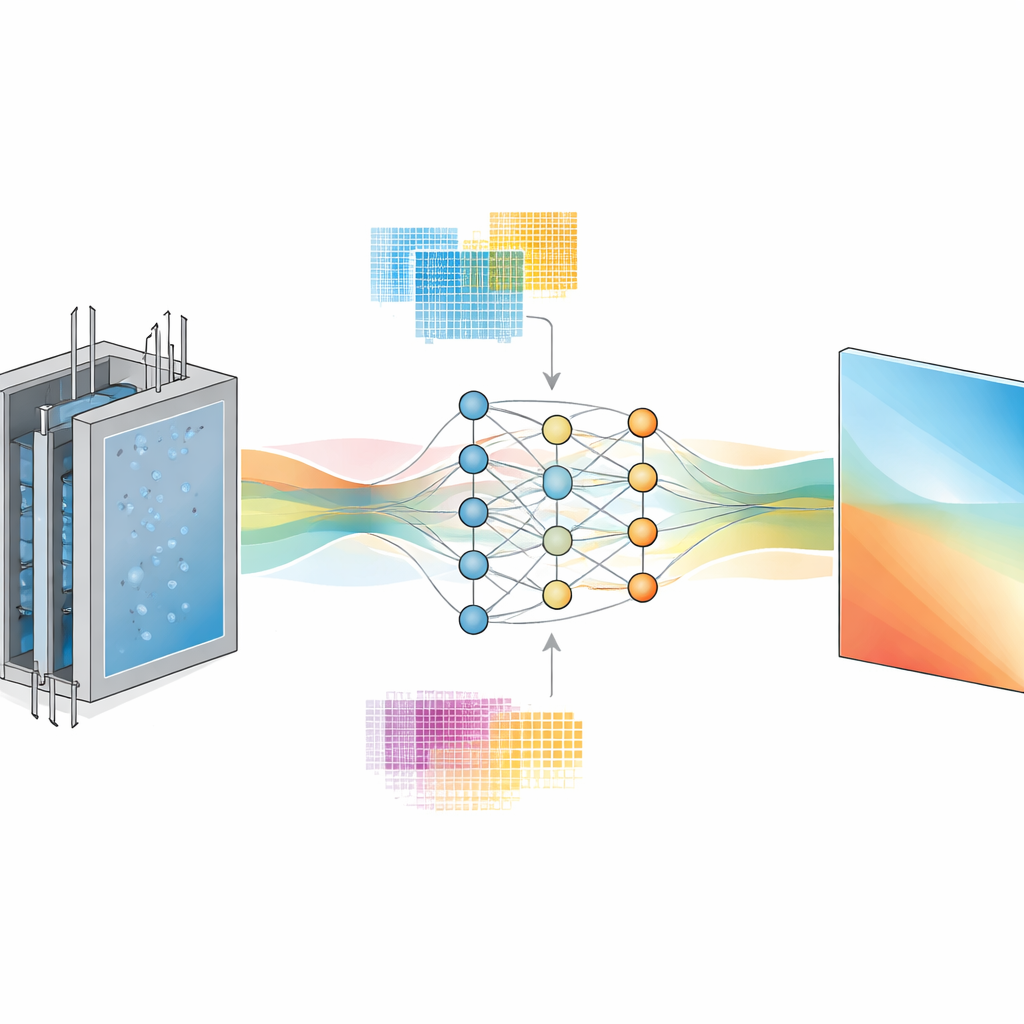
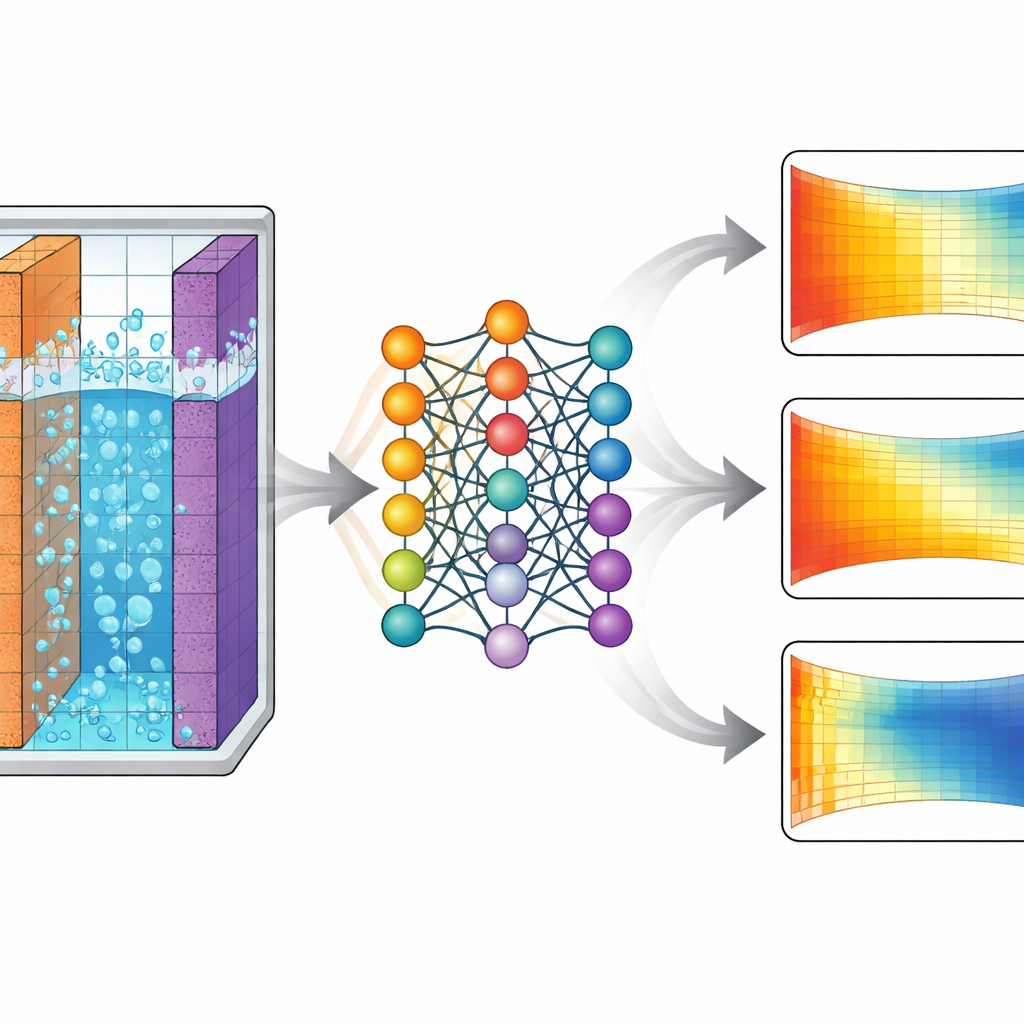
Instead of repeatedly solving the full physical equations, the authors build a surrogate model: a deep neural network that learns to map operating settings and design features directly to detailed internal fields such as current density, temperature, and gas volume fraction. They use an encoder–decoder structure similar to image-processing networks, which is well suited to predicting two-dimensional maps across the cell cross-section. To keep the model honest, they embed basic physical constraints into the training process so that the neural network is penalized whenever its predictions violate charge conservation, a core law linking applied current and local current distribution.
Recycling Cheaper Simulations With Transfer Learning
A central idea in this work is transfer learning—reusing knowledge gained from cheaper, lower-accuracy simulations to improve predictions for expensive, high-accuracy ones. The team first runs many “low-fidelity” simulations on coarser grids or with simplified physics, which are far faster to compute, and uses them to pre-train the network. Then they fine-tune this pre-trained network with a much smaller set of “high-fidelity” simulations that fully capture the complex physics. Carefully designed training strategies, including gradually unfreezing layers and modest physics-based penalties, allow the model to carry over what it has already learned without overfitting or becoming unstable.
How Well the Smart Model Performs
When tested against unseen high-fidelity simulations, the surrogate model reproduces key quantities with impressive accuracy. For current density and temperature fields, the coefficient of determination exceeds 0.98, and average relative errors stay below 2%. Predictions for gas bubble volume fraction are somewhat less precise but still capture the main patterns. Most importantly, once trained, the model delivers results in milliseconds on a modern graphics processor—up to about one million times faster than a full three-dimensional finite element run. The authors also show that, thanks to transfer learning, they can cut the amount of expensive high-fidelity training data by roughly 70% while actually improving accuracy compared with training the same network from scratch.
What This Means for Green Hydrogen
For a non-specialist, the takeaway is that this work turns a slow, resource-heavy simulation problem into something that can run almost instantly, without giving up much accuracy. Engineers could use such models to scan thousands of design options, tune operating conditions under fluctuating renewable power, or eventually guide real-time control of industrial electrolyzer plants. The framework still needs further testing for large commercial stacks and extreme conditions, but it demonstrates a powerful way to blend physics and machine learning so that low-cost simulations and basic laws help train fast, reliable digital surrogates for next-generation green hydrogen systems.
Citation: Yan, J., Jiao, L. & Chen, Z. Transfer learning enhanced deep neural network surrogate model for rapid multiphysics simulation of alkaline water electrolyzers. Sci Rep 16, 13680 (2026). https://doi.org/10.1038/s41598-026-43905-x
Keywords: green hydrogen, alkaline water electrolysis, deep learning, transfer learning, multiphysics simulation