Clear Sky Science · en
Machine learning identifies distinct movement control impairment clusters in patients with chronic neck pain
Why neck pain is more than just a sore spot
Neck pain is now one of the leading causes of disability worldwide, and for many people it doesn’t simply fade after a few bad days. It lingers for months, returns repeatedly, and can quietly reshape how the head and neck move in everyday life. Yet doctors often treat chronic neck pain as if most patients are alike. This study asks a different question: are there hidden subgroups of neck-pain sufferers, each with its own pattern of movement problems, that might need different types of rehabilitation?
A moving target for the neck
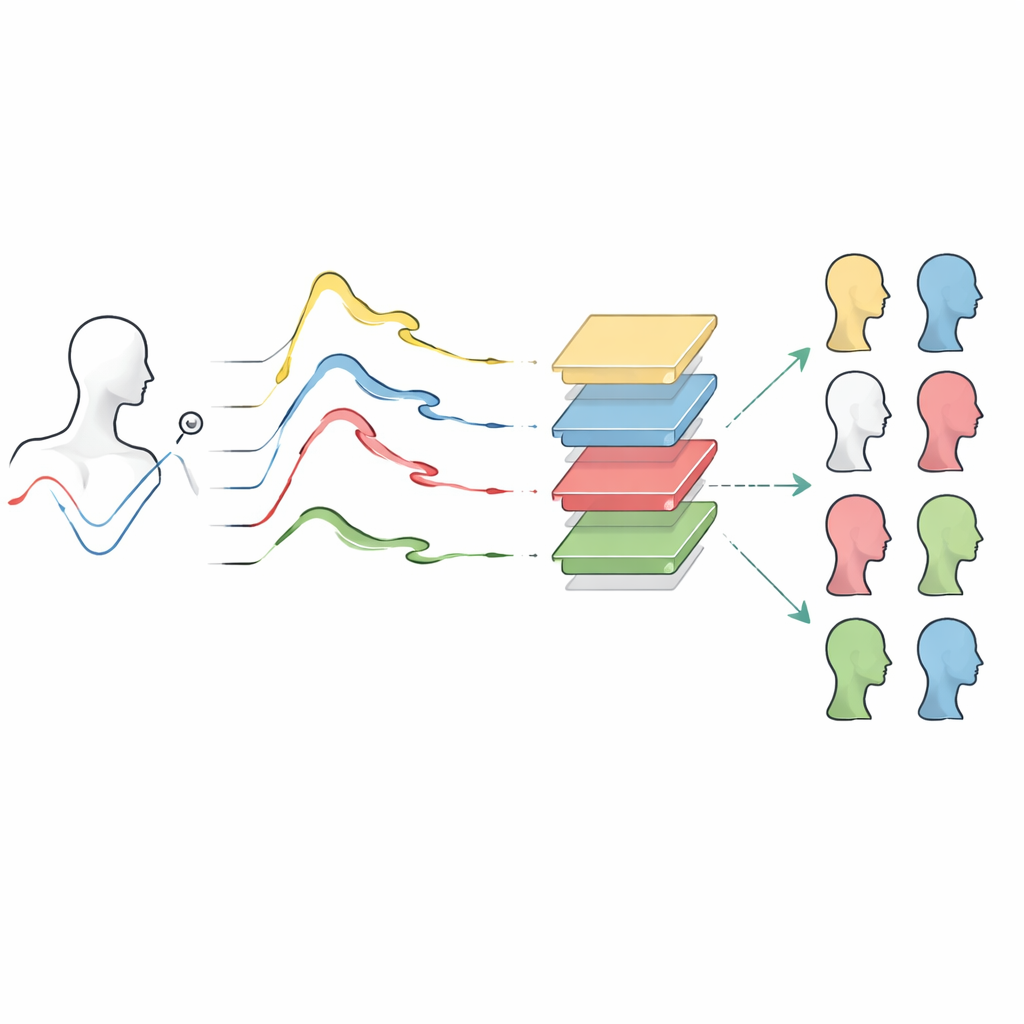
To probe how people with chronic neck pain control their head and neck, the researchers used a test called the Butterfly test. Participants wear a small motion sensor on the head and are asked to follow an unpredictably moving target by turning and nodding their head. The target speeds up, slows down, and changes direction in three levels of difficulty—easy, medium, and difficult. From these trials the team extracted several measures: how much time the head spent on the moving target, how often it lagged behind, how often it shot ahead, and how far overall the head position strayed from the ideal path. They combined these movement measures with each person’s reported pain intensity.
Letting algorithms find hidden groups
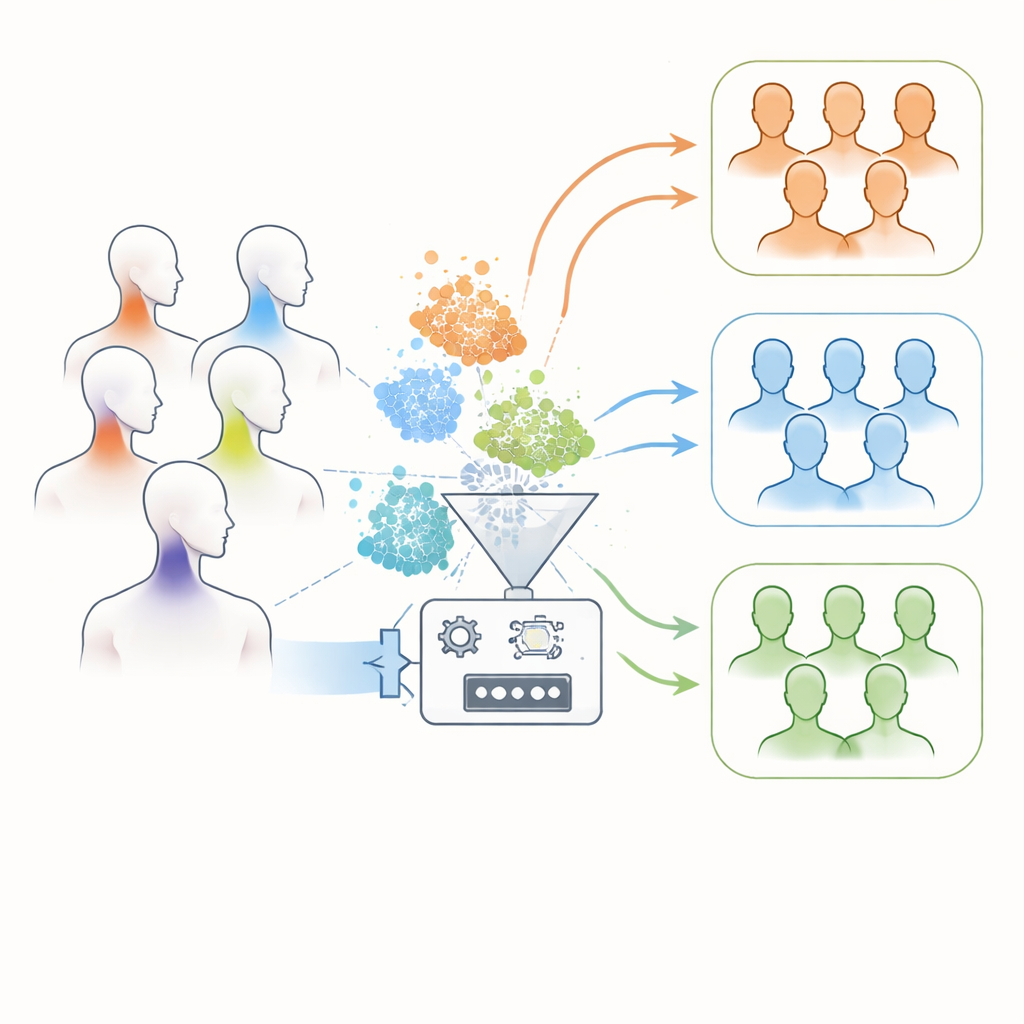
Instead of deciding in advance how to label patients as “mild” or “severe,” the authors turned to data-driven methods. They applied several clustering techniques—mathematical tools that look for natural groupings in complex data—using 13 features from the Butterfly test plus pain ratings. To judge which method separated people most cleanly, they used a quality measure that checks how distinct each cluster is from the others. K-means clustering, a widely used algorithm, produced the best balance of clear and reasonably sized groups. The most informative solution divided the 135 patients into four distinct clusters, each reflecting not only how impaired the movements were but also how they were impaired.
Four different ways movement can go wrong
At one end of the spectrum was a cluster with only small movement problems and mild to moderate pain. These patients generally kept their head close to the target path and spent more time on target, with little tendency to lag or overshoot. Another cluster showed modest deficits but a characteristic pattern of moving too slowly and lagging behind the target at higher speeds, suggesting a cautious style of movement often linked to fear of motion. A third cluster showed greater problems, especially overshooting the target, hinting at difficulty braking or finely controlling the neck muscles when changing direction. The most impaired cluster combined moderate to severe pain with large errors across all difficulty levels—including the supposedly easy one—and showed both marked lagging and overshooting, indicating broad disruption of neck movement control.
From patterns to personalized tools
To test whether these clusters could be recognized reliably, the researchers trained several machine-learning models to predict cluster membership from the same movement and pain data. Neural networks and combined “stacked” models were able to assign patients to the four groups with very high accuracy, sensitivity, and specificity, far outperforming a simple nearest-neighbor rule. Using a technique called SHAP, the team then examined which movement features most strongly drove these decisions. Measures of how far patients overshot or undershot the target, especially at medium and high difficulty, emerged as key ingredients that distinguished the clusters from one another.
What this means for people living with neck pain
For a lay reader, the takeaway is that chronic neck pain is not one uniform problem. When asked to follow an unpredictable moving target, patients naturally fall into several distinct patterns of movement control—some mainly slower and cautious, others less stable and more prone to overshoot, and some severely disrupted across the board. The study shows that modern data-analysis methods can reliably detect these hidden profiles from a short movement test and a pain score. While this work is an early proof of concept, it points toward a future in which rehabilitation for neck pain is tailored to a person’s specific movement-control pattern, rather than offered as a one-size-fits-all program.
Citation: Majcen Rosker, Z., Rosker, J. Machine learning identifies distinct movement control impairment clusters in patients with chronic neck pain. Sci Rep 16, 12993 (2026). https://doi.org/10.1038/s41598-026-43903-z
Keywords: chronic neck pain, movement control, kinesthetic testing, machine learning, rehabilitation subgroups