Clear Sky Science · en
Optimizing mechanized cleaning of Corcyra cephalonica eggs for stored-product biocontrol via DEM parameter calibration and enhanced vibratory separation
Cleaning Tiny Eggs to Protect Big Harvests
Rice and stored grains around the world are quietly attacked by moths whose caterpillars chew through kernels and cause serious losses. Farmers increasingly turn to a helpful ally: microscopic wasps that lay their own eggs inside pest eggs and stop the next generation of caterpillars. To rear these wasps on a large scale, factories use eggs of a harmless rice moth as a stand‑in host. But there is a hitch: freshly collected moth eggs are tangled with scales, hairs, and dust, and today much of the cleaning is done by hand. This study asks how to design machines that can clean these fragile eggs reliably and cheaply, opening the door to wider use of pesticide‑free biological control.
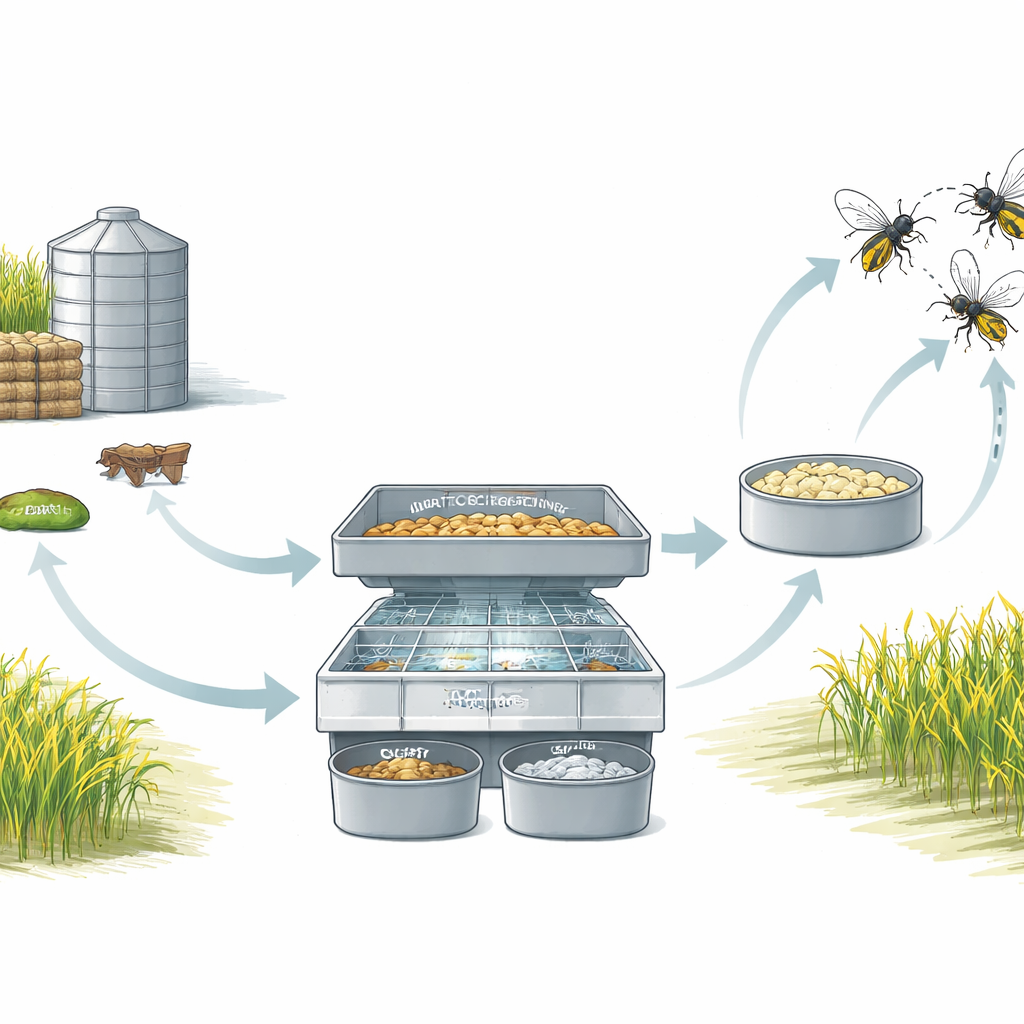
How Tiny Wasps Help Guard Stored Grain
The work starts from a simple idea: if we can mass‑produce clean moth eggs, we can mass‑produce beneficial wasps and release them over rice fields and grain stores instead of spraying chemicals. In this system, rice plants are attacked by a stem‑boring moth whose eggs are the vulnerable stage. In insectaries, another moth, Corcyra cephalonica, is reared on grain to provide eggs that the wasps parasitize. Those egg cards are later placed in fields or warehouses, where the emerging wasps search out and destroy pest eggs. The whole chain depends on handling enormous numbers of moth eggs efficiently without damaging them.
Why Egg Cleaning Is Harder Than It Sounds
At first glance, separating eggs from loose debris seems straightforward, but the authors show that the mixture behaves more like sticky powder than dry sand. The eggs cling to each other through moisture and subtle surface forces, forming stubborn clumps that resist flowing through screens. They are mixed with long and short hair‑like appendages, wing scales, and dust, each with different size, shape, and behavior in air flow. Because the eggs are so small, it is difficult to experiment by trial and error alone. The team therefore set out to measure the eggs’ physical traits in detail—such as size, density, stiffness, and how easily they roll, bounce, and slide—and then use those measurements to build a realistic digital model of how the mixture moves.
Building a Digital Twin of the Egg Mixture
Using high‑magnification imaging and mechanical tests, the researchers determined how heavy and how elastic individual eggs are, and how they deform when compressed. They then studied how piles of eggs naturally settle into a cone, a property called the angle of repose, which captures how freely the material flows. By gradually tuning computer parameters that represent friction between eggs, friction with steel, and the “stickiness” of their surfaces, they matched the simulated cone angle to the one seen in the lab within only a few percent. They also measured the air speeds at which eggs, scales, and hair‑like pieces just begin to float, defining a safe window of air flow in which light impurities can be blown away while the heavier eggs stay under control. Together, these measurements created the first dedicated database for simulating this particular type of moth egg.
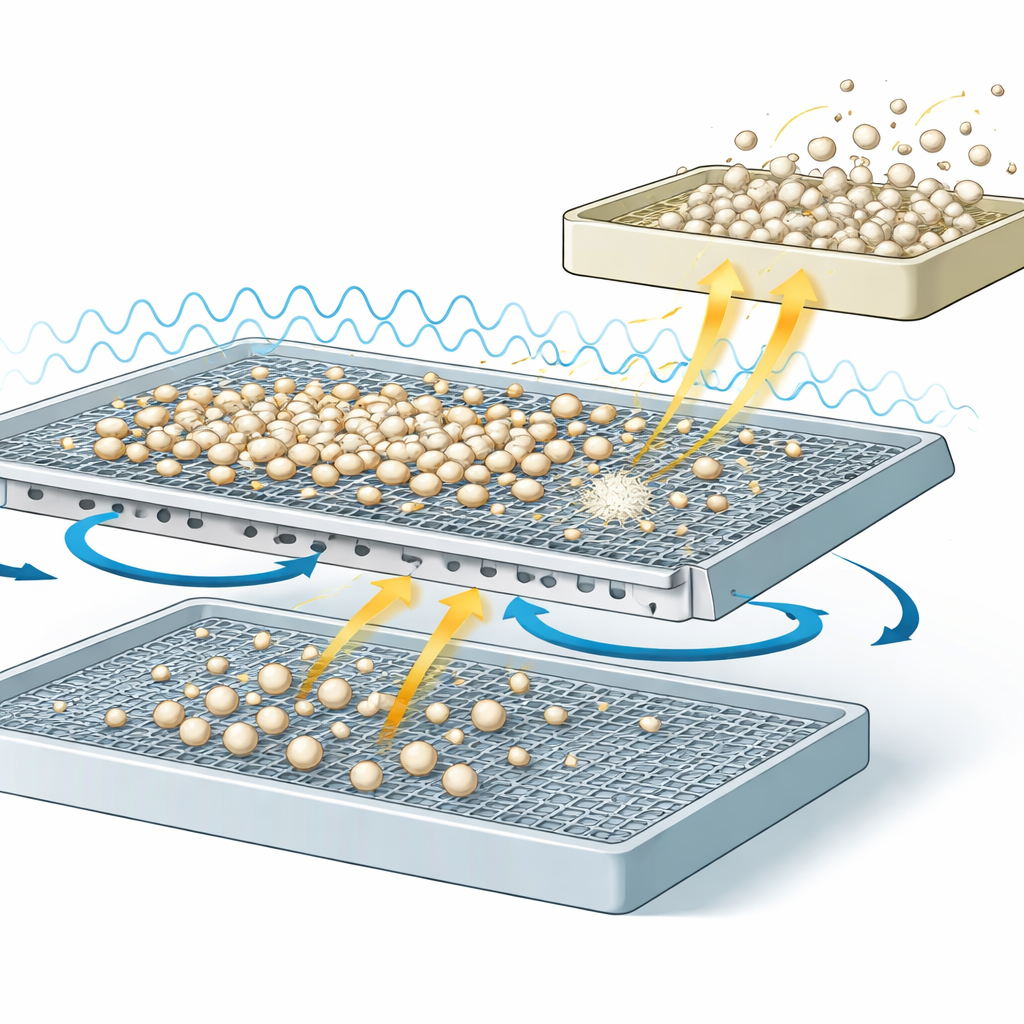
Finding the Sweet Spot for Shaking and Airflow
With the digital twin in place, the team explored how a vibrating screen—sometimes assisted by ultrasonic vibrations—can best separate eggs from impurities. In the simulations, they varied three main settings: how fast the screen vibrates, how far it moves each cycle, and how much it tilts in a gentle cone‑like swing. The results revealed clear sweet spots rather than a simple “more is better” pattern. A moderate vibration frequency around 12 cycles per second gave the highest rate of clean eggs passing through, because it kept the layer of material loose and well mixed without flinging particles off too quickly. An amplitude of about one millimeter and a slight swinging angle around one degree further improved the flow. Adding high‑frequency ultrasound on top of this motion helped break apart clumps and boosted the screening rate by up to about 15 percent, especially under moderate shaking where particles would otherwise stay stuck together.
From Lab Findings to Safer Stored Food
For non‑specialists, the take‑home message is that the authors have turned a messy, manual step in wasp production into a process that can be engineered with numbers. By pinning down how these delicate eggs move, stick, and float, they provide design rules for future cleaning machines—how fast to shake, how far to move, and how strong an air current to use. Such machines should be able to clean egg batches more quickly and consistently while minimizing breakage and loss. In turn, that makes it easier and cheaper to produce the tiny wasps that keep moth pests in check, helping to cut pesticide use, protect stored grain, and support more sustainable food systems.
Citation: Aiju, K., Haoyu, H., Fuxing, W. et al. Optimizing mechanized cleaning of Corcyra cephalonica eggs for stored-product biocontrol via DEM parameter calibration and enhanced vibratory separation. Sci Rep 16, 10904 (2026). https://doi.org/10.1038/s41598-026-43900-2
Keywords: biological pest control, Trichogramma mass rearing, vibratory screening, pneumatic separation, stored grain protection