Clear Sky Science · en
Oxygen-controlled IGZO channel deposition for enhanced memory window in ferroelectric FETs
Smarter Memory for a Data-Hungry World
As our phones, cars, and cloud services chew through ever-growing oceans of data, the tiny chips that store information are being pushed to their limits. This study explores a new way to build long-lasting, low-power memory devices by fine-tuning something as simple as the amount of oxygen used when making a key transistor layer. By carefully controlling this invisible ingredient, the researchers show they can make future memory faster, more reliable, and better suited to energy-efficient computing and artificial intelligence.
Why New Memory Devices Are Needed
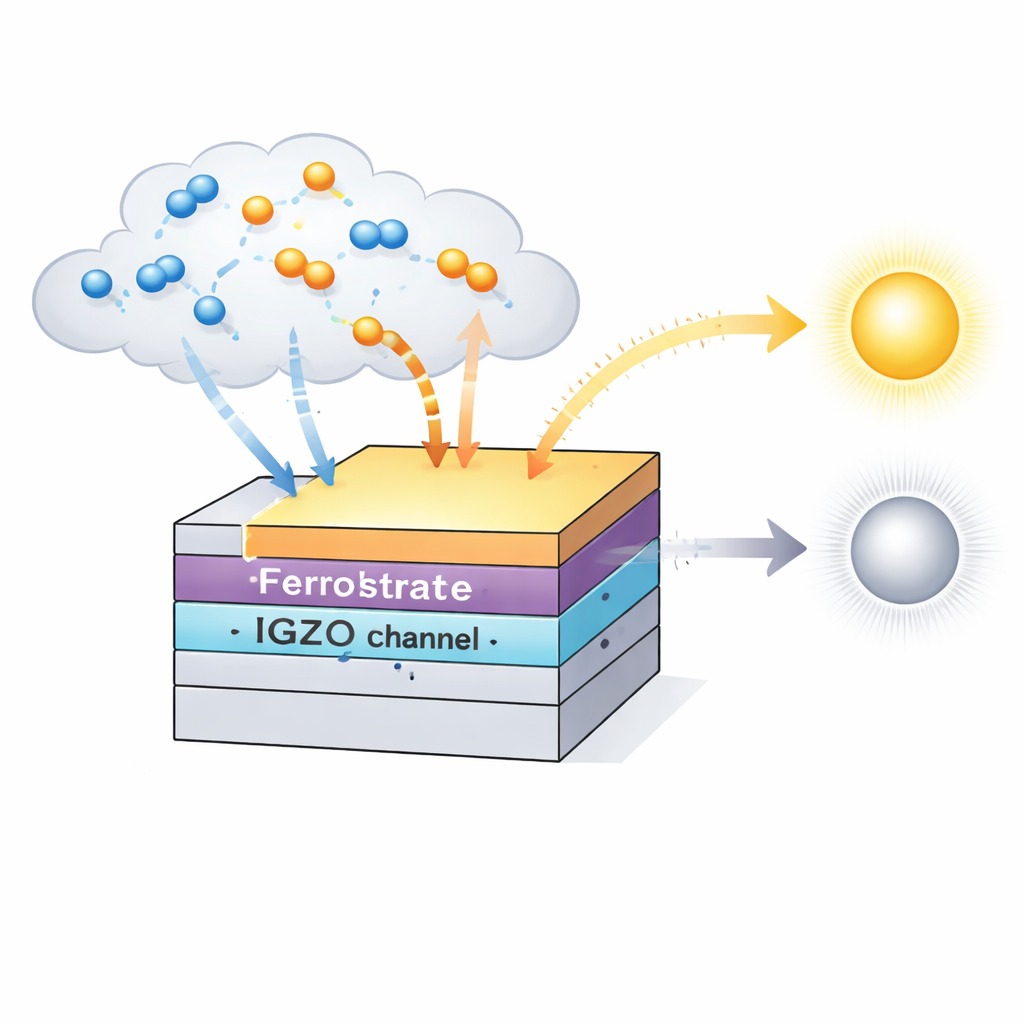
Today’s mainstream nonvolatile memories, such as NAND flash, are struggling to keep up with demands from artificial intelligence, the Internet of Things, and autonomous vehicles. A promising alternative is the ferroelectric field-effect transistor, or FeFET, which stores data using a special material whose internal electric polarization can be flipped and remembered even with the power off. Ferroelectric layers based on hafnium oxide are especially attractive because they fit well into standard chip factories. However, when these layers are paired with the usual silicon channels, a thin unwanted film grows at the interface, weakening the electric field and causing stored information to fade over time. To break past this bottleneck, researchers are turning to oxide semiconductors such as indium gallium zinc oxide (IGZO), which naturally form cleaner, more compatible interfaces with hafnium-based ferroelectrics.
Tuning Oxygen as a Hidden Control Knob
The team focused on how the oxygen environment during IGZO deposition shapes both the channel itself and its boundary with the ferroelectric layer made of hafnium zirconium oxide. They fabricated top-gate transistors while varying the oxygen partial pressure from 0% to 20% during the sputtering step that creates the thin IGZO film. Basic electrical tests showed that all devices behaved as expected ferroelectric memories, but with striking differences in the “memory window,” the voltage range that separates the two stored states. The sweet spot occurred when only about 5% oxygen was used, delivering a wide memory window of 1.85 volts, while higher or lower oxygen levels shrank this range.
What Happens Inside the Material
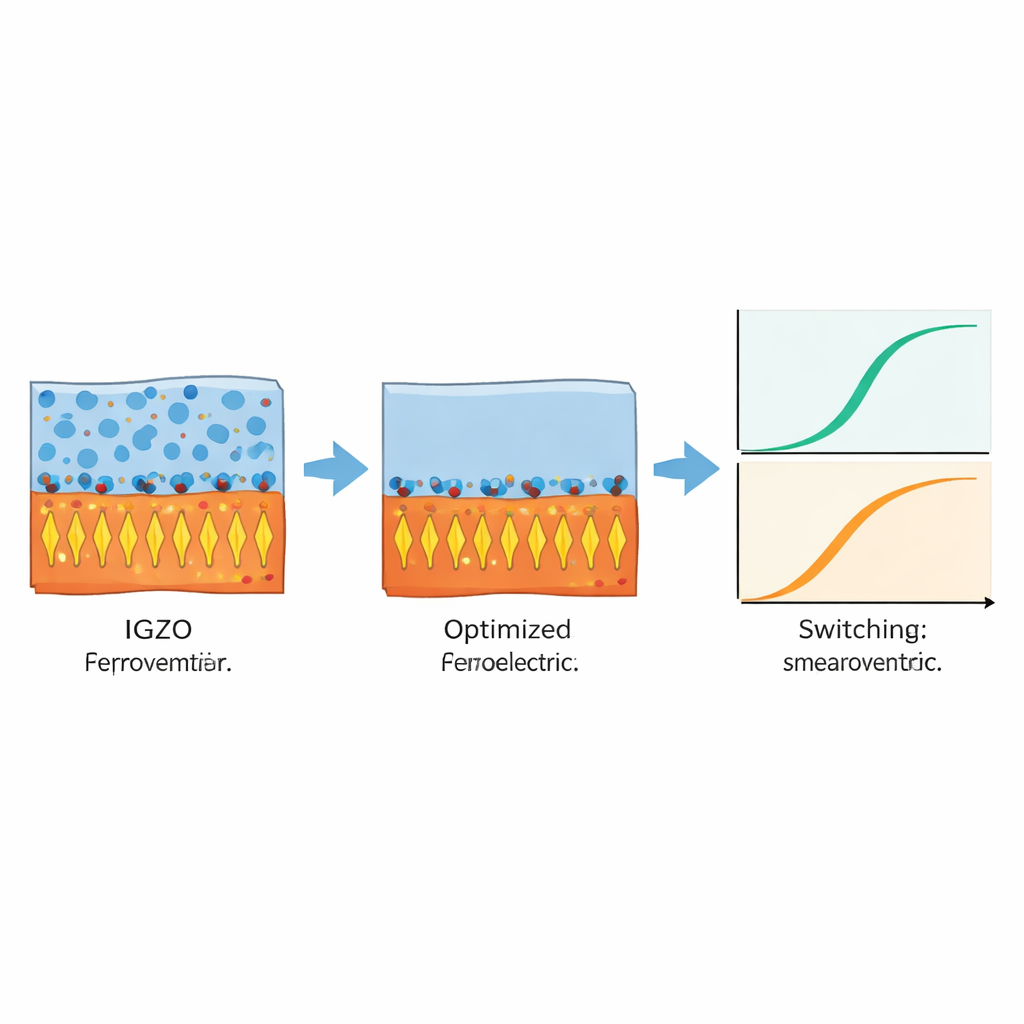
To understand why oxygen made such a difference, the researchers probed the films with a suite of structural and spectroscopic tools. X-ray diffraction confirmed that the ferroelectric layer’s crystal phase and polarization strength were essentially unchanged across all oxygen levels, ruling out the ferroelectric itself as the cause. Instead, measurements of the IGZO’s electronic band structure showed that more oxygen suppresses oxygen vacancies—tiny missing atoms that donate free electrons. As oxygen increased, the number of these donors fell, reducing carrier density and mobility in the channel. At very high oxygen levels, the IGZO also became less dense and more open in structure, making it easier for hydrogen and metal atoms from the ferroelectric layer to diffuse into the channel during heating, forming additional defects at the interface.
Interfaces, Defects, and Switching Speed
Because the bulk ferroelectric properties stayed constant, the crucial factor turned out to be the quality of the interface between IGZO and the ferroelectric. Detailed depth profiling with X-ray photoelectron spectroscopy showed that the 5% oxygen films had the densest structure and the fewest defect-related chemical states at the boundary. Devices made under this condition exhibited the lowest density of interface traps, which are microscopic sites that can pin ferroelectric domains and hinder their motion. Using a switching model that tracks how quickly polarization flips over time, the team found that the optimized devices switched faster and more uniformly, while those made with too much or too little oxygen showed broader, slower switching distributions tied to greater defect levels.
Lasting Performance Over Time
Ultimately, memory technologies must endure billions of write and erase cycles and hold data for years. Under demanding electrical stress tests, the transistors made with 5% oxygen maintained a large and stable memory window through one million switching cycles and showed strong data retention over many hours. In contrast, devices produced under nonoptimal oxygen conditions started with smaller memory windows and saw more pronounced degradation as defects accumulated and interfered with switching. This clear link between process conditions, interface cleanliness, and long-term behavior suggests that oxygen control during IGZO growth is a powerful lever for engineering robust ferroelectric memories.
What This Means for Everyday Electronics
In plain terms, the study shows that getting the oxygen level “just right” while fabricating the IGZO channel can dramatically improve how well ferroelectric transistors store and retain information. With carefully chosen oxygen levels, the devices switch their internal state more easily, remember that state over longer times, and survive many more write cycles before wearing out. This process-centered approach offers a practical path to building future nonvolatile memories that are faster, more durable, and more energy efficient—key ingredients for advancing AI hardware, edge computing, and data-intensive electronics without a corresponding explosion in power consumption.
Citation: Kang, H.Y., Cha, S.H., Jeong, Y.J. et al. Oxygen-controlled IGZO channel deposition for enhanced memory window in ferroelectric FETs. Sci Rep 16, 13962 (2026). https://doi.org/10.1038/s41598-026-43896-9
Keywords: ferroelectric memory, oxide semiconductors, IGZO transistors, nonvolatile storage, device reliability