Clear Sky Science · en
Progeny testing of tropical and sub-tropical maize lines for grain yield and Striga resistance
Why a hidden weed threatens a staple crop
Across sub-Saharan Africa, millions of families rely on maize as their daily staple. Yet a tiny parasitic weed called Striga, sometimes called “witchweed,” can quietly latch onto maize roots underground and drain the plant’s nutrients. Entire fields can look healthy early in the season, only to wither and fail once Striga takes hold. This study set out to find maize parents and hybrids that can stand up to two major Striga species while still producing high grain yields, a combination that could help protect food supplies for vulnerable farming communities.
A closer look at the maize–Striga battle
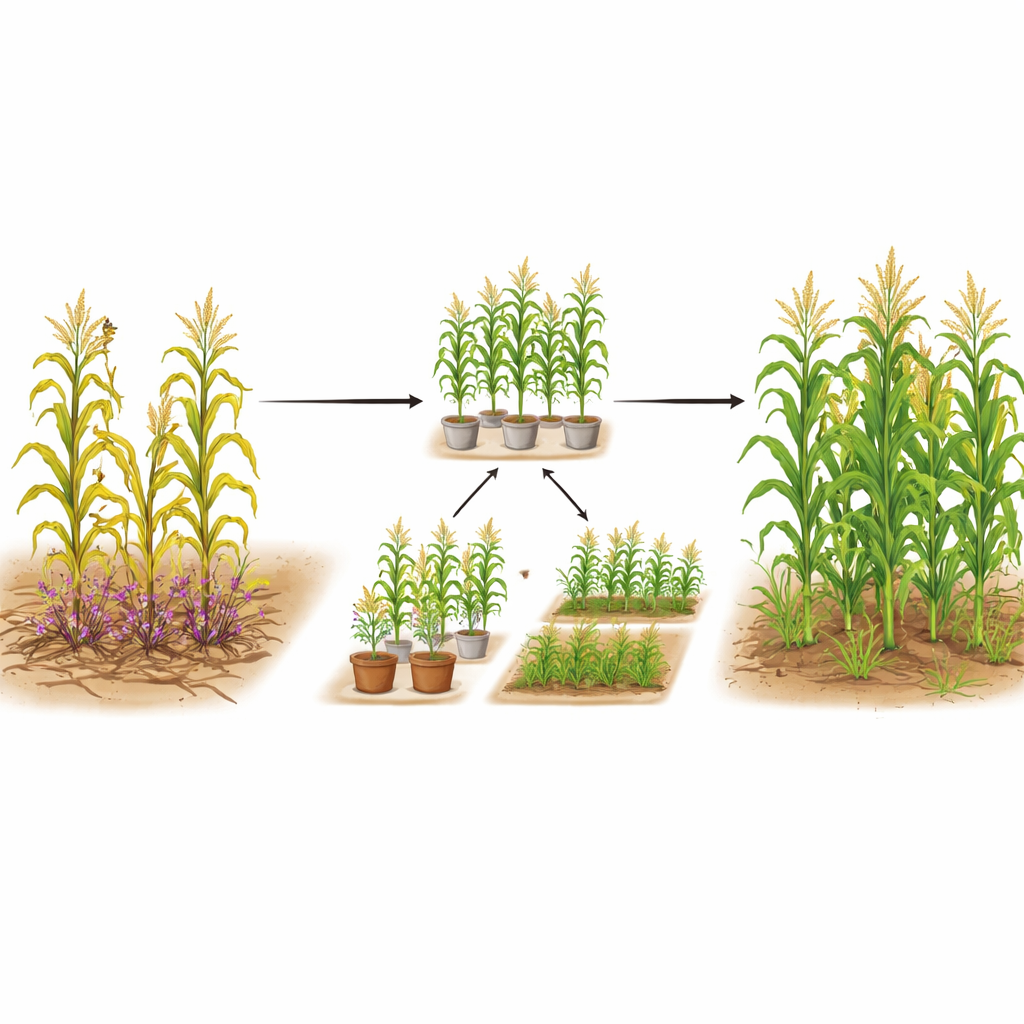
Striga hermonthica and Striga asiatica are small flowering plants, but they behave more like stealthy parasites than ordinary weeds. Their dust-like seeds can survive in soil for decades. Once they sense a nearby maize root, they germinate and tap directly into the root system, siphoning off water and nutrients. Above ground, the maize shows yellowing leaves, stunted stalks, and poor ears, and farmers may lose anywhere from a tenth to their entire harvest. Because most of the damage happens before Striga emerges, hand weeding comes too late, making genetic resistance in the maize plant itself one of the few practical long-term solutions.
Designing smart crosses between maize parents
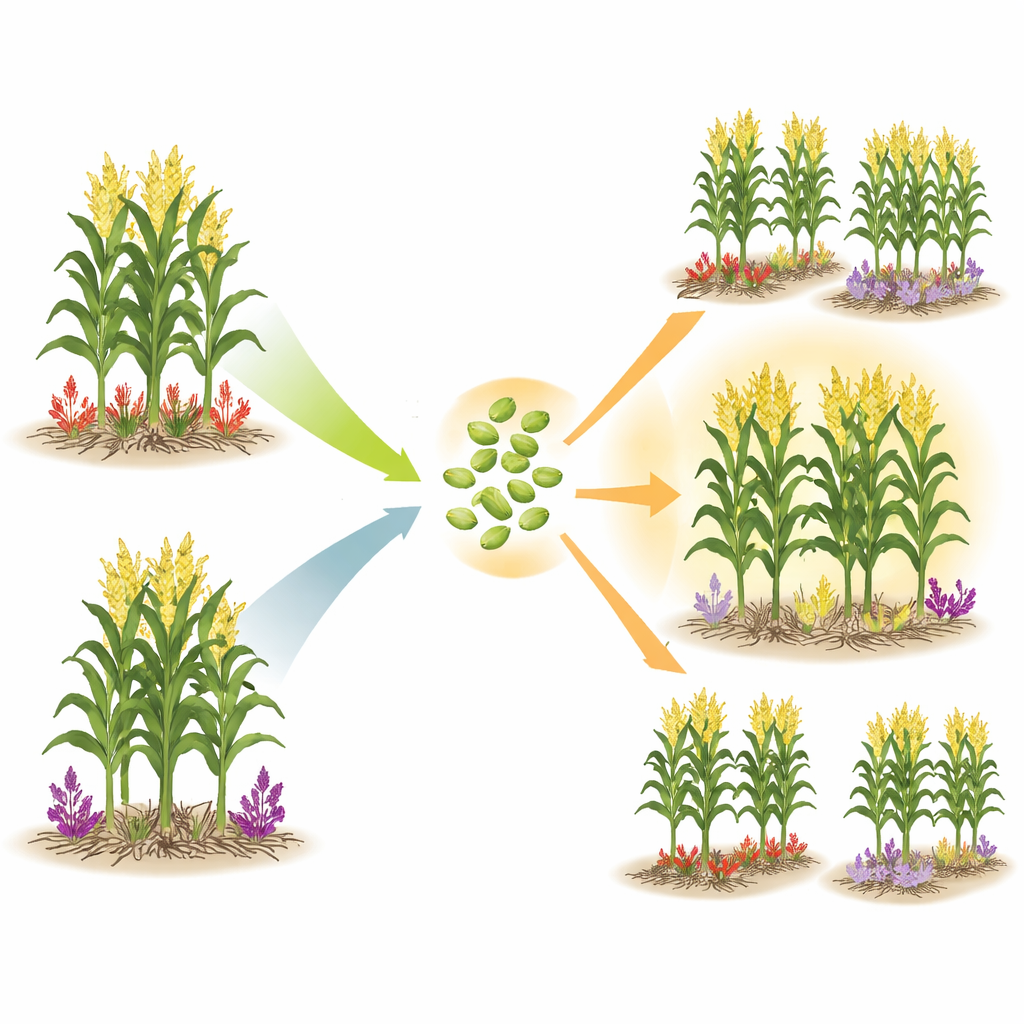
The researchers worked with twelve inbred maize lines from international breeding centers. Some lines had been selected earlier for resistance to S. asiatica, others for resistance to S. hermonthica, and a few were known for good performance across many environments. Using a structured crossing scheme, they created 30 single-cross hybrids by mating each female line with a smaller set of tester lines, then grew both parents and hybrids under three conditions: pots and field plots infested with S. asiatica, pots and plots infested with S. hermonthica, and Striga-free controls. This allowed them to see not only which hybrids yielded well, but also which parents consistently passed on favorable traits such as low Striga counts and minimal damage.
Finding standout performers under heavy pressure
Under both Striga species, the differences among genotypes were striking. Many plants suffered strong yield losses and high damage scores in infested pots, but a subset of hybrids combined high yields with fewer Striga plants and milder symptoms. A line named CML540 emerged as a particularly valuable parent: it maintained solid yields in all environments and contributed resistance against both Striga species. Hybrids involving CML540, such as crosses with testers TZISTR1174 and TZDEEI50, ranked among the top performers under S. asiatica. Under S. hermonthica, the cross CML440 × TZDEEI50 produced especially high yields and low Striga impact, with other hybrids from CZL99017 and CML540 also doing well. Overall, hybrids clearly outperformed their inbred parents, reflecting strong hybrid vigor under stress.
Unpacking the genetics behind resistance and yield
By analyzing how traits were inherited, the team found that “non-additive” gene action—interactions between gene versions from different parents—played a major role in grain yield and Striga resistance. In practical terms, this means that the right parent combinations can produce hybrids that are much better than either parent alone. While some traits still showed moderate heritability from one generation to the next, the predominance of these interaction effects supports a strategy focused on hybrid breeding rather than trying to improve open-pollinated varieties solely through gradual selection.
What this means for farmers and food security
For non-specialists, the takeaway is straightforward: careful choice of maize parents and crosses can produce hybrid varieties that both resist Striga and deliver high yields. The study pinpoints specific inbred lines—especially CML540, CML539, CML440, and testers TZDEEI50, TZISTR1174, and TZISTR1248—as building blocks for such hybrids. Promising combinations like CML540 × TZISTR1174, CML540 × TZDEEI50, CML539 × TZISTR1174, and CML440 × TZDEEI50 offer a clear path toward new commercial hybrids tailored for Striga-prone regions. If these lines are advanced and released, farmers could see more reliable harvests even in heavily infested fields, helping narrow the yield gap and strengthen food security across tropical and sub-tropical Africa.
Citation: Dossa, E.N., Shimelis, H. & Abady, S. Progeny testing of tropical and sub-tropical maize lines for grain yield and Striga resistance. Sci Rep 16, 13657 (2026). https://doi.org/10.1038/s41598-026-43895-w
Keywords: Striga-resistant maize, hybrid breeding, sub-Saharan Africa, parasitic weeds, grain yield