Clear Sky Science · en
Research on establishment of bonded particle model for pellet feed and its application
Why protecting tiny feed pellets matters
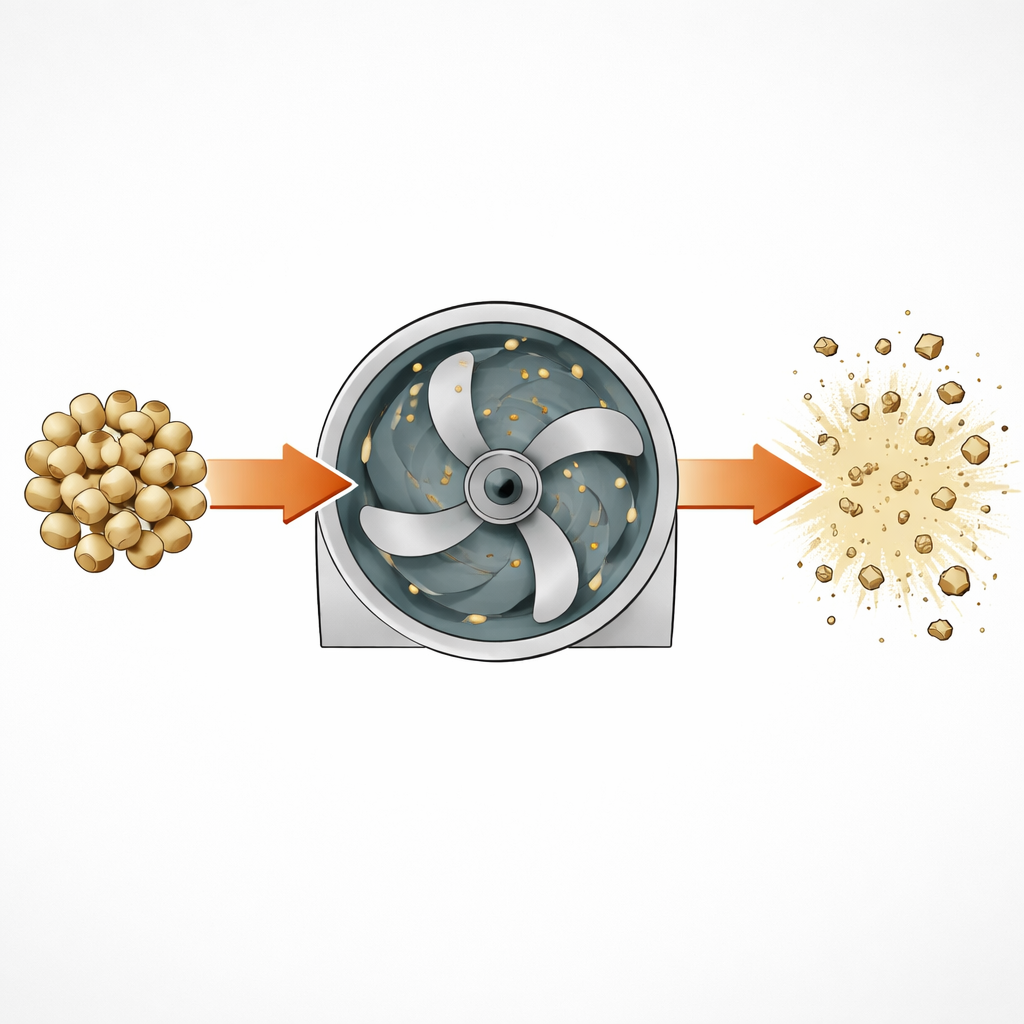
On modern farms and fish hatcheries, animal feed often comes in the form of small, compact pellets that are easy to transport, store, and digest. But as these pellets travel through pipes, conveyors, and feeders, they crack and crumble into dust. Too many fines can waste expensive nutrients, harm animal health, and pollute the environment. This study asks a deceptively simple question: how, exactly, do these pellets break—and can computer models help us design gentler equipment and tougher pellets?
From whole pellets to hidden cracks
The researchers focus on piglet feed pellets, which are typical of the products used in livestock and aquaculture. Even though these pellets look solid to the naked eye, their internal structure is a packed mass of tiny particles pressed together. When machinery squeezes or slams them, damage starts as microscopic cracks and broken links between those particles, long before the pellet visibly shatters. Because it is hard to watch that process directly, engineers increasingly turn to digital tools that track each tiny grain in a virtual experiment.
Building a digital twin of a single pellet
To make their virtual pellets realistic, the team first measured real ones in the lab: their size, weight, density, moisture, and how much force it takes to crush them in a slow, one‑direction squeeze. They then recreated a single pellet in specialized software as a cluster of hundreds of small spheres, each glued to its neighbors by invisible bonds. These bonds stand in for the real internal ties in the material. By carefully adjusting a few key settings—how stiff the bonds are and how strong they are before snapping—the researchers tuned the computer model until its simulated crush test matched the experimental force and deformation curves within about ten percent over most of the loading. This step effectively gave them a calibrated “digital twin” of a piglet pellet.
Spinning pellets into a virtual impact rig
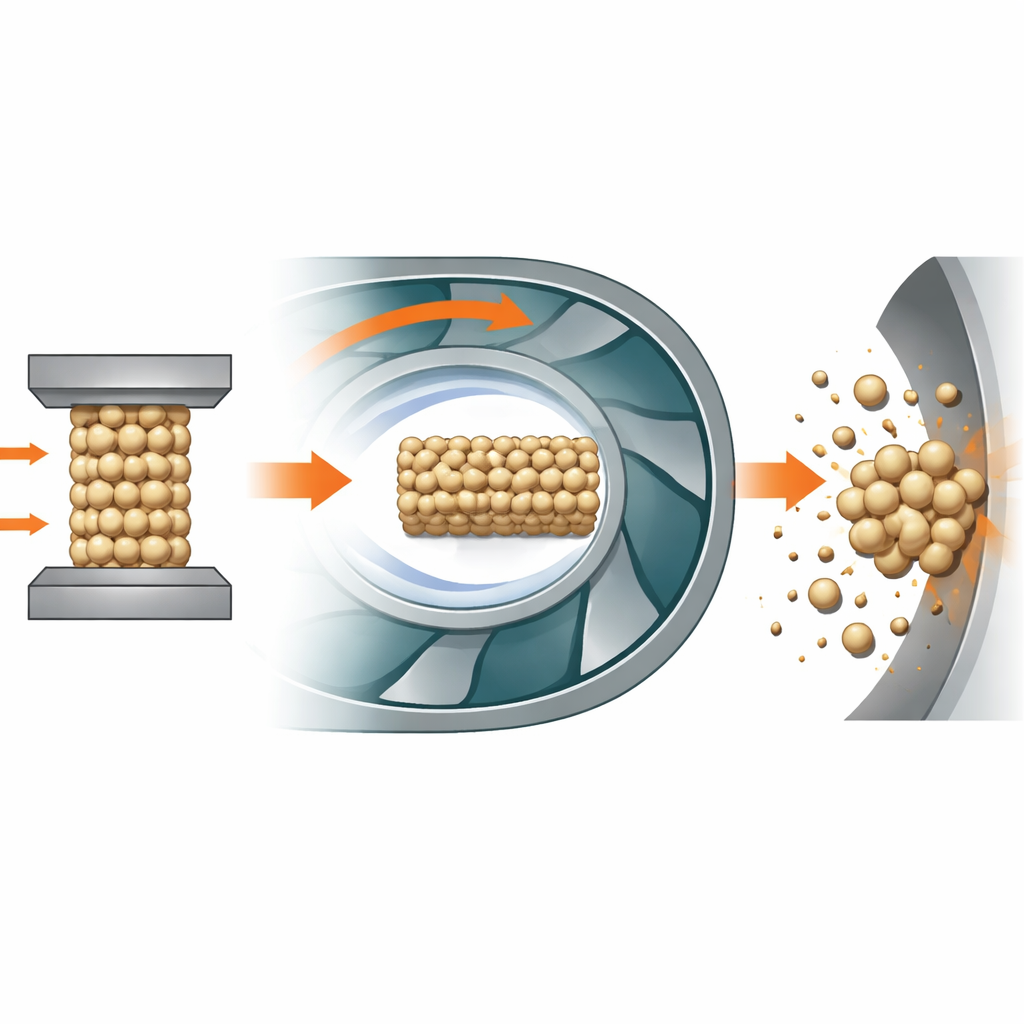
With their model pellet validated, the team moved from slow squeezing to fast impacts, mimicking what happens in real feed handling systems. They built a computer version of a centrifugal impact device, where a rotating impeller flings pellets outward against a stationary ring. As the spin speed increases, so does the collision speed and the energy delivered to each pellet. In the simulation, each pellet’s internal bonds were monitored: when bonds broke, the pellet fractured into larger pieces and fines. The fraction of bonds that failed provided a microscopic measure of damage, while the researchers also ran physical impact tests to weigh the actual broken material. Across speeds from 500 to 1500 revolutions per minute, both the simulated bond‑breakage fraction and the measured mass loss rose steadily, and they tracked each other almost perfectly.
How impact angle changes the break pattern
The team then explored how the angle at which pellets hit the impact ring affects damage. When pellets hit straight on, they experience mainly head‑on compression; at shallower angles, they are pushed more sideways and tend to spin. The simulations showed that breakage is not simply bigger or smaller with angle, but peaks at an intermediate setting: around 75 degrees. At this angle, the loading combines both head‑on and sideways components, keeping the pellet under stress for longer and driving more cracks through its interior. At steeper or shallower angles, more of the collision energy is either bounced back elastically or converted into rotation and sliding, which produces less fragmentation.
What this means for better feed and gentler machines
In plain terms, the study shows that a well‑tuned computer model of a single pellet can faithfully predict how real pellets will crumble in high‑speed equipment. By linking invisible internal bond failures to the visible amount of breakage, the work offers a practical tool for feed producers and equipment designers. They can now explore how changes in pellet recipe, moisture, or machine settings—such as impeller speed and impact angle—will affect durability, without having to build and test every option physically. This kind of virtual testing can guide the design of tougher pellets and gentler handling systems, cutting waste and improving the efficiency and sustainability of animal production.
Citation: Liu, Z., Kong, X., Wang, W. et al. Research on establishment of bonded particle model for pellet feed and its application. Sci Rep 16, 13224 (2026). https://doi.org/10.1038/s41598-026-43893-y
Keywords: pellet feed breakage, discrete element modeling, centrifugal impact testing, granular materials, animal feed engineering