Clear Sky Science · en
Estimation of onion crop evapotranspiration and crop coefficients using weighing lysimeters and machine learning models in semi-arid region
Why onions and water use matter
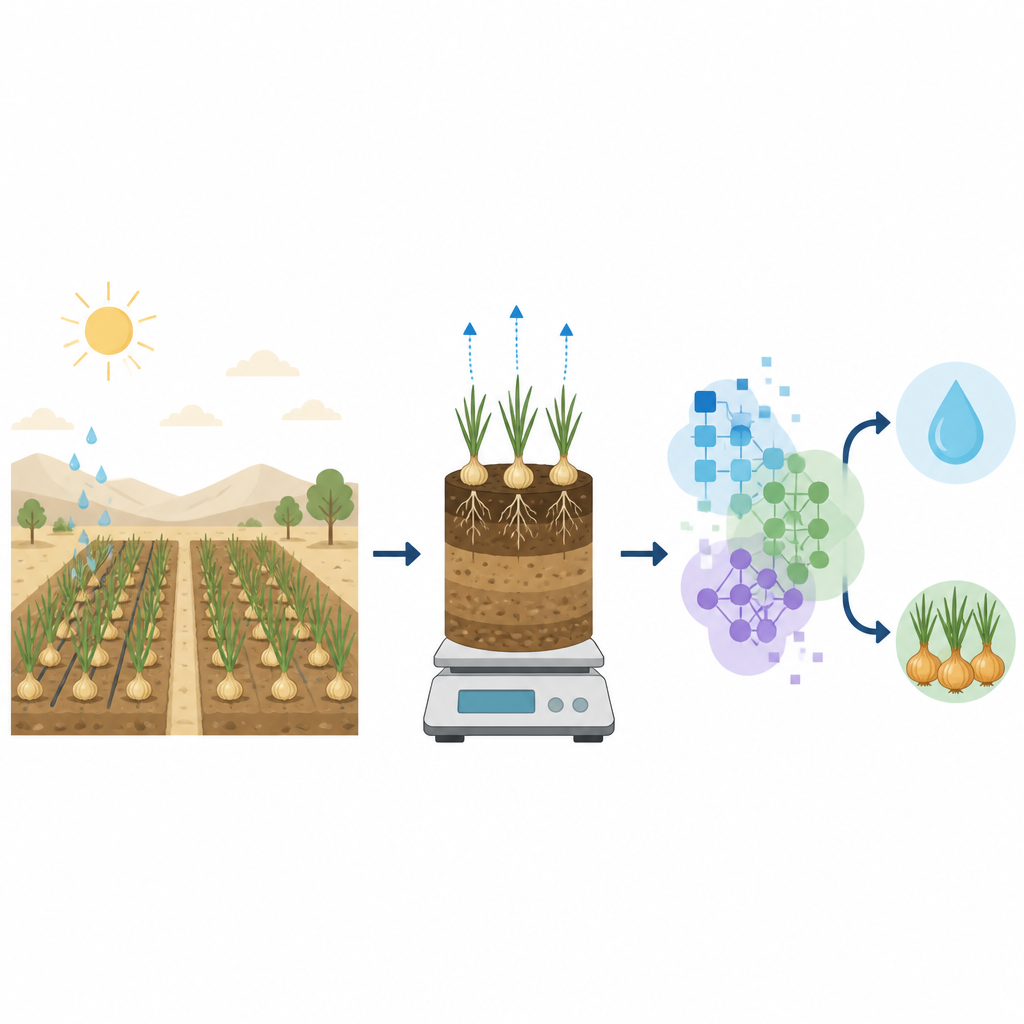
Onions are a staple in kitchens and a major crop in Iran, yet they demand a lot of water in a region where every drop counts. Farmers and water managers need to know exactly how much water onion fields lose to the air so they can irrigate wisely, avoid waste, and still harvest good yields. This study combined careful field measurements with modern computer models to better understand onion water use in a semi arid part of Iran.
Measuring how onion fields lose water
Plants lose water in two main ways: from the soil surface and through the leaves. Together, this water loss is called evapotranspiration. To track it with high precision, the researchers used large weighing containers buried in the ground, each holding onion plants and soil. By recording how the weight changed over time, and tracking rainfall, irrigation, and drainage, they could tell exactly how much water left the system each day. Over two growing seasons, the onion crop used about 447 millimeters of water in the first year and 432 millimeters in the second, with cooler weather in the second year leading to slightly lower use.
Separating plant thirst from soil drying
Water is not only taken up by onion roots; it also evaporates directly from bare soil between the rows. To tease these parts apart, the team placed small soil cylinders, called micro lysimeters, inside the main weighing units. These small samples were weighed daily to show how much water left the soil surface alone. By subtracting this from total water loss, they could estimate how much was actually passing through the onion plants. They found that about one third of total water loss came from the soil surface, while the rest came from plant transpiration. They also tracked how these shares changed across the season, with soil evaporation higher when plants were small and leaf cover was limited.
Simple numbers that guide irrigation
Farmers and advisers often rely on crop coefficients, simple factors that link local weather to how much water a specific crop will use. In this study, the team calculated both single and dual crop coefficients for onions under semi arid Iranian conditions. The single coefficient links total onion water use to a standard grass reference, while the dual form splits the effect between plant leaves and bare soil. For the combined measure, the average values were 0.41 at the start of the season, 0.68 around the peak of growth, and 0.51 near the end. The leaf based part stayed lower than values reported in some other countries, reflecting the relatively modest leaf area and height of the local onion variety and the cool winters that slowed its growth.
Teaching computers to predict water use
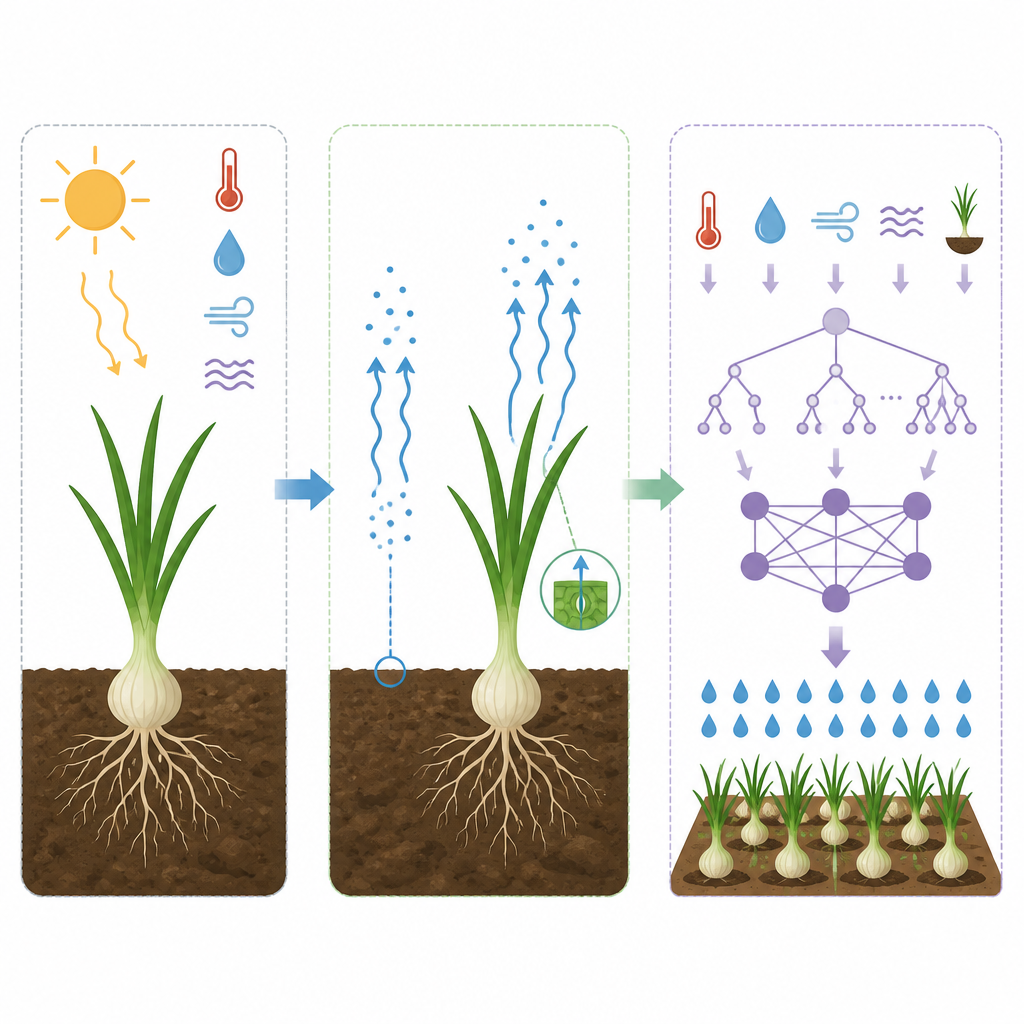
Because the large weighing devices are expensive and rare, the researchers also tested whether computer models could estimate onion water use using common weather and crop measurements. They trained five types of machine learning models on two years of data, including air temperature, humidity, wind speed, sunlight, leaf area, and plant height. The models learned to mimic the measured water loss and were tested on unseen days. Two tree based methods, Random Forest and Decision Tree, gave the most accurate predictions, closely followed by neural networks and support vector regression. A simpler linear method, LASSO regression, was less accurate, suggesting that onion water use responds in a complex, non linear way to weather and plant growth.
What drives onion water use
By looking inside the best performing model, the team identified which inputs mattered most. Measures of plant size, such as leaf area and height, ranked highest, along with net radiation from the sun and wind speed. In contrast, air humidity played a smaller role in this semi arid setting. This means that to predict water needs reliably, it helps to know not just the weather, but also how much green leaf surface the crop has at a given time.
What this means for farmers
For growers and planners in dry regions, this work delivers two key tools. First, it provides locally tested numbers that relate standard weather data to onion water use, helping design better irrigation schedules. Second, it shows that well trained machine learning models can stand in for costly field instruments, as long as basic weather and crop growth data are available. Together, these advances can support more efficient use of scarce water resources while maintaining onion production in semi arid landscapes.
Citation: Shirazi, S.H.M., Razzaghi, F. & Sepaskhah, A.R. Estimation of onion crop evapotranspiration and crop coefficients using weighing lysimeters and machine learning models in semi-arid region. Sci Rep 16, 16166 (2026). https://doi.org/10.1038/s41598-026-43887-w
Keywords: onion irrigation, evapotranspiration, semi arid agriculture, crop coefficients, machine learning models