Clear Sky Science · en
Unveiling the immoral ramp feature of dissolved oxygen signals with dynamical systems analysis: perspectives for robust soft-sensor development
Why smarter water monitoring matters
Across cities and rural communities, small wastewater treatment systems are becoming vital for saving water and protecting rivers. Yet the sensors needed to track water quality are costly and can degrade over time. This study explores a new way to design “soft sensors” that infer water quality from cheap, simple measurements. The authors show how a mathematical lens called dynamical systems analysis can reveal when a seemingly reliable signal feature in dissolved oxygen actually hides traps that lead to wrong decisions about water safety.
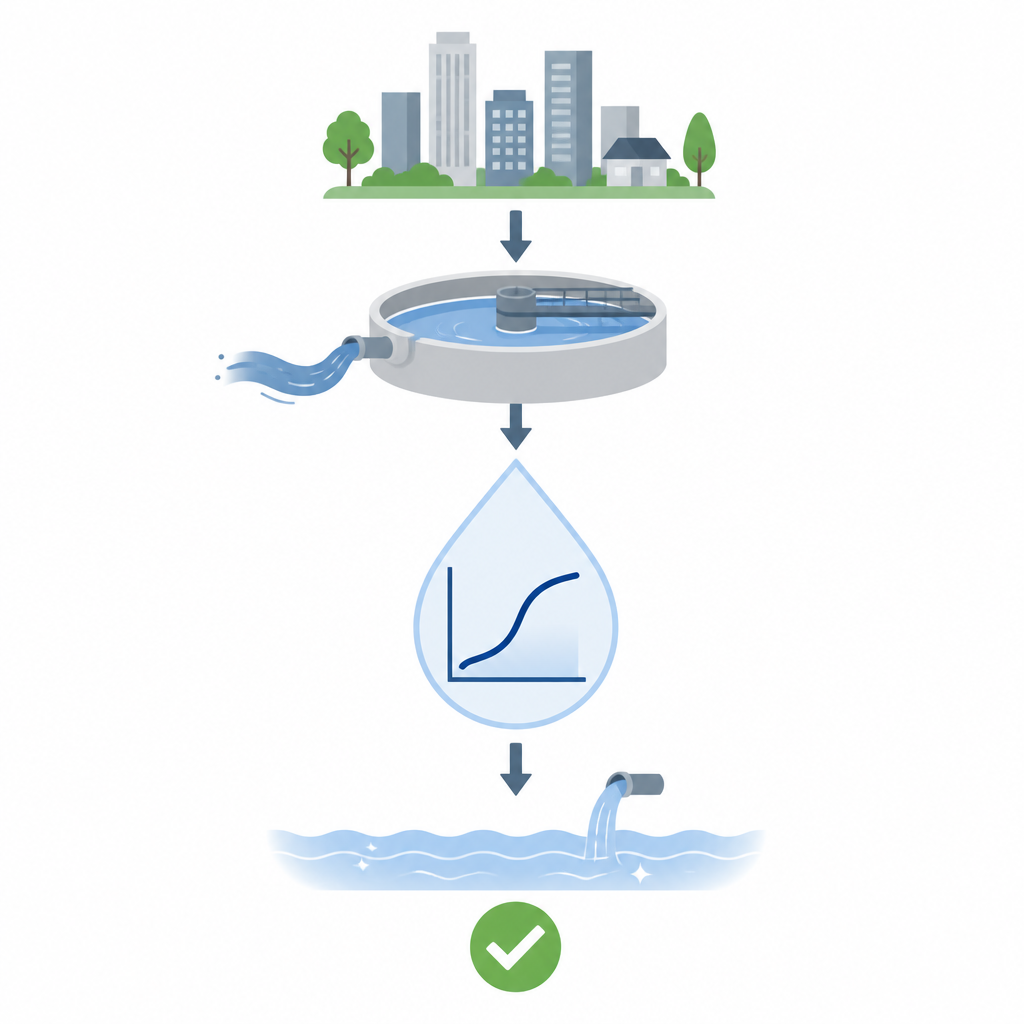
Reading between the lines of sensor signals
Engineers often replace expensive laboratory measurements with proxy signals, for example using dissolved oxygen curves to infer when harmful ammonia has been removed. A popular approach looks for a ramp, a characteristic bend in the oxygen signal over time, and uses it as a cue that the treatment cycle can stop. Earlier work showed that this ramp feature is fairly robust against noise and sensor drift, because it relies on the overall shape of the curve rather than exact values. But extensive experiments and computer simulations also hinted that other process conditions, such as how air is supplied or how much buffering mineral is present, can produce a similar ramp even when ammonia is not fully removed.
A new lens on complex treatment biology
To untangle these overlapping causes, the authors turned to dynamical systems analysis, a family of tools used in climate science and robotics to study how models behave without simulating every possible scenario. They applied it to a standard mathematical description of activated sludge treatment, where microbes consume pollutants while air is bubbled through the water. Instead of tracking full time series, they derived equations for the first and second time derivatives of dissolved oxygen directly from the model. This allowed them to pinpoint all combinations of internal states that can create a ramp feature, across a huge space of possible conditions, in a computationally efficient way.
When a trusted feature turns “immoral”
The analysis revealed that the dissolved oxygen ramp is “immoral” in a technical sense: it can be produced not only by low ammonia, the desired situation, but also by eight other state variables linked to microbial populations and organic matter. In graphical terms, these variables form V shaped patterns, where several different parents funnel into the same child feature. A data driven model trained only on past data may latch onto correlations created by this structure and confidently misinterpret a ramp as safe effluent when it is not. By scanning the space of possible states, the authors mapped where ramps are true positives, correctly flagging full ammonia removal, and where they become false positives that risk releasing insufficiently treated water.
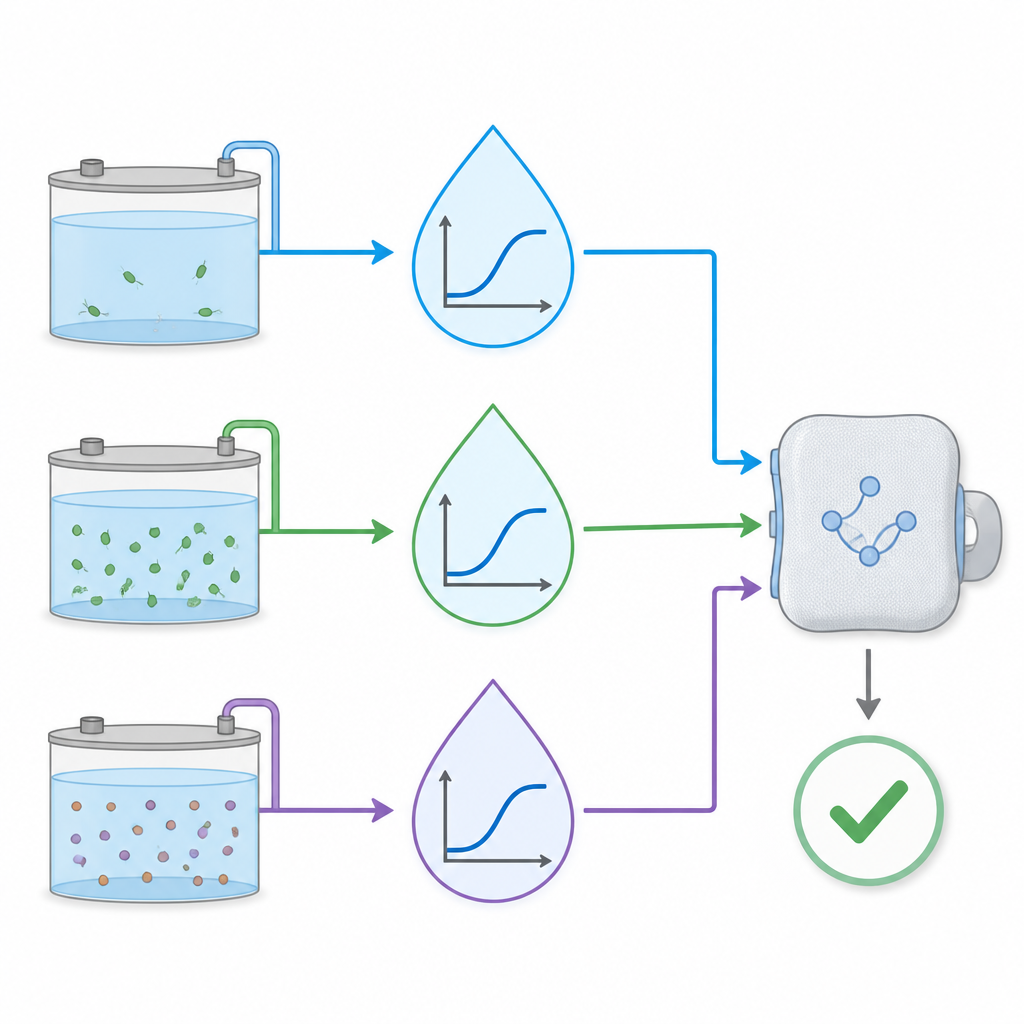
Turning a fragile cue into a more reliable tool
The study did not stop at exposing the weakness of the ramp feature. It also showed how to make it more reliable. One important finding is that the steepness of the ramp matters: true ramps associated with low ammonia tend to have a much higher slope than false ones. Setting a minimum slope requirement can filter out many misleading cases, although this introduces its own trade off by potentially missing some true events. The analysis further suggests that knowing the abundance of certain bacteria could relax this slope requirement and reduce missed detections. The same framework can be reused with other mathematical models in wastewater treatment, helping to design feature sets that combine several simple signals into a more robust soft sensor.
What this means for safer water reuse
For readers, the key takeaway is that not all apparently reliable sensor patterns are trustworthy guides for decisions that affect human and environmental health. By rigorously exploring all model based ways a feature can appear, dynamical systems analysis exposes hidden look alike situations that could mislead data driven tools. In this case, it shows that a commonly used oxygen ramp alone is not a safe stand in for ammonia measurements, but can become part of a robust monitoring strategy when combined with slope information and possibly other features. The approach offers a path toward smarter, more transparent soft sensors that are better suited to the growing demands of water recovery and reuse.
Citation: Schneider, M.Y., Torfs, E. & Carbajal, J.P. Unveiling the immoral ramp feature of dissolved oxygen signals with dynamical systems analysis: perspectives for robust soft-sensor development. Sci Rep 16, 15414 (2026). https://doi.org/10.1038/s41598-026-43885-y
Keywords: wastewater treatment, soft sensors, dissolved oxygen, dynamical systems analysis, ammonium monitoring