Clear Sky Science · en
Bioactive-fat engineered nanostructured lipid carriers from Illipe butter: optimized design and enhanced in vitro anti-inflammatory performance
Why a Tropical Butter Matters for Your Skin
Many people reach for creams and gels to calm red, irritated skin, but few stop to ask what fats those products contain or where they come from. This study explores a little-known tropical fat called Illipe butter, traditionally used in Southeast Asia, and tests whether it can be turned into modern nano-sized carriers for soothing inflamed skin. By marrying a local, renewable resource with nanotechnology, the researchers aim to build kinder, more sustainable skincare that still performs like cutting-edge laboratory products.
A Natural Fat with Hidden Promise
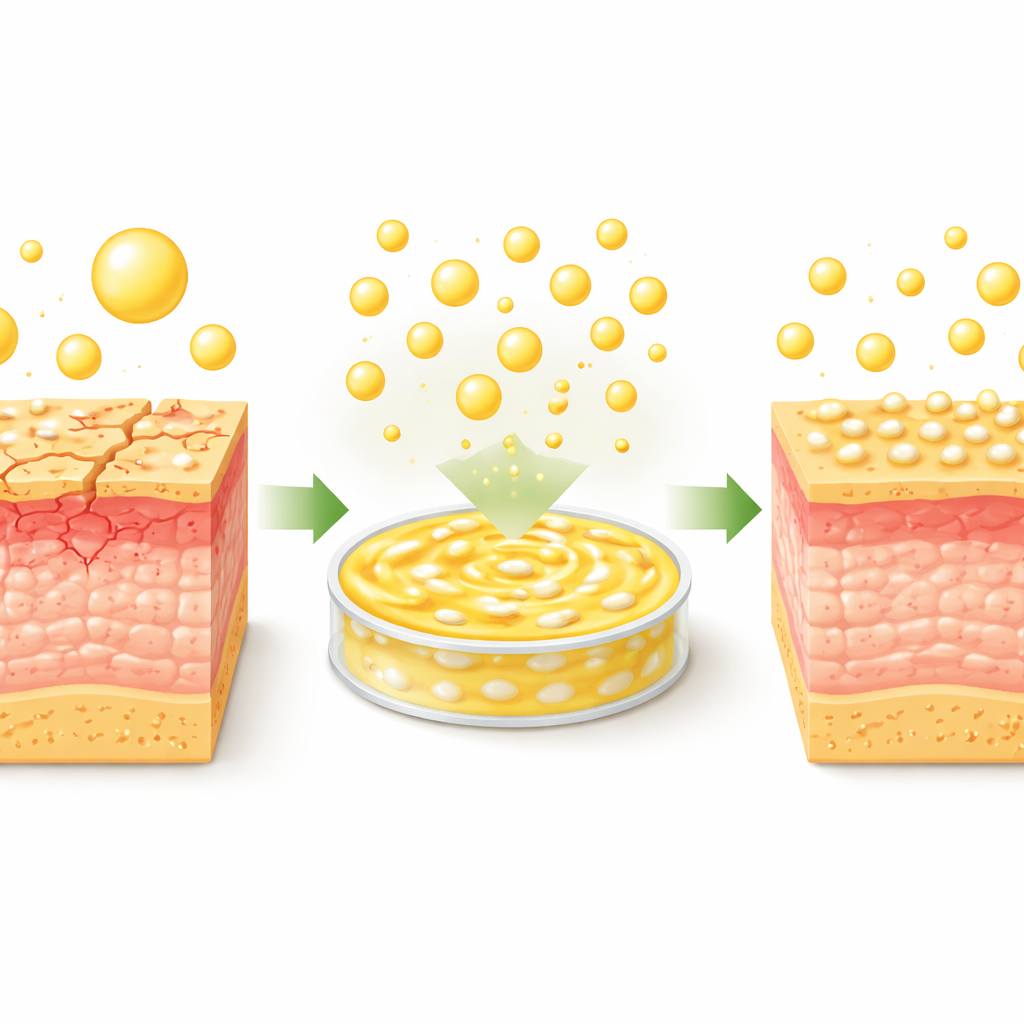
Illipe butter is a solid fat pressed from the seeds of Shorea trees that grow in Indonesian forests. Villagers have long used it as a rich moisturizer, and its fatty acid makeup closely resembles cocoa butter, a staple of many cosmetics. Those same fatty acids—especially stearic and palmitic acids—are thought to help protect and calm the skin’s outer barrier. However, Illipe butter is very water-repellent and difficult to spread evenly in ordinary creams. That poor dispersion and low solubility limit how much of its beneficial components can actually contact the skin where inflammation occurs.
Shrinking Butter into Nanoscale Carriers
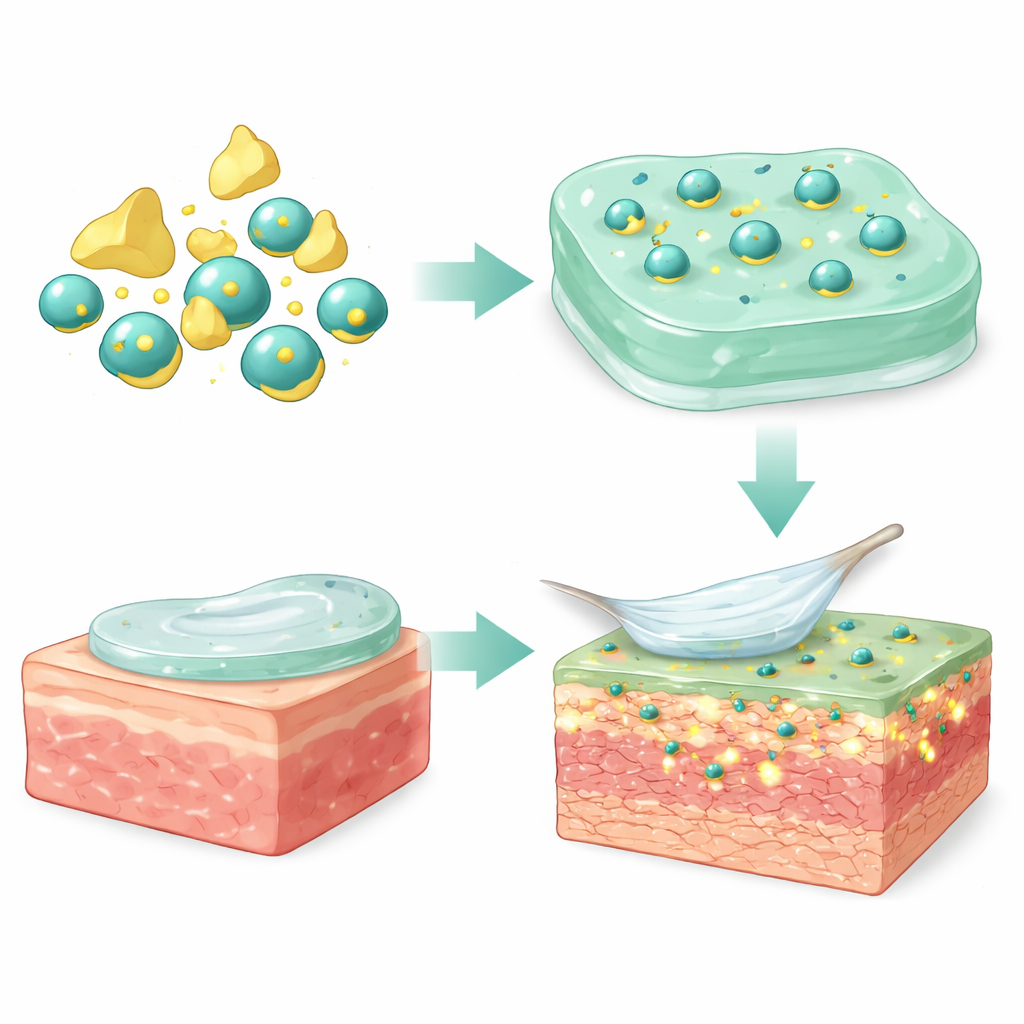
To overcome these drawbacks, the team engineered “nanostructured lipid carriers,” or NLCs—tiny fat-based particles hundreds of times smaller than the width of a human hair. They melted Illipe butter together with another solid fat and a small amount of liquid oil, then mixed this hot blend with a warm water phase containing gentle surfactants, followed by powerful ultrasound to break the droplets into nanoparticles. Using a statistical planning tool known as a Box–Behnken design, they systematically varied the amounts of Illipe butter, the companion fats, and the surfactant mixture across 15 recipes to see which combinations produced the smallest, most uniform, and most stable particles for skin use.
Finding the Sweet Spot for Stable Nano-Droplets
Careful measurements showed that particle sizes across these recipes ranged roughly from 200 to 430 nanometers, with the most promising formula coming in at about 277 nanometers and a reasonably narrow size distribution. Electron microscopy confirmed that the particles were smooth, mostly spherical droplets with an intentionally “imperfect” internal fat structure that helps them hold on to their cargo. Electrical charge measurements indicated strongly negative surfaces, a sign that the particles repel one another instead of clumping, which supports shelf stability. Chemical analysis by gas chromatography–mass spectrometry revealed that the major fatty acids in Illipe butter survived the manufacturing process with almost no change in their proportions, meaning the nano-carriers still contained the original bioactive fats the researchers hoped to deliver.
Turning Nano-Carriers into a Usable Skin Gel
Because consumers do not apply watery nanoparticle suspensions directly to their skin, the team blended the optimized NLC dispersion into a clear carbopol-based gel. This created a product with the feel of a modern cosmetic: it thinned out when spread but thickened again at rest, an advantage for staying on the skin after application. The gel’s acidity and texture remained stable through repeated freeze–thaw cycles, a simple indication that it could withstand everyday temperature swings. In a laboratory test that measures how well a substance prevents heat-induced protein damage—a rough stand-in for anti-inflammatory behavior—pure Illipe butter, the nano-dispersion, and the NLC gel all showed moderate protective effects. Notably, the nano-dispersion performed better than the raw butter, suggesting that nanosizing does enhance its apparent activity, whereas embedding the particles in gel slightly dampened the effect, likely by slowing their release.
What This Could Mean for Future Skin Soothers
For everyday users of creams and gels, the study’s message is that a traditional plant fat can be redesigned into a sophisticated nano-delivery system without losing its key ingredients. The researchers show that Illipe butter can form stable, skin-ready nanoparticles and that these nano-carriers modestly improve an in vitro sign of anti-inflammatory action compared with the unprocessed fat. However, they also acknowledge that the particles were larger than originally hoped, that only short-term stability and a single lab assay were tested, and that real skin studies still lie ahead. If future work confirms these early results, sustainably sourced Illipe butter could help power a new generation of topical products that both respect local ecosystems and offer scientifically tuned relief for irritated skin.
Citation: Kurniawansyah, I.S., Chaerunisaa, A.Y. & Akmalia, N.N.N. Bioactive-fat engineered nanostructured lipid carriers from Illipe butter: optimized design and enhanced in vitro anti-inflammatory performance. Sci Rep 16, 13741 (2026). https://doi.org/10.1038/s41598-026-43880-3
Keywords: Illipe butter, nanostructured lipid carriers, topical anti-inflammatory, sustainable skincare, nanotechnology gel