Clear Sky Science · en
Deep learning based 3D brain metastasis synthesis with configurable parameters for 3D data augmentation
Why fake brain scans matter
Doctors increasingly rely on computer programs to spot tiny cancer deposits in the brain, but these programs need lots of high quality examples to learn from. Real patient scans are hard to collect and share, so researchers are exploring whether realistic, computer made brain scans could safely “stand in” as extra training material. This study asks a simple question with big implications: can carefully crafted synthetic brain metastases help computers find and outline real tumors more accurately, especially when real data are scarce? 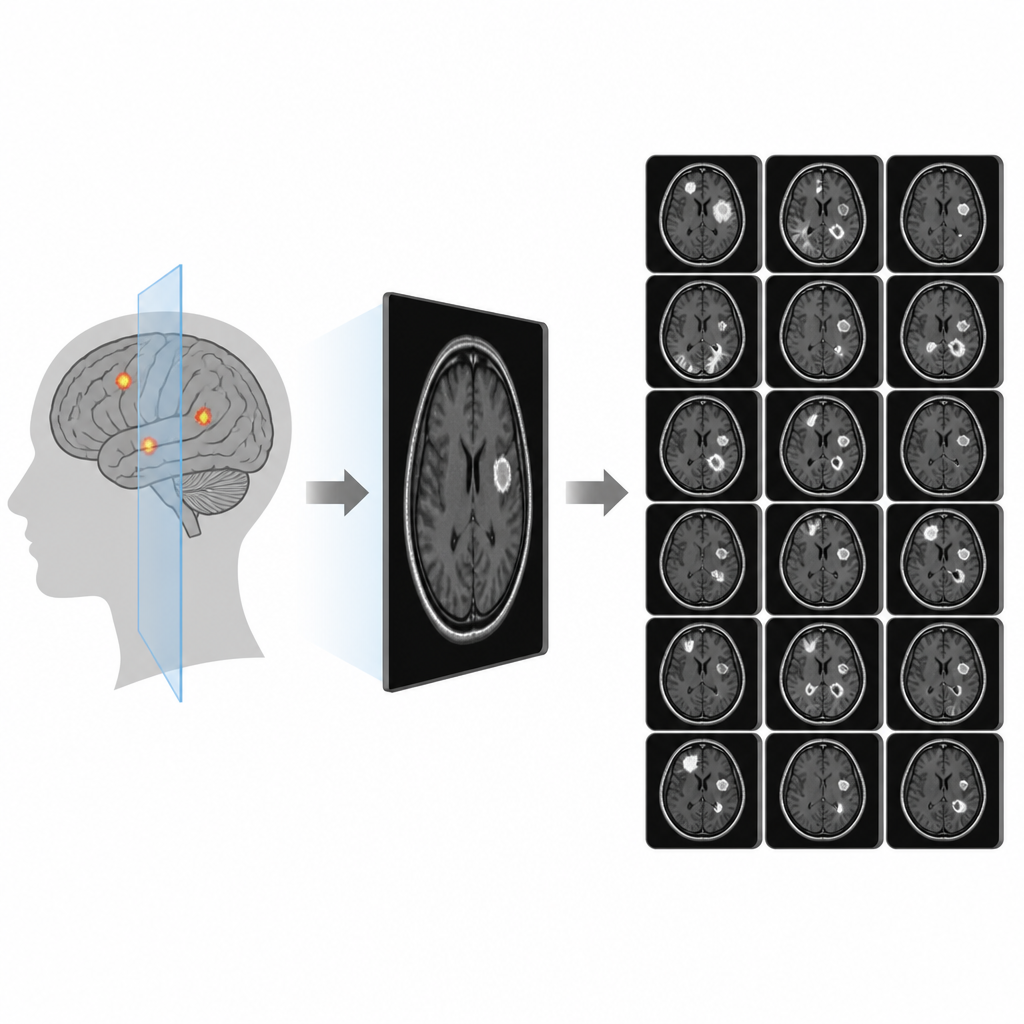
Making teaching images out of thin air
The team focused on brain metastases, cancer spots that have spread to the brain from tumors elsewhere in the body and affect up to two in five cancer patients. They worked with 3D MRI scans from 1832 people and more than ten thousand metastases. Instead of simple copy paste tricks, they used deep learning to generate new tumors directly inside real brain images. Their method lets users dial in basic properties such as where a lesion sits, how big it is, how bright it appears, and how patchy or uniform it looks, so that computer vision models can be trained on a richer mix of realistic cases.
Blending 3D structure with 2D detail
A key challenge is that tumors must look believable in three dimensions, slice after slice, while also matching the fine textures of real MRI images. The researchers solved this by chaining together two types of neural networks. First, 3D networks build a coarse “skeleton” of each synthetic tumor, controlling its size, shape and internal intensity pattern across the volume. Then a 2D network refines each slice, guided by a visual quality check that compares its appearance to huge collections of natural images. This two step design helps the fake tumor merge smoothly into the surrounding brain, avoiding unnatural edges or blocky artifacts that could make training too easy or unrealistic. 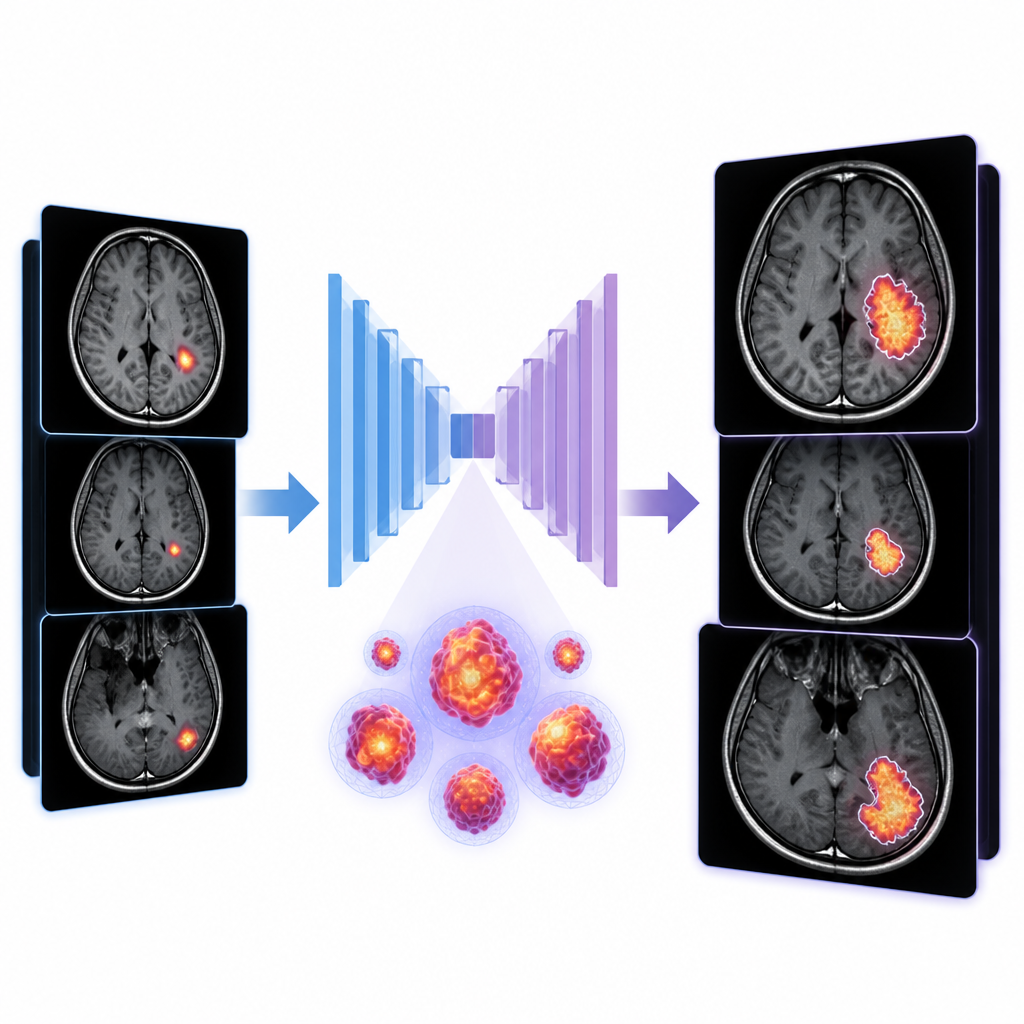
Do synthetic tumors actually help?
To test real world value, the authors trained a popular open source tool for medical image segmentation on different mixtures of real and synthetic scans. They compared traditional tricks like rotating or flipping images against adding fully synthetic metastases. When they restricted themselves to only ten percent of the available training data, models that combined standard augmentation with a modest number of synthetic lesions performed best. They detected more tumors and drew tighter, more accurate outlines, as shown by higher overlap scores and smaller boundary errors. In some settings, using a small real dataset plus synthetic images even beat a model trained on the full real dataset without any augmentation.
Finding the sweet spot for fake data
The study also explored how much synthetic data is enough. Adding a moderate number of computer generated lesions clearly helped, but flooding training with thousands more began to hurt detection performance. The authors point out that synthetic images, no matter how realistic, are not perfect copies of real scans. If they dominate training, the model may become biased toward patterns that appear more often in the fake images than in true patient data. Still, across several comparisons with other simulation techniques, the proposed method consistently produced sharper tumor boundaries and more faithful 3D structure, especially for small or complex lesions.
What this means for future cancer imaging
In plain terms, the researchers show that carefully designed “fake” brain tumors can make computer tools better at spotting and outlining real ones, particularly when hospitals do not have enough labeled scans to spare. Their approach creates 3D tumors that look convincing to both algorithms and human experts while allowing users to vary key properties in a controlled way. Used in balance with real data, these synthetic images could support more reliable screening, treatment planning and follow up for people with brain metastases, and the same ideas may extend to other cancers and rare conditions where data are limited.
Citation: Zhao, G., Gibson, E., Yoo, Y. et al. Deep learning based 3D brain metastasis synthesis with configurable parameters for 3D data augmentation. Sci Rep 16, 15563 (2026). https://doi.org/10.1038/s41598-026-43875-0
Keywords: brain metastasis, MRI, synthetic data, deep learning, tumor detection