Clear Sky Science · en
Beyond diagnosis: a network approach to the emotional and control processes involved in the binge eating spectrum disorders
Why this matters for everyday eating
Binge eating is often portrayed as a simple problem of willpower, but for many people it reflects a tangled web of emotions, body signals, and habits that are hard to break. This study looks at binge eating spectrum disorders as a whole system rather than as separate diagnoses, asking a practical question: which feelings, body states, and thinking patterns most strongly keep the cycle going? Understanding this web can point to smarter ways to spot risk early and design treatments that go beyond "just eat less" advice.
Seeing binge eating as a spectrum
The authors focus on what they call binge eating spectrum disorders, which include binge eating disorder, bulimia nervosa, night eating syndrome, and other binge-type conditions. All share repeated episodes of eating unusually large amounts of food with a sense of losing control, but they differ in details such as whether people purge or when the eating happens. Rather than treating each diagnosis as a separate box, the researchers adopt a spectrum view: symptoms and difficulties blend and overlap, and many people fall between tidy categories. This approach better fits real-world experience, where distress and impairment can be high even when someone does not neatly match a textbook definition.
Looking at the whole web, not single causes
To explore how different influences work together, the researchers studied 187 adults aged 18 to 45 receiving care for binge-type eating problems in Ecuador. They measured body weight and metabolic risk, along with psychological factors such as sensitivity to tempting food in the environment, momentary cravings, feelings of hunger, impulsivity, stress, anxiety and depression, obsessive thoughts and rituals, emotion regulation, and decision-making style. Instead of asking which single factor “causes” binge eating, they used a network approach that treats each factor as a node in a web. Links between nodes reflect how strongly two factors move together after accounting for all the others. Central nodes are those that are most tightly connected to the rest of the system and may be especially important in keeping the problem in motion. 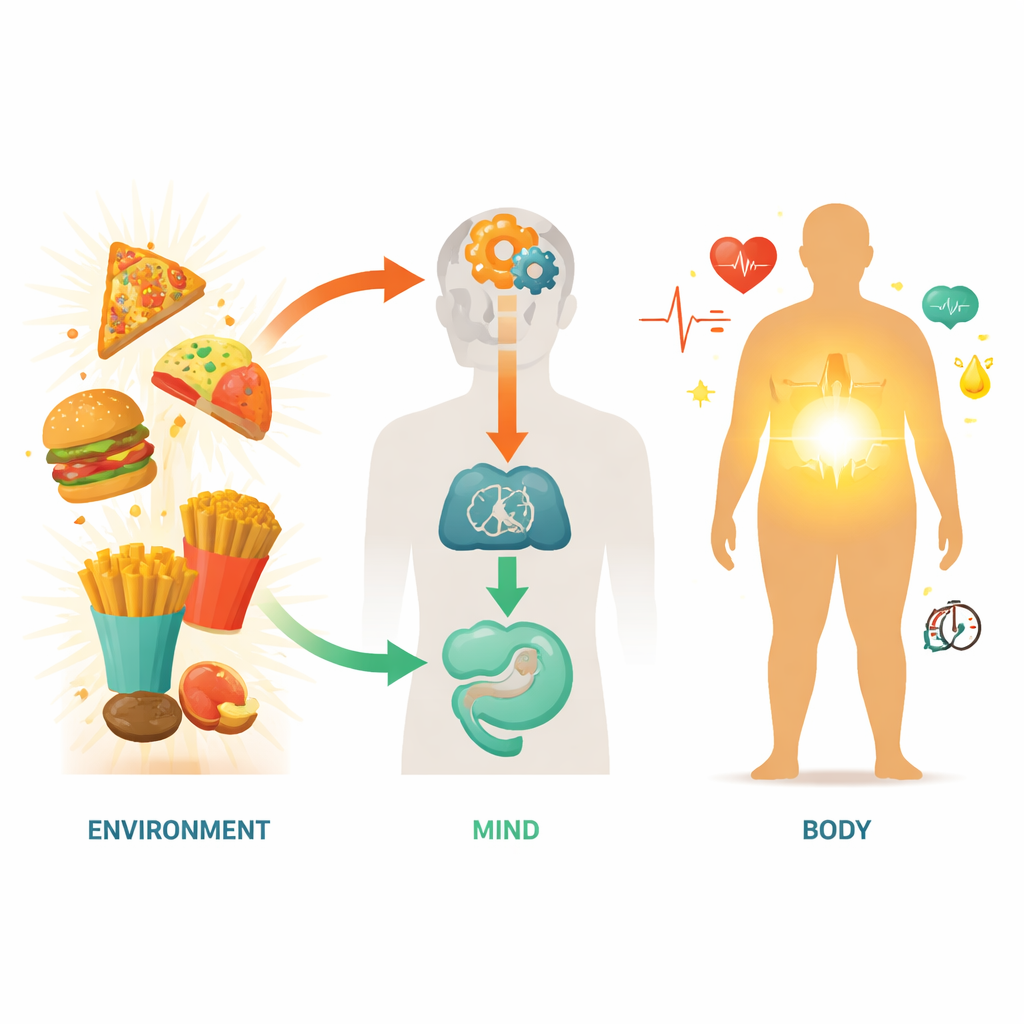
Food cues at the center of the storm
The resulting network showed a moderately dense but organized structure, with three main clusters. One cluster linked food cues, stress, impulsivity, and obsessive–compulsive tendencies, forming what the authors describe as a stress and cue-reactivity system: people who are more stressed and more impulsive also tend to be more thrown off balance by tempting food in their surroundings. A second cluster combined decision-making style, hunger, cravings, emotion regulation, and anxiety–depression, reflecting how mood and thinking patterns shape responses to internal body signals and external temptations. A third cluster tied together overall eating-disorder severity, body mass index, and metabolic risk, capturing the more visible medical consequences of longstanding dysregulated eating.
The key roles of food cues, stress, hunger, and choices
Among all variables in the network, one stood out: psychological sensitivity to food cues, such as the sight and smell of palatable foods. This factor was the most central by several mathematical criteria, meaning it was strongly linked to many other influential nodes and often sat on the shortest connection paths between different parts of the network. Food cue reactivity was also most closely tied to overall eating-disorder severity, followed by impulsivity and body mass index. Hunger, stress, and decision-making style also occupied central positions, suggesting that physical appetite, emotional strain, and how people weigh short-term versus long-term outcomes are deeply interwoven with binge eating patterns. 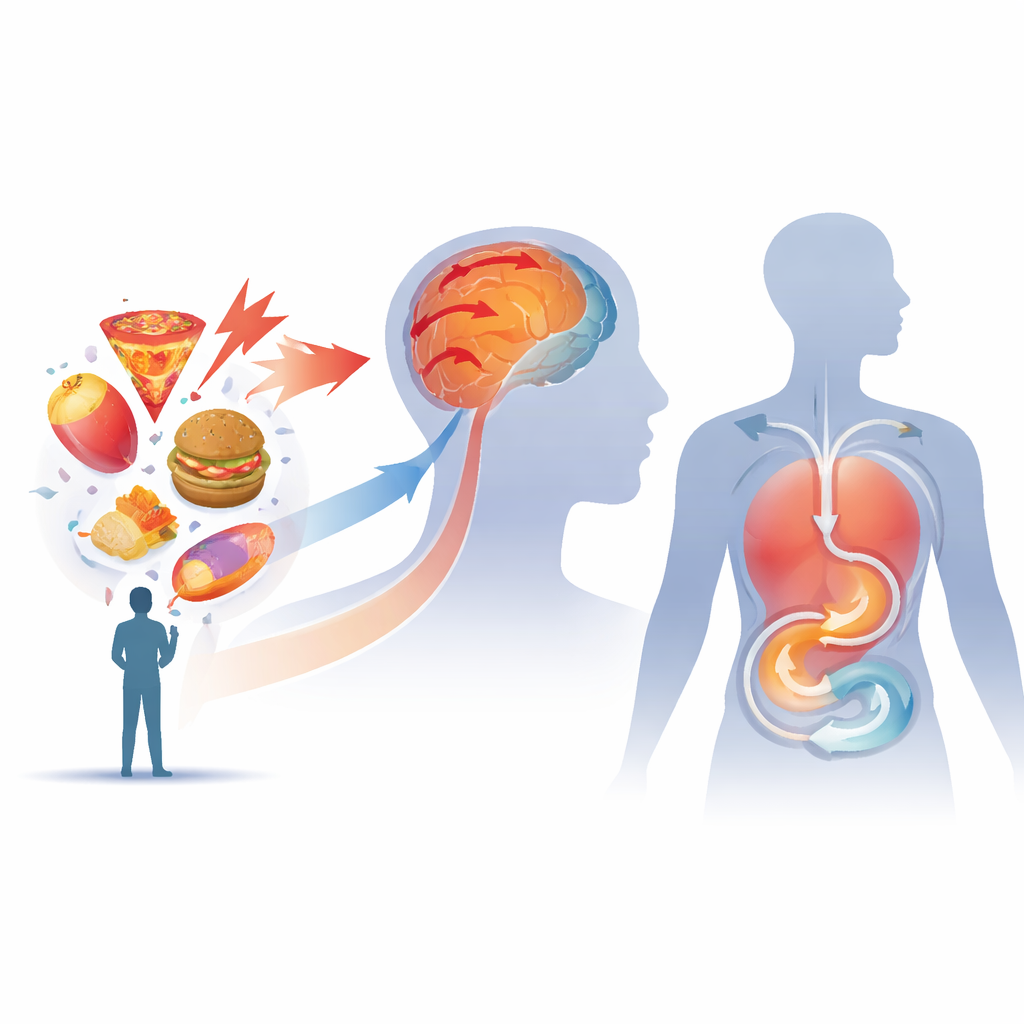
What this means for help and prevention
Because the study is cross-sectional, it cannot prove that food cues or stress cause binge eating; instead, it shows that they are tightly interlinked with other problems in this group of patients. Still, this web-like picture has clear practical implications. Adding questions about food cue sensitivity to routine assessments may help clinicians identify people whose symptoms are most likely to escalate. Treatments that directly target reactions to tempting food—such as gradual exposure to trigger foods, mindfulness-based approaches that change how urges are handled, and training in decision-making and stress management—may have broad ripple effects across the network of symptoms. In plain terms, the study suggests that for many people with binge-type eating problems, the battlefield is not just the plate but the entire environment of food signals, emotions, and split-second choices that surround every meal.
Citation: Reivan Ortiz, G., Quezada Gómez, M., Campoverde, A. et al. Beyond diagnosis: a network approach to the emotional and control processes involved in the binge eating spectrum disorders. Sci Rep 16, 13234 (2026). https://doi.org/10.1038/s41598-026-43873-2
Keywords: binge eating spectrum, food cue reactivity, stress and eating, decision making, eating disorder treatment