Clear Sky Science · en
A systematic bias in float pH leads to overestimation of derived pCO2 and underestimation of carbon uptake by the Southern Ocean
Why tiny ocean measurements matter
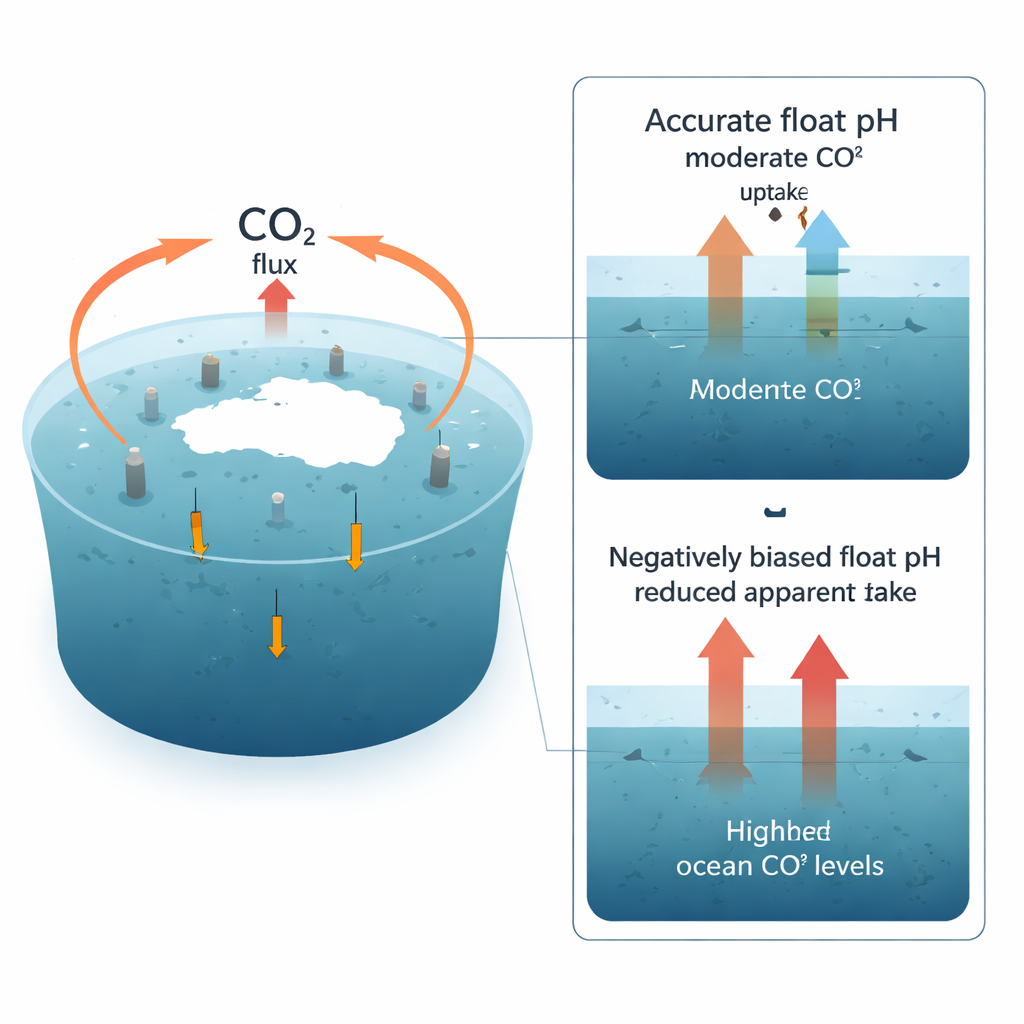
The Southern Ocean, the vast ring of water around Antarctica, quietly soaks up an outsized share of the planet’s excess heat and carbon dioxide. Because it is remote and stormy, scientists increasingly rely on robotic profiling floats rather than ships to track how much CO2 this ocean actually absorbs. This study shows that a subtle but systematic error in how those floats measure acidity (pH) leads to overestimating how much CO2 is dissolved in the water—and therefore underestimating how much carbon the Southern Ocean really takes up from the atmosphere.
Robots watching a hard-to-reach ocean
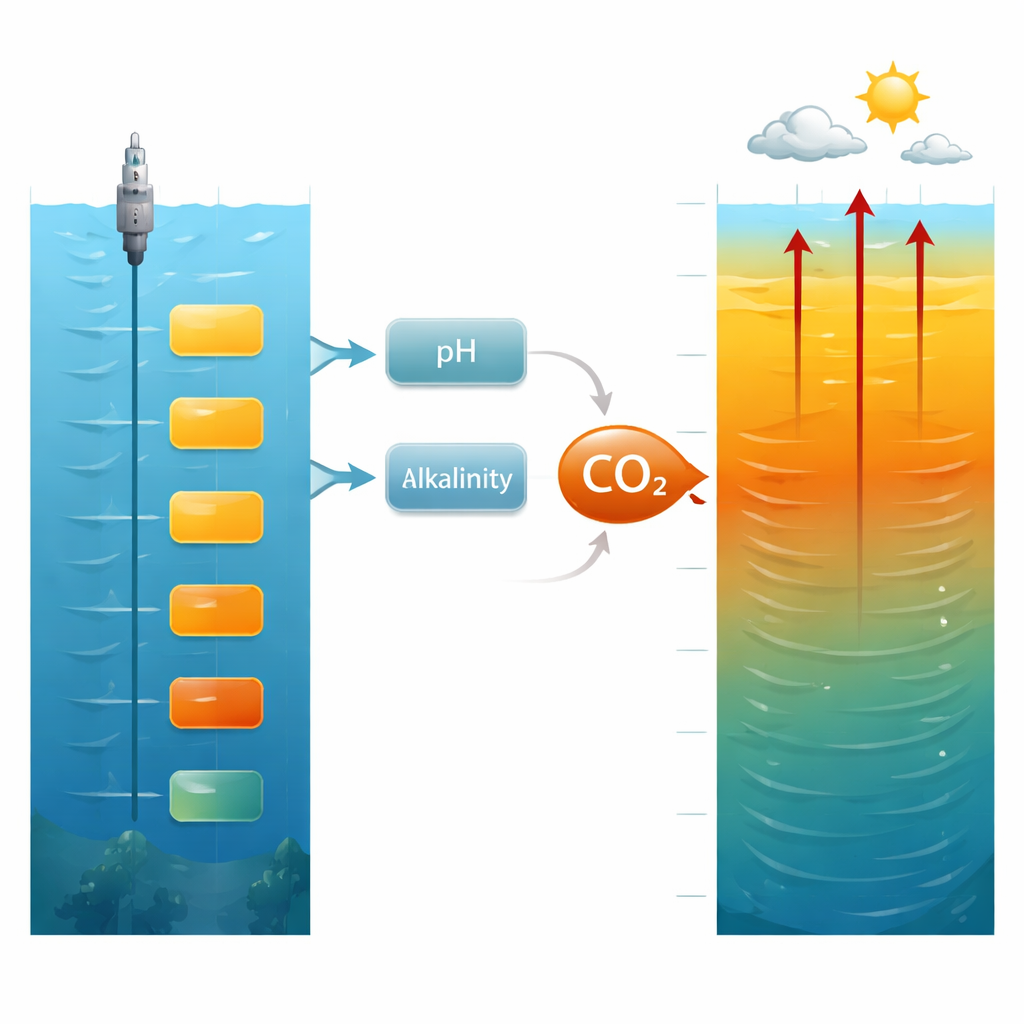
Biogeochemical Argo floats are free‑drifting instruments that dive from the surface down to about 2,000 meters every few days, measuring temperature, salt, oxygen, nutrients, and pH. In the Southern Ocean, large arrays of these floats now provide far more frequent measurements than ships ever could. From pH and an estimated value of another chemical property called alkalinity, scientists compute the partial pressure of CO2 (pCO2) in seawater, which is then used to estimate the exchange of CO2 between the ocean and the air. Surprisingly, float‑based calculations have suggested that the Southern Ocean is releasing CO2 overall, contradicting ship and aircraft measurements that point to it being a net absorber of carbon.
Comparing robots with ships in old deep waters
To find out whether the floats or the traditional observations are at fault, the authors compared float profiles with high‑quality ship data from the Global Ocean Data Analysis Project. Crucially, they focused first on deep water masses that have been isolated from the atmosphere since before industrial times and therefore contain very little human‑added carbon. In these “old” waters, any difference between the float and ship measurements should mainly reflect instrument bias rather than real environmental change. The comparison showed that float and ship readings match closely for temperature, salinity, oxygen, nitrate, and alkalinity, but not for the carbon system: float pH is on average about 0.021 units lower than ship pH, and float‑derived pCO2 is about 20 microatmospheres higher.
Bias from top to bottom, not just at the surface
By grouping data into depth bands, the study found that these discrepancies are present through much of the water column, especially between 200 and 1,500 meters, and only shrink in the deepest layers. Because the floats’ pCO2 values are calculated from pH and alkalinity, and because alkalinity agrees well between floats and ships, the most likely culprit is a systematic offset in the pH sensor measurements and in how they are corrected. Current processing assumes that a single adjustment determined at about 1,500 meters applies equally at all depths. The depth‑dependent pattern of the mismatch suggests that this one‑point approach is not always valid: the correction appears to work reasonably well below 1,500 meters but leaves a sizeable residual error higher up in the water column.
How surface errors distort carbon flux estimates
Since air–sea CO2 exchange depends directly on surface pCO2, the authors then quantified the bias right at the ocean’s skin. Using a combined analysis of CO2 and oxygen departures from their equilibrium values, they estimated that float‑derived surface pCO2 is biased high by about 14 microatmospheres. An independent comparison with a global surface CO2 product based on ship and other direct measurements gave a very similar answer, about 17 microatmospheres. Together, these lines of evidence point to a mean surface bias of 15±3 microatmospheres across hundreds of Southern Ocean float profiles—substantially larger than previously assumed. Statistical tests show that this offset cannot be explained by random measurement error, seasonal changes, or long‑term acidification trends.
What this means for our picture of the Southern Ocean
If the floats’ surface pCO2 values are systematically too high, previous studies have made the Southern Ocean look less of a carbon sink than it really is. Using published relationships between pCO2 bias and carbon flux, the authors estimate that correcting this error would flip float‑based estimates from a net release of CO2 to a net uptake, bringing them much closer to ship and aircraft assessments. In other words, rather than failing us, the Southern Ocean may be absorbing substantially more human‑produced CO2 than some float analyses have suggested. The study concludes that more sophisticated, depth‑aware calibration of float pH data—anchored by continued high‑quality ship measurements—will be essential to fully exploit autonomous observing systems while keeping our global carbon budget on solid footing.
Citation: Zhang, C., Wu, Y., Brown, P.J. et al. A systematic bias in float pH leads to overestimation of derived pCO2 and underestimation of carbon uptake by the Southern Ocean. Sci Rep 16, 13929 (2026). https://doi.org/10.1038/s41598-026-43863-4
Keywords: Southern Ocean carbon sink, ocean pH bias, biogeochemical Argo floats, air–sea CO2 flux, ocean carbon cycle