Clear Sky Science · en
Bandwidth broadening in cavity-type sound-absorbing metamaterials via additional equivalent stiffness
Why quieter spaces at low pitch matter
Many of the noises that bother us most—rumbling traffic, aircraft flyovers, or the throb of heavy machinery—live in the low-pitch range below about 500 hertz. These sounds travel far, pass easily through walls, and are hard to block without using thick, bulky materials. The paper summarized here reports a new way to build thin wall panels that can soak up a wide span of low-frequency noise more efficiently, opening possibilities for quieter homes, vehicles, and workspaces without sacrificing precious space.
Limits of today’s noise-absorbing panels
Conventional sound-absorbing panels often rely on hidden air-filled “cavities” and tiny holes or channels that convert sound energy into heat. Each cavity behaves a bit like a musical instrument tuned to a single note: it works very well at one frequency and less well elsewhere. To widen the useful range, engineers usually add more cavities of different sizes or combine them with porous materials. But there is a catch. The working frequency is tightly tied to each cavity’s volume and to the fact that its walls behave as perfectly rigid barriers. As a result, gaining more low-frequency “notes” typically demands larger or more numerous cavities, which conflicts with the desire for compact panels.
Turning rigid walls into smart gates
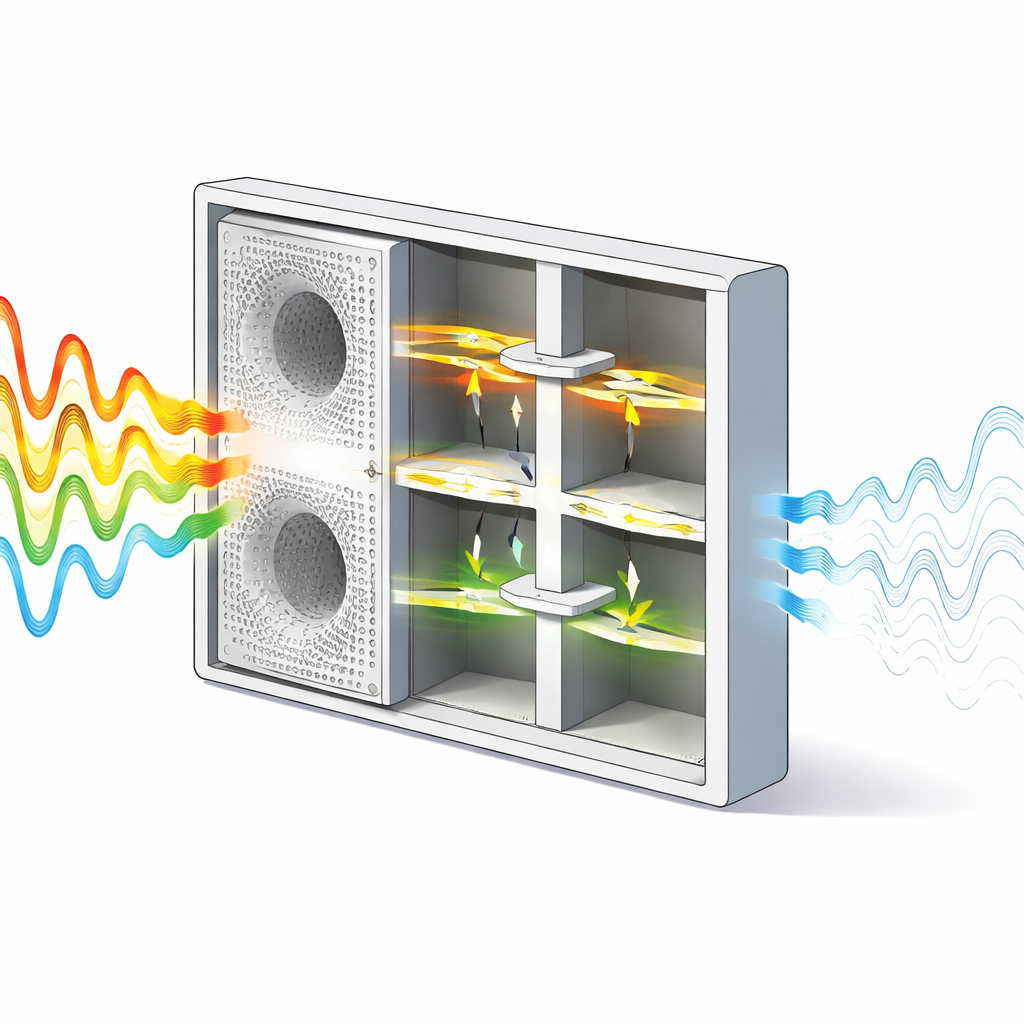
The authors show that the real bottleneck is not the cavities themselves, but the rigid rule imposed by their walls: they either fully trap sound or fully ignore it, with no room for flexibility. To break this constraint, they propose replacing some rigid walls with what they call band-pass acoustic valves—thin metal plates bearing small weights. These valves act like smart gates that remain effectively closed to most frequencies but open within chosen frequency bands, allowing sound to pass between neighboring cavities only in those bands. When the gate is closed, each cavity behaves as a separate resonator. When it opens, the cavities merge into a larger combined space with different “springiness,” creating a new way for sound to be absorbed without changing the overall panel size.
How extra “spring” broadens the quiet zone
Using mathematical models and computer simulations, the team describes this behavior as adding “equivalent stiffness” to the system—similar to inserting adjustable springs that change how easily air in the cavities can move. By carefully choosing the frequency range where the valve opens, they can turn a region that previously reflected sound (an anti-resonance gap between two absorption peaks) into a new absorption band. In tests with two adjacent cavities backed by micro-perforated plates, switching from a fully rigid divider to a valve-like boundary increased the number of strong absorption peaks from two to three, all at low frequencies, and raised the overall absorption by about 20 percent.
Designing better acoustic valves
The basic valve is a thin steel plate with a small lead mass attached. Because such a plate naturally vibrates only in narrow frequency bands, the authors systematically tune its geometry—plate thickness, mass size, and placement—to set where and how strongly it opens. They explore adding several valves in parallel and even shaping the masses asymmetrically so that a single valve produces two distinct pass bands. This strategy generates multiple extra absorption peaks between the original ones, effectively chopping the low-frequency range into sub-bands that the same compact panel can handle. At the same time, they discover trade-offs: too many valves or plates that are too flexible begin to leak sound where the walls are supposed to stay stiff, degrading the original absorption peaks.
From theory to a working sample
To prove the idea in practice, the researchers build a 70-millimeter-thick test sample containing two unit cells and two optimized valves, fabricated with 3D-printed frames, thin steel plates, and lead blocks. Measurements in an acoustic waveguide using precision microphones show six distinct absorption peaks between 200 and 800 hertz—two inherited from the original cavities and four created by the valves. Compared with a traditional design of the same thickness, the average absorption in this band rises by about 41 percent and, most notably, the usable bandwidth widens by 65 percent, confirming that the added “smart” stiffness successfully unlocks broadband low-frequency performance without enlarging the device.
What this means for everyday noise control
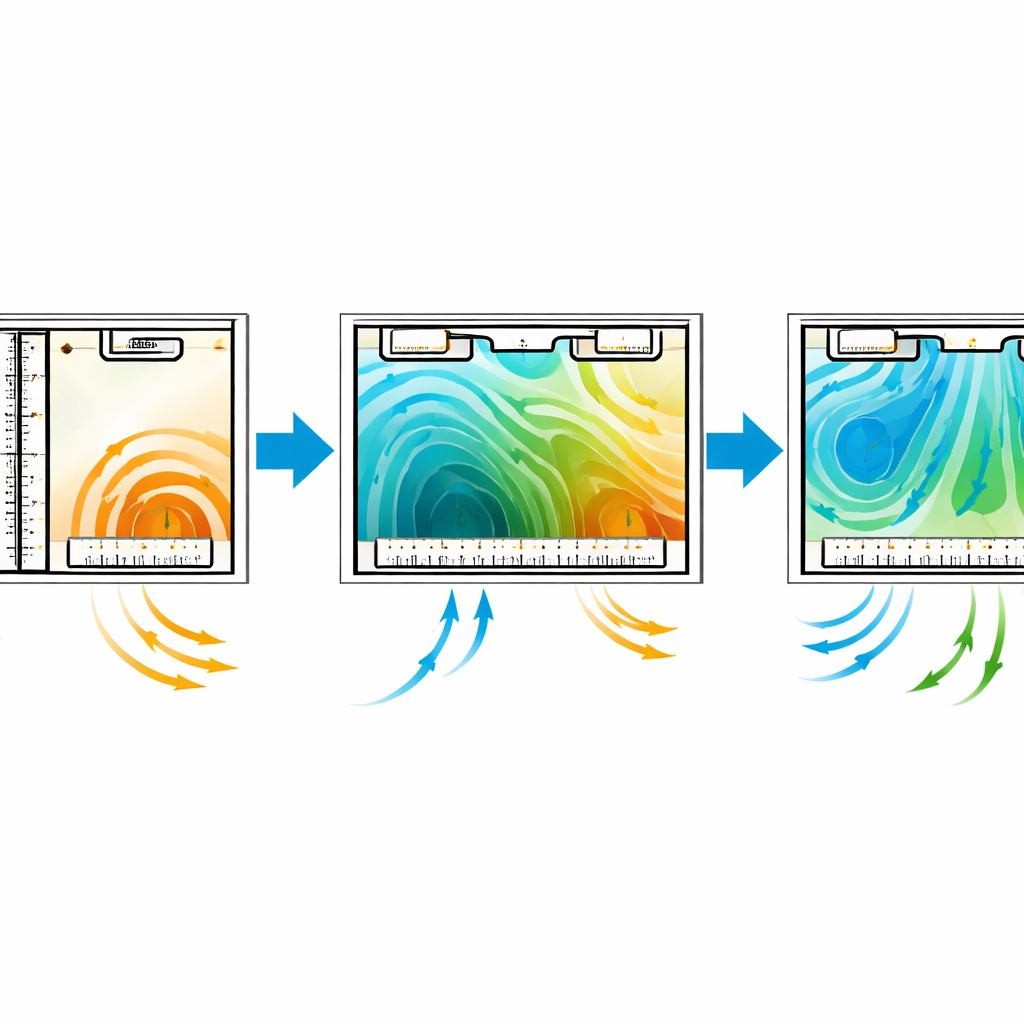
In accessible terms, this work turns a set of rigid, single-note sound traps into a compact, multi-note “equalizer” for low-pitch noise. By letting cavity walls selectively connect and disconnect with frequency, the panel can target several troublesome bass ranges at once while staying thin. Such technology could help tame the roar of engines in aircraft cabins, smooth out the rumble inside cars and trains, and improve acoustic comfort in buildings where space is limited. More broadly, it shows how cleverly engineered motion of internal parts can give otherwise simple structures far more flexible acoustic behavior.
Citation: Wang, L.B., Wu, J.H. & Zhang, J.F. Bandwidth broadening in cavity-type sound-absorbing metamaterials via additional equivalent stiffness. Sci Rep 16, 13187 (2026). https://doi.org/10.1038/s41598-026-43861-6
Keywords: acoustic metamaterials, low-frequency noise, sound absorption, band-pass acoustic valve, noise control