Clear Sky Science · en
Tennis training enhances blindfolded navigation in children and adults
Why this matters for everyday life
Walking through a dark hallway to your bedroom, or navigating your house during a power outage, depends on your brain’s ability to turn what you saw a moment ago into a safe, accurate path—even when you can’t see. This study asks a surprisingly practical question: can playing a fast-paced sport like tennis sharpen that ability, not just on the court but in completely different situations, such as walking blindfolded to a remembered spot? The answer sheds light on how sports shape the growing brain and offers clues for how schools and parents might boost children’s spatial skills through play.
How the study put navigation to the test
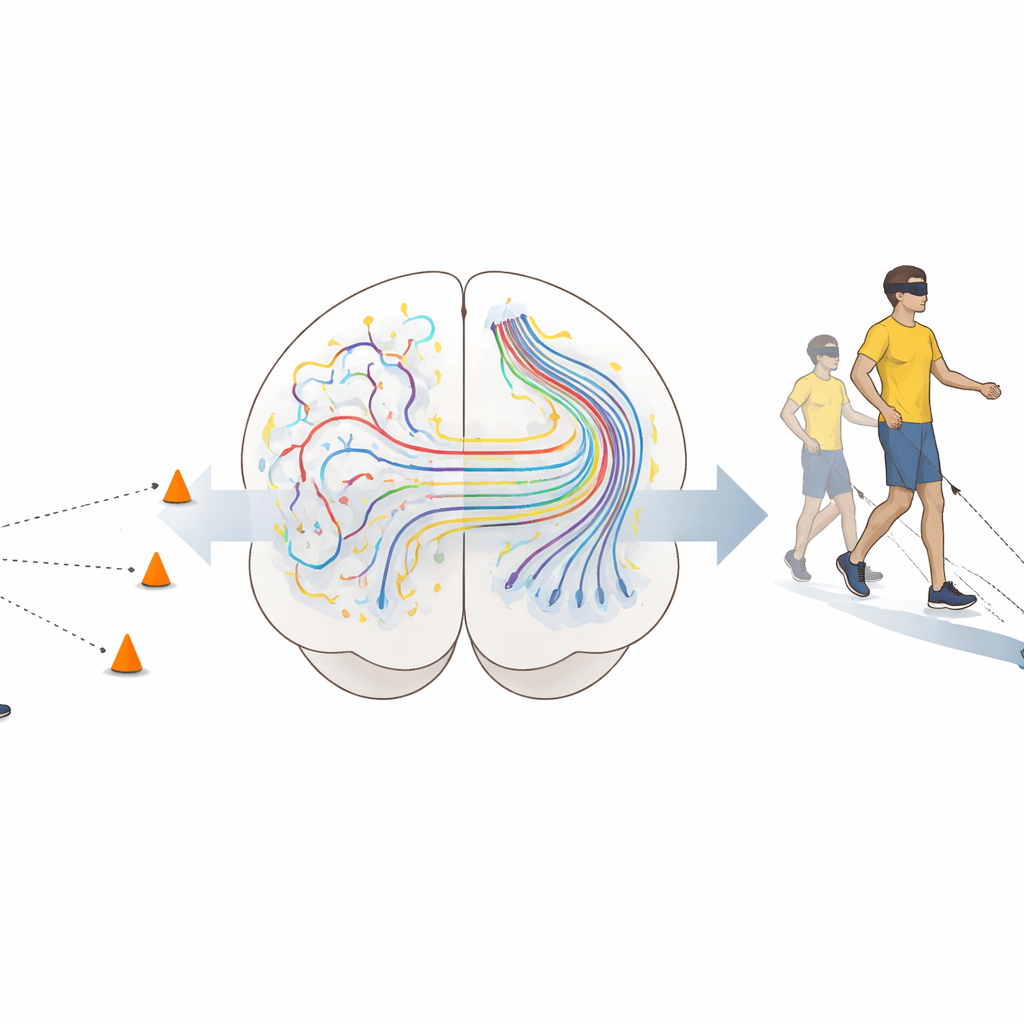
The researchers recruited school-age children and young adults, some of whom had years of systematic tennis training and others who were active but did not specialize in ball sports. Everyone performed a “blind walking” task. First, participants briefly looked at a small cone placed at an unfamiliar distance down a long, empty corridor or beside a tennis court. The cone distances were chosen to be irregular—numbers like 3.15 or 6.85 meters—so that people could not rely on familiar markings from daily life. After a one-second glimpse, participants put on opaque goggles and attempted to walk straight to where they remembered the cone had been, guided only by their sense of body movement and balance.
Measuring accuracy and consistency
To understand performance, the team measured two kinds of error. One was bias: did people tend to stop too short or overshoot the target, on average? The other was noise: how large were their moment-to-moment deviations from the true distance, regardless of direction? The researchers also examined how tightly a person’s walked distances “scaled” with the actual target distances across trials—basically, whether longer targets reliably led to longer walks in a smooth, proportional way. This scaling measure reflects how well the brain’s internal map links what the eyes see to how far the body moves.
What tennis training changed in children and adults
Children, whether they played tennis or not, showed little overall bias: on average, they neither consistently undershot nor overshot the targets. But children with tennis training had noticeably smaller errors overall and a stronger match between walked and target distances. In simple terms, their blindfolded walks were less noisy and more precisely tuned to how far away the cone had been. Adults told a slightly different story. Both tennis-playing adults and non-players again showed little systematic bias, and their raw error sizes were similar. However, the tennis players’ walked distances still tracked target distances more faithfully. Even at randomly chosen, rarely experienced distances, their internal sense of “how far to go” aligned more consistently with reality—even though they were taller and thus, in principle, faced a harder perceptual problem.
What this reveals about the brain’s internal map
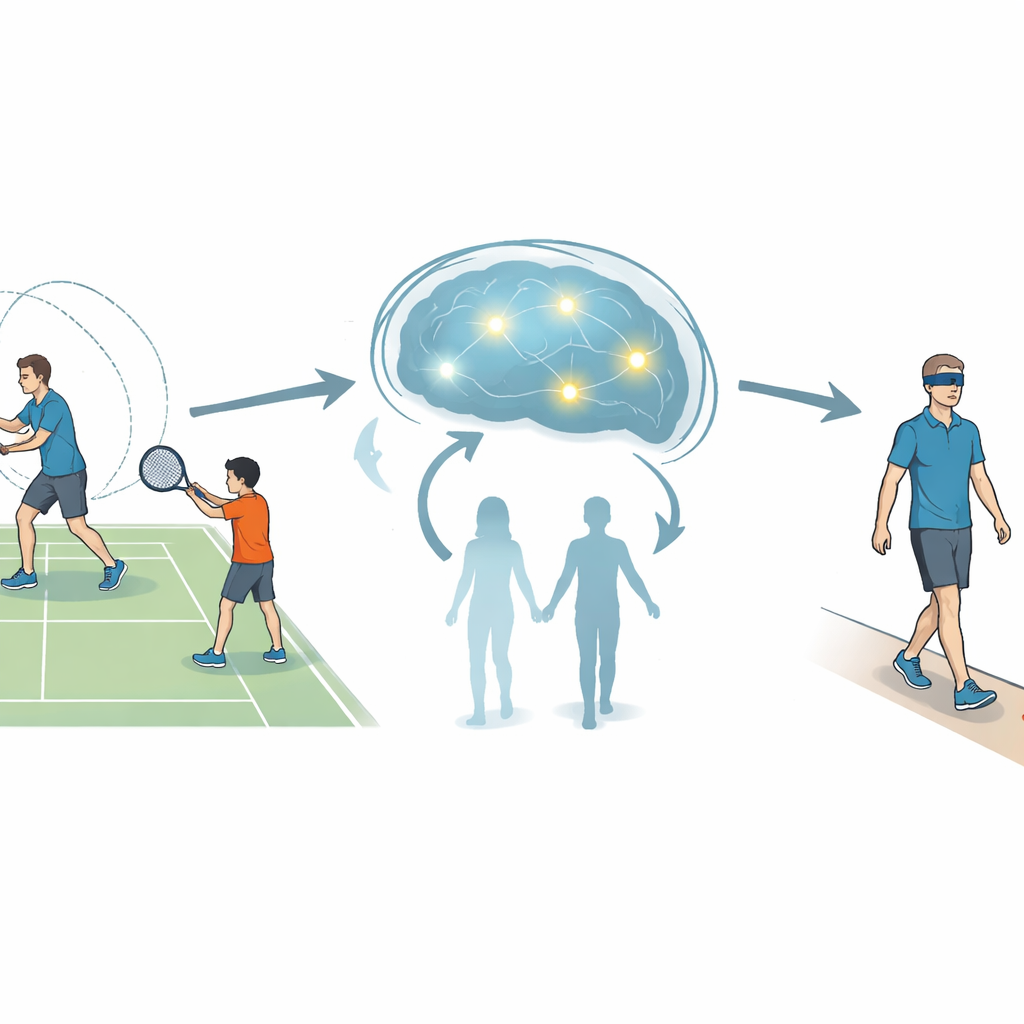
These patterns suggest that tennis does more than build sport-specific skills like swinging a racket. Tennis constantly demands that players judge where the ball will be and move their whole body into position, again and again, at many distances. The authors argue that this kind of training tunes a deeper internal model: the brain’s prediction system that links visual distance to the muscle commands needed to get there. In the blind walking task, that same predictive machinery is reused in a new context—no racket, no moving ball, and no visual feedback while walking—yet tennis-trained participants still perform better at matching distance to action. The effect was especially striking in children, whose sensorimotor systems are still maturing, suggesting that such sports may help stabilize noisy developing control systems.
Take-home message for daily life and education
In everyday language, the study’s conclusion is that learning tennis seems to make people better at “walking to where something was” after just seeing it briefly, even with their eyes covered and in places very different from a tennis court. This benefit appears in both children and adults, but in children it also reduces random variability, hinting at a stronger boost to development. While the work cannot fully separate training effects from natural talent—people are not randomly assigned to become tennis players—it supports the idea that sports requiring precise whole-body movements over varying distances can sharpen core navigation skills. That, in turn, suggests that carefully chosen field sports could serve as a powerful, engaging form of cognitive training in schools and youth programs.
Citation: Xing, D., Wang, J., Yan, X. et al. Tennis training enhances blindfolded navigation in children and adults. Sci Rep 16, 13619 (2026). https://doi.org/10.1038/s41598-026-43860-7
Keywords: tennis training, spatial navigation, sensorimotor integration, child development, sports and cognition