Clear Sky Science · en
Effect of copper rod length on the melting behavior of paraffin wax in hemispherical latent heat storage units
Why a Simple Metal Rod Matters for Clean Energy
As homes, electric cars, and gadgets lean more on renewable power, we need smart ways to store heat so it can be used when the sun isn’t shining or the wind isn’t blowing. This study asks a surprisingly simple question with big implications: if you place a single copper rod inside a small heat storage capsule filled with wax, how much faster can it soak up heat? The answer turns out to be: dramatically faster, and in a way that could make compact, low-cost thermal batteries far more practical.
Storing Heat in Melting Wax
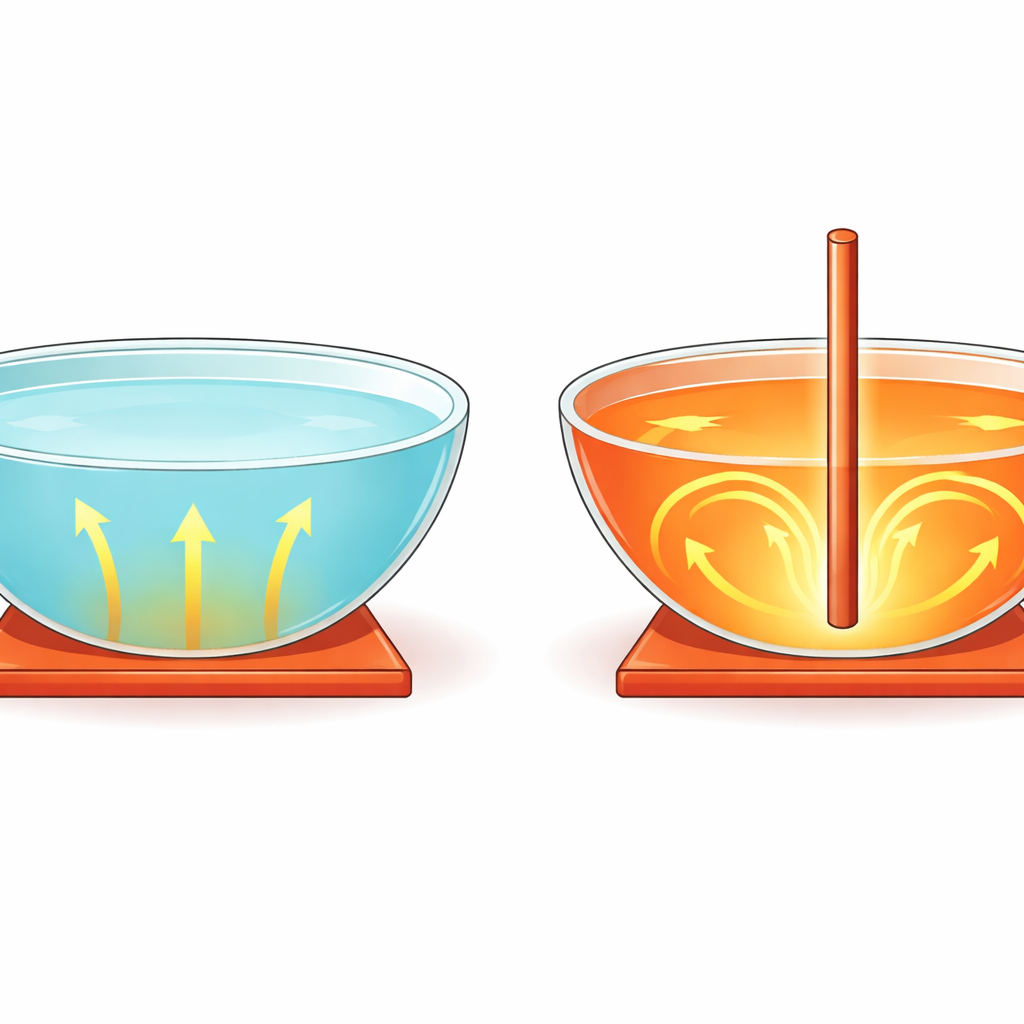
The work focuses on “latent heat” storage, where energy is stored when a material melts and released when it solidifies again—much like an ice pack that stays cold for a long time while the ice slowly turns to water. Here, the material is a common paraffin wax called RT42, kept inside a dome-shaped (hemispherical) metal shell about the size of a small bowl. The bottom of this shell is heated, while the curved top is insulated so heat can only enter from below. Systems like this can smooth temperature swings in buildings, protect batteries from overheating, or help balance the output of solar heaters.
The Problem of Slow Heat Uptake
Paraffin wax can store a lot of heat, but it’s a poor conductor of it—more like a blanket than a frying pan. When the flat bottom of the dome is heated, only a thin layer of wax near that surface melts at first. Because the melted wax doesn’t move very vigorously, heat creeps into the rest of the volume slowly. In the base design with no metal insert, the researchers’ computer simulations show it takes about 300 minutes, or five hours, to completely melt the wax. That sluggish response limits how quickly a real-world thermal storage unit could charge up during a burst of sunshine or waste heat.
A Single Copper Rod as a Heat Highway
Instead of adding complex metal fins or foams, the authors tested something much simpler: a single, thin vertical copper rod attached to the hot bottom wall and extending up into the wax. Copper conducts heat roughly 2,000 times better than the wax, so the rod acts like a highway for thermal energy, carrying heat deep into the interior where it would otherwise arrive only slowly. Using detailed fluid and heat-flow simulations, they studied four cases: no rod, and rods of 10, 20, and 30 millimeters long, all inside the same 50-millimeter-radius dome.

How Rod Length Changes the Melt
The results show a clear trend: the longer the rod, the faster and more evenly the wax melts. With a 10 mm rod, the total melting time drops from 300 to 150 minutes—half the original time—because the rod quickly warms wax near its length and triggers stronger circulating currents. A 20 mm rod cuts the melting time further to 120 minutes and produces a larger, more uniform melted zone. The biggest change appears with a 30 mm rod, which reaches more than halfway up the dome. In that case, the wax melts in just 90 minutes, a 70 percent reduction in charging time. The melted region spreads more evenly throughout the dome, and the simulated flow inside shows vigorous circulation loops that sweep heat through nearly the entire volume.
Design Clues for Future Heat Batteries
Beyond just reporting faster melting, the authors extract simple design rules. They find that the rod’s effectiveness mainly depends on how far it reaches into the dome relative to its size: in this setup, the sweet spot is when the rod length is about 50–60 percent of the dome’s radius. At that point, the rod not only conducts heat deeper but also strongly stirs the melted wax, turning a mostly sluggish system into one dominated by active circulation. Remarkably, the rod occupies less than three percent of the storage volume yet boosts the melting rate by more than 200 percent, meaning you get much quicker charging with almost no loss in storage capacity.
What This Means for Everyday Technology
For a non-specialist, the key message is that small, inexpensive changes in geometry can overcome one of the main drawbacks of wax-based heat storage: their tendency to charge slowly. A single thin copper rod, if sized correctly, can transform a simple wax-filled capsule into a far more responsive thermal battery. That insight could guide engineers designing compact systems to regulate building temperatures, protect batteries, or capture industrial waste heat. In short, this study shows that you don’t always need exotic materials or complicated structures—sometimes, one well-placed piece of metal is enough to unlock much better performance.
Citation: Khalaf, A.F., Rashid, F.L., Abdalrahem, M.K. et al. Effect of copper rod length on the melting behavior of paraffin wax in hemispherical latent heat storage units. Sci Rep 16, 13936 (2026). https://doi.org/10.1038/s41598-026-43858-1
Keywords: thermal energy storage, phase change materials, paraffin wax, heat transfer enhancement, copper inserts