Clear Sky Science · en
Service-oriented vulnerability assessment for the larger-scale high speed railway infrastructure network: a case in China
Why fast trains need smart backup plans
High-speed rail has become the backbone of long-distance travel in China, moving millions of people every day between major cities. But what happens when a snowstorm, flood, or other disruption suddenly shuts down a key rail line? This paper explores that question in a new way: instead of just looking at tracks and stations as dots and lines on a map, it asks how well the system can still move passengers to where they need to go when parts of the network fail.
Looking beyond the map
Traditional studies of rail safety often treat the network like a simple web of connections, focusing on which stations or links are most central in a purely geometric sense. However, experience has shown that the breakdown of a seemingly important junction does not always cause widespread chaos, while interruptions on less obvious sections sometimes have huge impacts. The authors argue that this is because the real mission of high-speed rail is not just to maintain connections on paper, but to reliably carry passengers. A truly useful vulnerability measure must therefore consider who is traveling, which trains they use, and what alternatives they have when trouble strikes.
Three layers of a living rail system
To capture this richer picture, the study builds a three-layer model of China’s high-speed rail. The first layer is the physical network: the actual stations and rail lines spread across the country. The second is the functional network, which shows how scheduled trains run over those tracks; here, each line is weighted by how many trains use it and how routes are stitched together between cities. The third is the demand network, which estimates how many passengers board each train at each station using only public timetable information. Together, these layers allow the researchers to trace how a disruption on a specific rail segment affects trains, and in turn how those changes ripple through passenger flows.
Estimating people without seeing every ticket
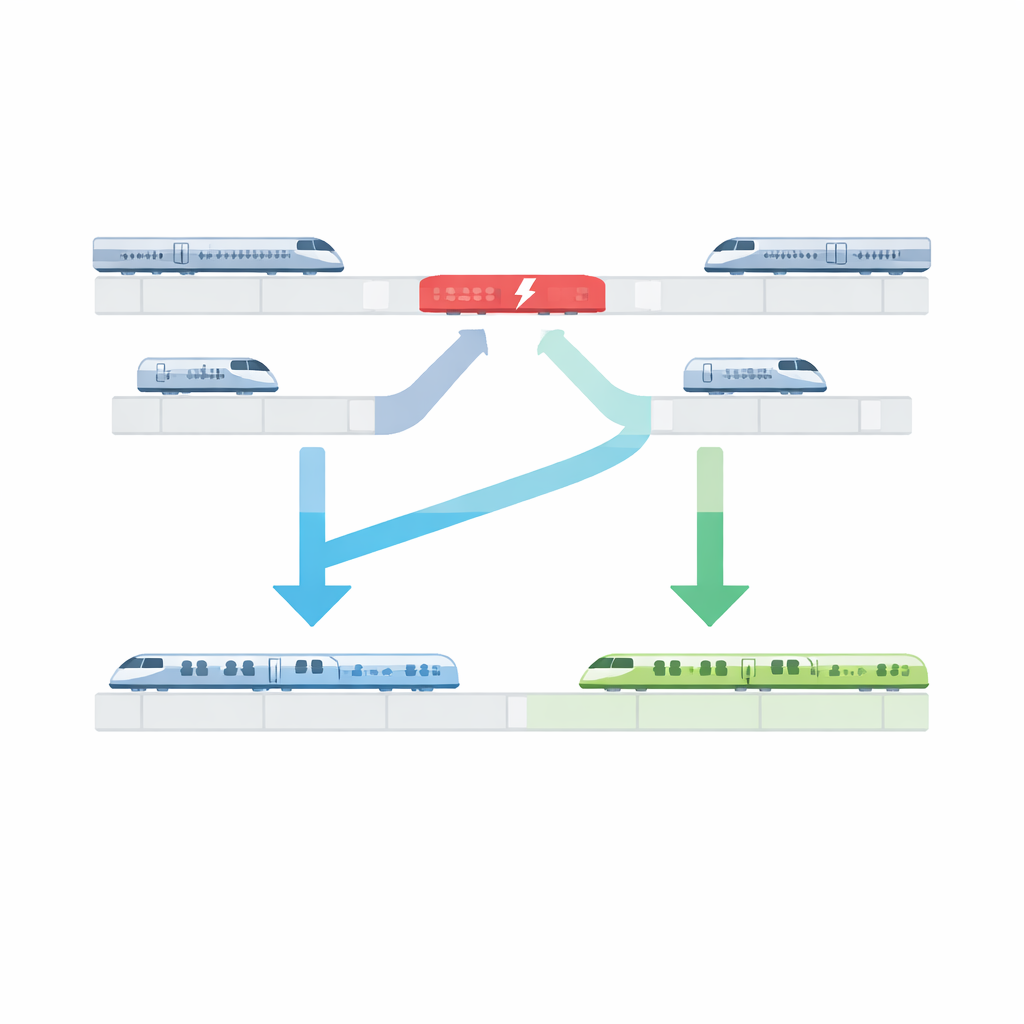
Because detailed ticket data in China are confidential, the authors design a clever way to infer demand from the official timetable. They assume that train capacity is mostly fixed and that the number of trains stopping at a station reflects how many people want to travel there. Using rules that set minimum and maximum passenger loads and scale flows with stopping frequency, they produce a nationwide estimate of daily riders. This estimate turns out to be very close—within about 2 percent—to official statistics, and it also matches known figures for major hubs like Guangzhou. With this demand picture in hand, they then simulate line failures and apply a transfer strategy that lets affected passengers try to continue their trip using direct or one-transfer alternatives, while carefully tracking how many can be successfully rerouted.
Where the network is most fragile
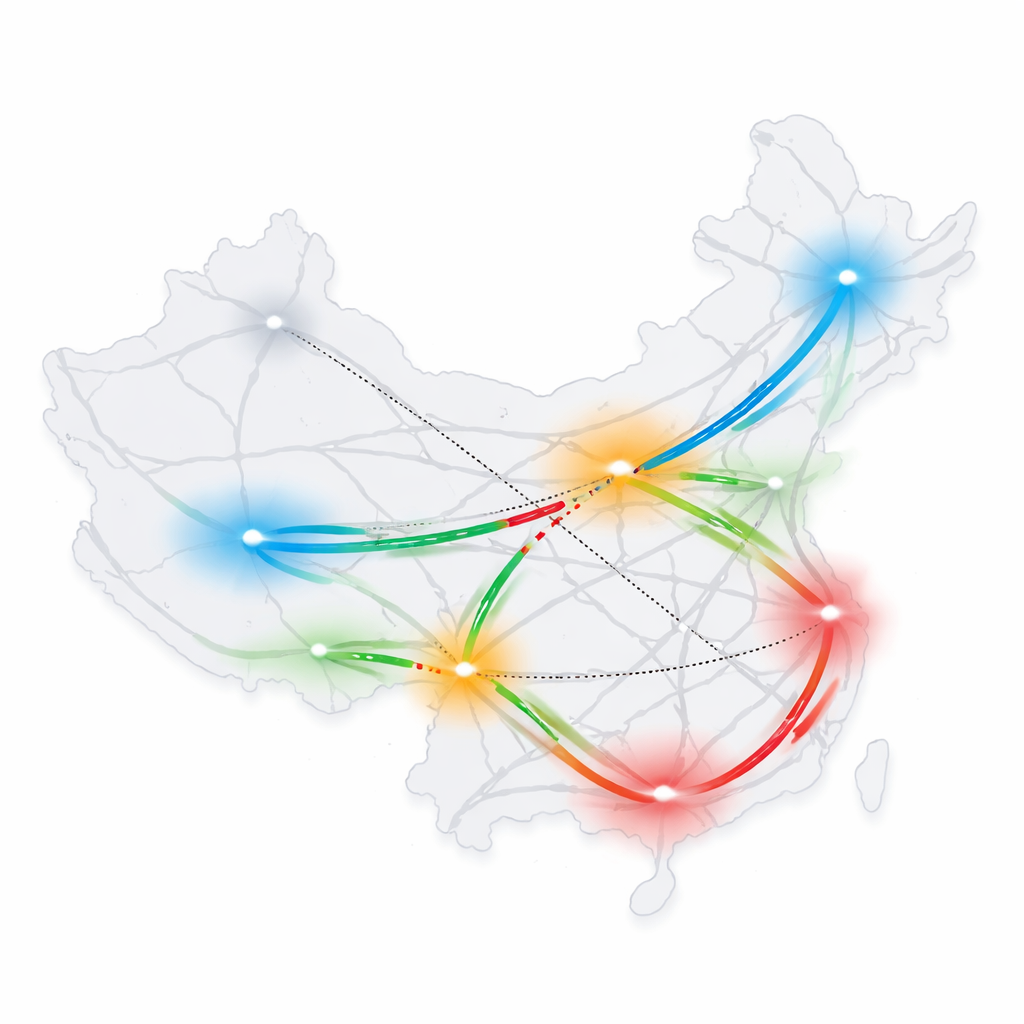
When the model is applied to the entire Chinese high-speed rail system, an uneven pattern of risk emerges. Overall, the network is strongly connected and often able to absorb disruptions by shifting passengers to other trains and routes. Yet a small number of busy corridors carry a disproportionate share of national traffic and prove far more vulnerable. Short but heavily used sections such as Guangzhou–Dongguan–Shenzhen, along with major north–south and east–west trunks linking Beijing, Shanghai, Zhengzhou, Wuhan, and Chengdu–Chongqing, cause large losses in passenger-carrying capacity when disrupted, even after all reasonable transfer options are used. In contrast, many peripheral lines with lower demand have little impact on the system as a whole when they fail. A detailed case study of the Dezhou–Jinan section on the Beijing–Shanghai line shows how a single overloaded link, with hundreds of trains and limited backup routes, can become a critical weak point.
What this means for travelers and planners
The authors conclude that vulnerability in a modern high-speed rail system is best understood as a question of service: how many people can still complete their trips when something goes wrong. By combining infrastructure, timetables, and estimated passenger flows in one integrated model, they show that China’s network is generally robust but highly dependent on a few core corridors that need special attention. For a lay reader, the takeaway is straightforward: keeping fast trains reliable is not only about building more tracks, but about knowing where passengers are concentrated, planning realistic backup routes, and, in some cases, adding parallel lines to relieve overworked sections. This service-oriented view offers transport planners a practical tool for prioritizing upgrades and emergency plans that protect what matters most—the journeys of millions of daily riders.
Citation: Zhang, H., Xing, H., Ma, X. et al. Service-oriented vulnerability assessment for the larger-scale high speed railway infrastructure network: a case in China. Sci Rep 16, 14268 (2026). https://doi.org/10.1038/s41598-026-43851-8
Keywords: high-speed rail, infrastructure risk, transport resilience, passenger demand, China railway