Clear Sky Science · en
Sustainable epoxy composites incorporating Aloe Vera and fly ash for bio derived reinforcement and circular economy advancement
Turning Waste into Useful Materials
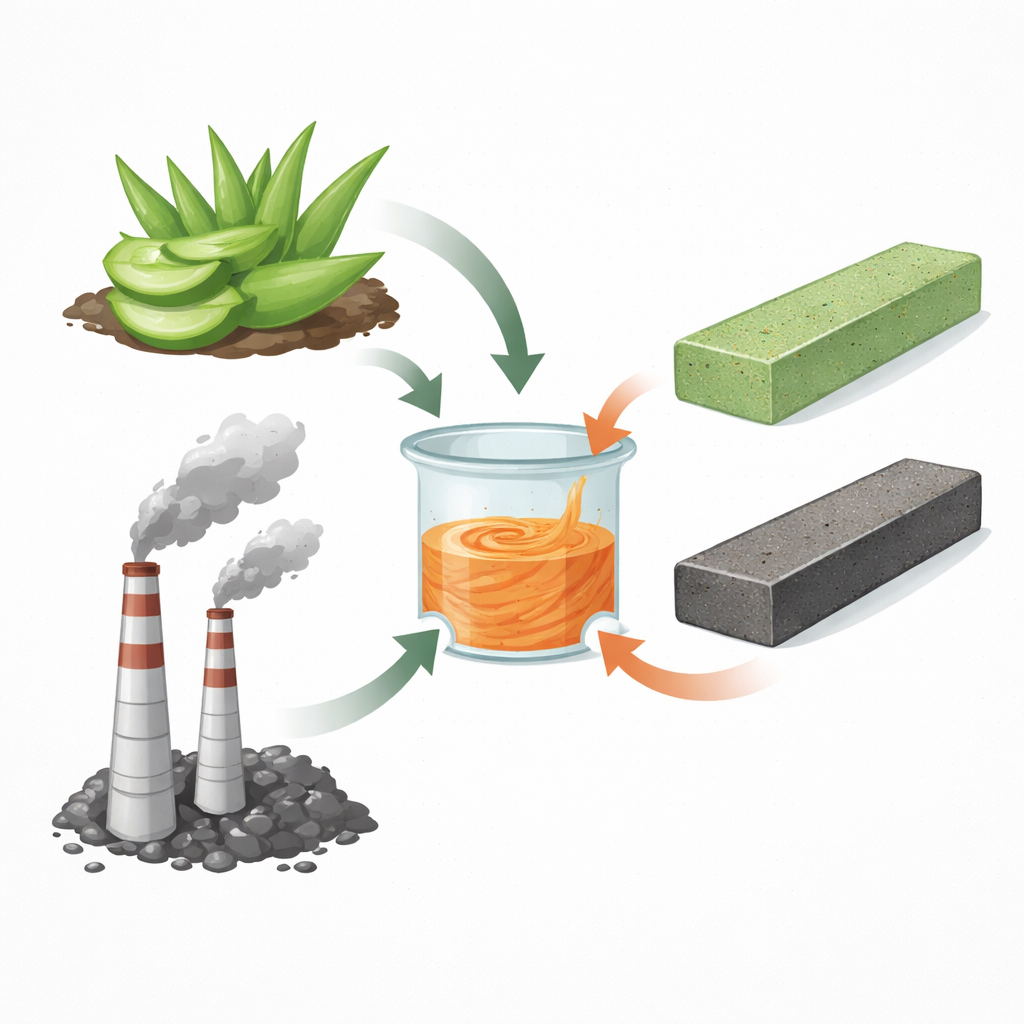
Imagine if the leaves from an Aloe Vera plant and the dusty ash from a coal power station could be turned into strong, durable materials instead of being thrown away. This study explores exactly that idea. The researchers show how two very different waste products—Aloe Vera leaf powder and fly ash—can be blended into a common plastic called epoxy to create tough, lightweight composites. These new materials are designed not just to perform well, but also to support a more circular economy, where wastes are reused instead of landfilled.
Why Aloe Plants and Power-Plant Ash Matter
Aloe Vera and fly ash may seem like an odd couple, but together they tackle two major waste streams. In countries like India, hundreds of millions of tons of crop leftovers and coal ash are produced every year, often burned or dumped, harming air, soil, and water. Aloe Vera leaves contain natural fibers and minerals that can help a plastic grip and carry loads. Fly ash, the fine gray powder left after burning coal, is rich in hard, rock-like particles of silica and alumina that can make materials stiffer and more resistant to wear. By finding ways to mix each of these into epoxy resin, the team aims to show that agricultural and industrial discards can become ingredients for high-value products.
How the New Composites Were Made
The researchers first processed fresh Aloe Vera leaves by washing, drying, grinding, and then treating the powder in an alkaline bath to clean the surface and help it bond to epoxy. Fly ash was collected from a coal-fired power plant and characterized to confirm its mineral makeup. Both fillers were sieved into two size ranges—finer particles about half the width of a human hair, and somewhat coarser ones. The powders were then mixed into liquid epoxy at several weight ratios, poured into molds, and cured in an oven at moderate temperature. This produced simple rectangular bars of material that could be pulled, pressed, and examined under microscopes to see how they behaved and how well the particles were distributed.
What the Tests Revealed About Strength and Stability
When the composite bars were stretched until they broke, both kinds of fillers gave clear gains over plain epoxy. Unreinforced epoxy had a tensile strength of about 24 megapascals, but adding Aloe Vera powder nearly doubled that value, reaching roughly 45 megapascals with the finer particles at a 30:70 filler-to-resin mix. Fly ash also boosted strength, up to around 41 megapascals. Hardness tests, which measure how easily a surface can be dented, showed that fly-ash-filled samples became especially rigid, climbing from a value of about 79 for plain epoxy to about 90 with higher ash content. Aloe Vera increased hardness too, but not as dramatically. Density and water uptake also shifted: the mineral-rich fly ash made the material heavier and less prone to swelling in water, while Aloe Vera made it lighter but more moisture-absorbing, thanks to its naturally water-loving structure.
Peeking Inside the Material
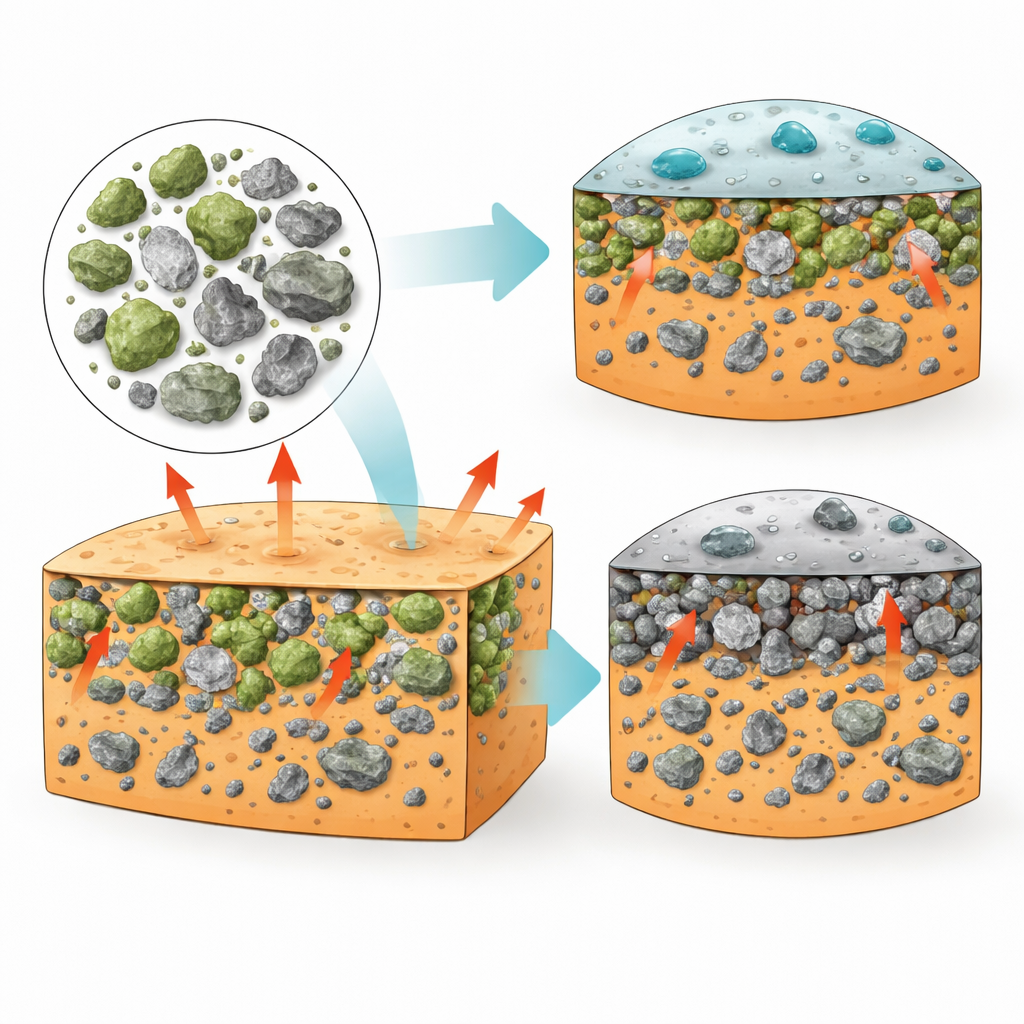
To understand why these changes occurred, the team examined the composites using tools that reveal structure at tiny scales. Infrared spectroscopy and X-ray diffraction confirmed that the Aloe Vera and fly ash particles were present and interacting with the epoxy, while electron microscope images showed how well they were dispersed. Finer particles, whether plant-based or mineral, tended to spread more evenly, creating a more continuous path for forces to travel through the material and reducing weak spots such as voids or clumps. This microscopic view agreed with the mechanical tests: better distribution and tighter bonding at the interfaces led to stronger and harder composites.
What This Means for Greener Products
In plain terms, the study shows that ground Aloe Vera leaves and fly ash—both often treated as nuisances—can be turned into useful building blocks for strong, durable plastics. Aloe Vera fillers help make lighter, tougher materials, while fly ash boosts hardness and dimensional stability, especially where moisture is a concern. Although the base epoxy is still a petroleum-derived plastic, replacing part of it with waste-derived powders cuts the need for new raw material and keeps waste out of landfills. With further work to swap in greener resins and to test long-term durability, this dual-waste approach could support future products in transport, construction, and other fields that demand materials that are not only strong, but also more responsible to the planet.
Citation: Bhowmik, A., Sen, B., Kumar, R. et al. Sustainable epoxy composites incorporating Aloe Vera and fly ash for bio derived reinforcement and circular economy advancement. Sci Rep 16, 13664 (2026). https://doi.org/10.1038/s41598-026-43850-9
Keywords: sustainable composites, Aloe Vera filler, fly ash epoxy, circular economy, waste valorization