Clear Sky Science · en
Probabilistic OPF and LFC of conventional with RES, energy storage and FACTS using DTBO
Keeping the Lights Steady in a Changing Power Grid
As wind turbines and solar panels replace coal and gas plants, keeping the power grid stable becomes much harder. This study explores how to run large power networks so that electricity stays affordable, clean, and, crucially, at the right frequency to protect our appliances and infrastructure. Using detailed computer models, the authors show how combining renewable energy, advanced storage, and smart grid devices can cut both fuel costs and pollution while still keeping the system steady.
Why Grid Frequency Matters to Everyday Life
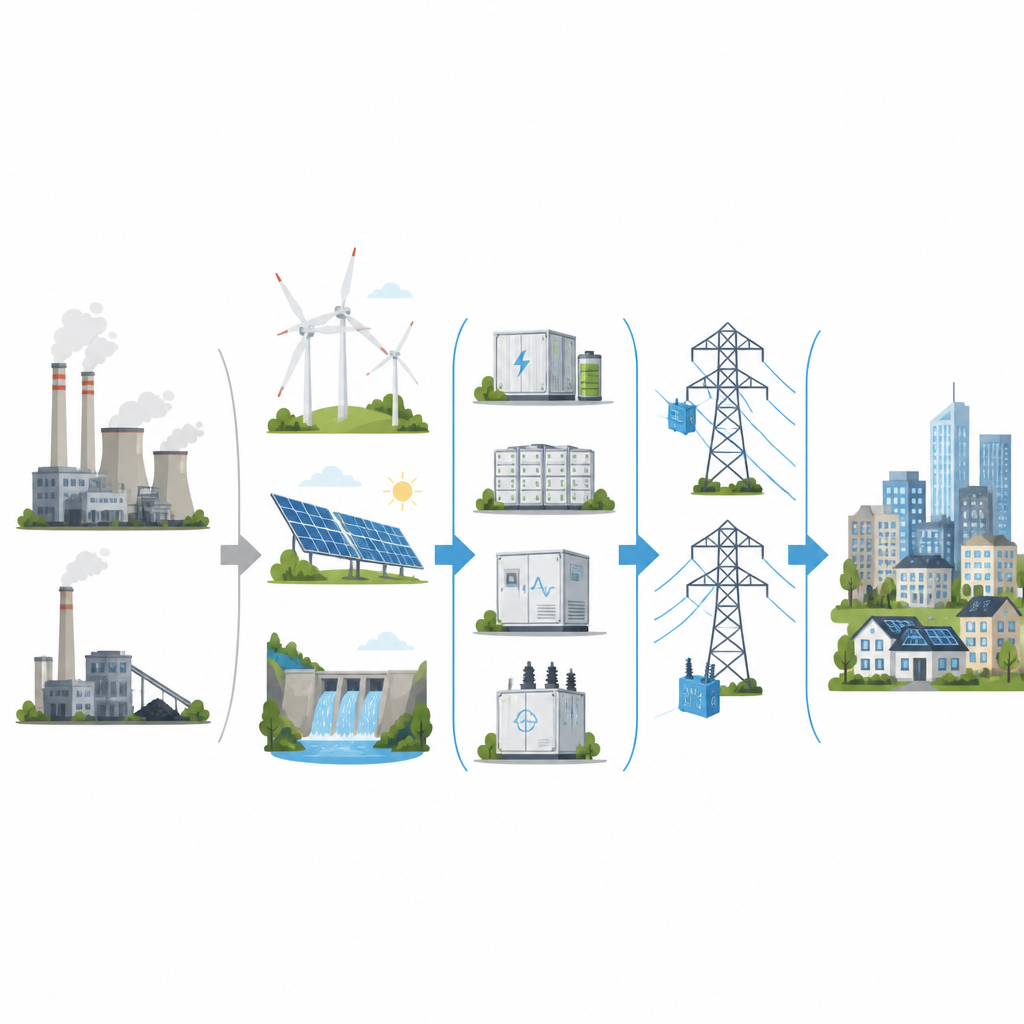
Most people never think about grid frequency, the tiny rhythm (for example, 50 hertz) that keeps motors, transformers, and clocks in sync. But when power plants ramp up and down, or when clouds pass over solar farms, this rhythm can wobble. Traditionally, heavy spinning machines in thermal power stations acted like flywheels and smoothed out these changes. As more renewables come online, that built-in steadiness shrinks, making sharp frequency swings more likely. The authors argue that planning power flows must now include frequency security alongside cost and emission targets, or risk a more fragile grid.
Mixing Old Plants with New Clean Sources
The researchers focus on two standard test networks, known as the IEEE 57-bus and 118-bus systems, which mimic real transmission grids. They start with conventional thermal generators, then gradually add wind turbines, solar panels, and two forms of energy storage: a hydrogen-based aqua electrolyzer plus fuel cell and high-power ultra capacitors. They also include flexible transmission tools (FACTS devices) that can fine-tune how power flows through lines. Across many operating cases and load levels, they compute the "optimal power flow" that meets demand at minimum cost, respects equipment limits, and now also keeps frequency within a safe band.
Smart Devices that Steady the Flow
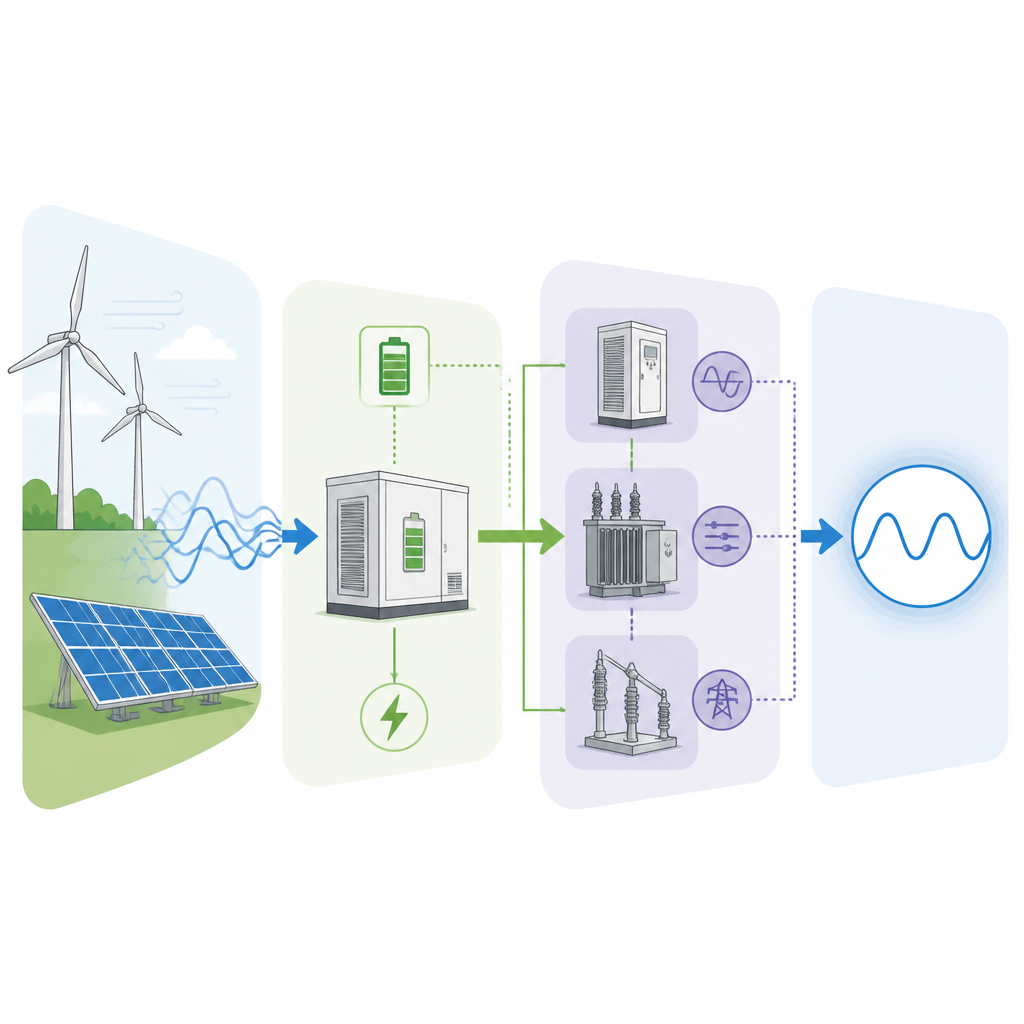
Key supporting actors in this story are the grid’s "shock absorbers." FACTS devices, such as series compensators, phase shifters, and static VAR compensators, can quickly adjust voltage and line loading, relieving bottlenecks and reducing losses. Energy storage adds another layer: hydrogen equipment stores surplus power for longer periods, while ultra capacitors respond almost instantly to sudden mismatches between supply and demand. On top of this hardware, the authors use an advanced frequency controller (a fractional-order PID, or FOPID) to respond more flexibly than a classic controller, damping out oscillations in both single-region and two-region interconnected grids, including cases that mimic deregulated power markets with multiple companies trading energy.
Training an Algorithm to Drive the Grid
To search for the best operating points in such a complex system, the study introduces a "driving training-based optimization" method. Inspired by how driving students learn from instructors and practice sessions, this algorithm alternates between broad exploration and focused fine-tuning. The authors compare its performance with two well-known methods, grey wolf optimization and biogeography-based optimization, across many scenarios. Statistical tests, including ANOVA and non-parametric rank tests, show that the new approach more consistently finds cheaper and cleaner operating solutions while satisfying all security limits.
Real Gains in Cost, Emissions, and Stability
Putting all pieces together, the combined strategy brings substantial improvements. Adding FACTS devices with frequency security cuts fuel cost by about 16.6 percent and emissions by nearly 35 percent compared with the baseline thermal system. When renewables and energy storage are also integrated, and the FOPID controller is used, fuel cost reductions reach about 36 percent and emissions fall by around 41 percent at moderate load levels, with similar gains at higher loads. Just as importantly, the size and duration of frequency deviations shrink markedly, meaning the grid can ride through disturbances more smoothly. For a lay reader, the message is clear: with the right mix of clean generation, fast-acting storage, controllable grid hardware, and smart optimization, it is possible to enjoy cheaper and cleaner electricity without sacrificing the reliability we depend on.
Citation: Roy, A., Dutta, S., Biswas, S. et al. Probabilistic OPF and LFC of conventional with RES, energy storage and FACTS using DTBO. Sci Rep 16, 15940 (2026). https://doi.org/10.1038/s41598-026-43847-4
Keywords: optimal power flow, frequency stability, renewable integration, energy storage, smart grid control