Clear Sky Science · en
Mutational analyses reveal PLP-independent functions at PipY, the cyanobacterial paradigm for pyridoxal-phosphate binding proteins
When A Vitamin Helper Protein Does More Than Expected
Vitamin B6 is famous for helping many enzymes do their jobs, but some of the proteins that hold onto its active form, pyridoxal phosphate (PLP), may also have hidden roles. This study looks at one such protein, called PipY, in photosynthetic bacteria and shows that it can influence cell growth and behavior in ways that do not always depend on carrying its vitamin cofactor. Because close human relatives of PipY are linked to a rare form of vitamin B6-dependent epilepsy, understanding these extra functions may eventually improve how we think about metabolic diseases in people.
A Conserved Protein With A Medical Connection
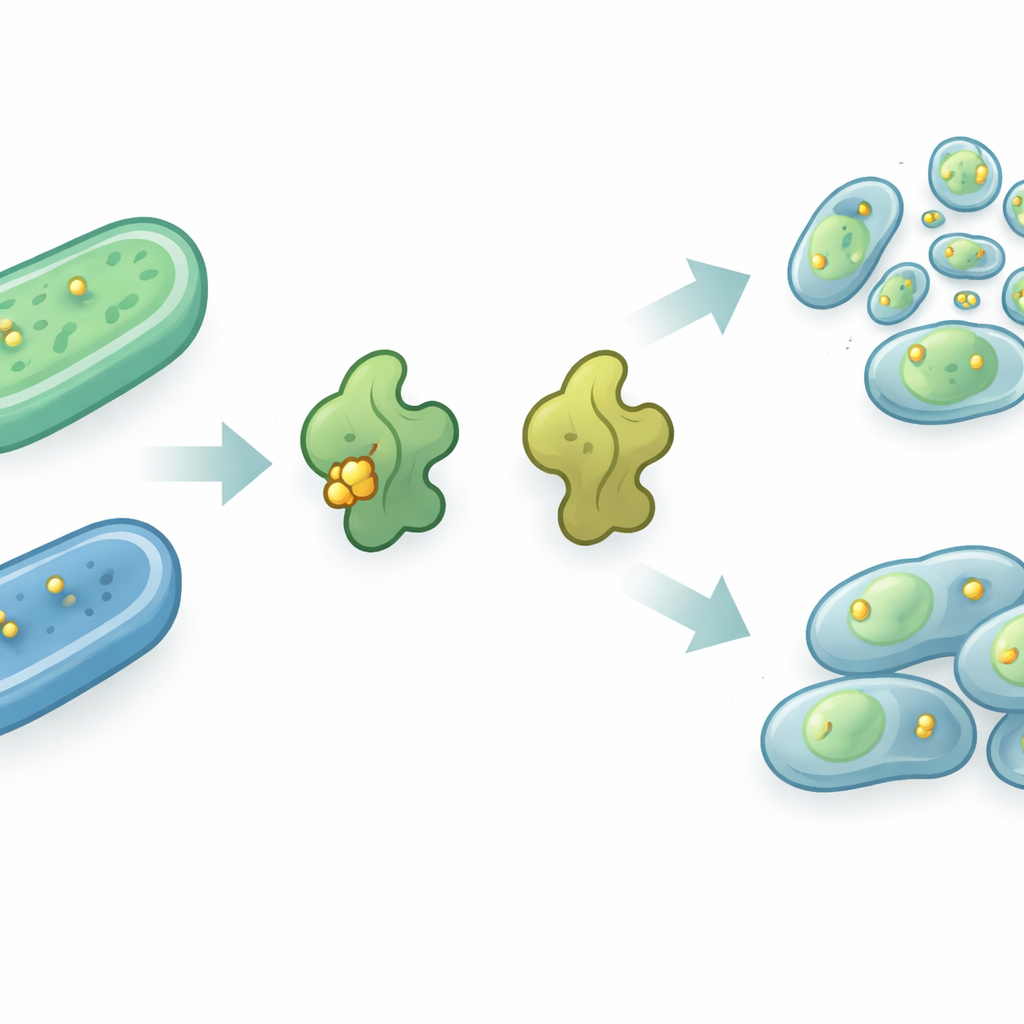
PipY belongs to a widespread family of PLP-binding proteins, found in bacteria, plants, and animals, including humans. These proteins help keep vitamin B6 and certain amino acids in balance, and mutations in the human version, known as PLPHP, can cause seizures that respond to vitamin B6 treatment. Curiously, even though these proteins always carry PLP in structural studies, no clear enzymatic activity has been found for them. Recent work instead points to a regulatory role, including the ability to bind RNA. In cyanobacteria, the authors’ chosen model organism Synechococcus elongatus, pipY sits next to and is co-expressed with another regulatory gene, pipX, hinting that PipY might plug into broader metabolic and gene-control networks.
Testing Disease-Like Mutations In Bacteria
The researchers focused on three precise changes in PipY: K26A, which blocks PLP from attaching; and P63L and R210Q, which mimic disease-causing mutations in the human PLPHP protein. They engineered cyanobacterial strains that overproduce either normal PipY or one of these variants, and also tested the same set of proteins in Escherichia coli. Overproducing normal PipY in Synechococcus is already known to halt growth, trigger bleaching of the photosynthetic pigments, lengthen cells, and cause the build-up of giant granules of polyphosphate, a phosphorus storage polymer. These dramatic changes make PipY a sensitive probe for how mutations alter its activity.
Surprising Effects Of Different Changes
The mutation that prevents PLP binding, K26A, abolished all of the overproduction effects in Synechococcus. Even though the mutant protein accumulated to high levels, the cells continued to grow normally, kept their green color, maintained normal cell size, and did not over-accumulate polyphosphate granules. In contrast, the P63L and R210Q variants behaved in the opposite way: even modest increases in their levels were strongly toxic. When the team tried to overexpress these two proteins in either Synechococcus or E. coli, very few or no colonies could be recovered, and in E. coli the colonies that did appear were small, especially for P63L. This shows that P63L and R210Q act as gain-of-function mutations that interfere with essential cellular processes in two very different bacterial species.
Clues About A Second, Cofactor-Free Role
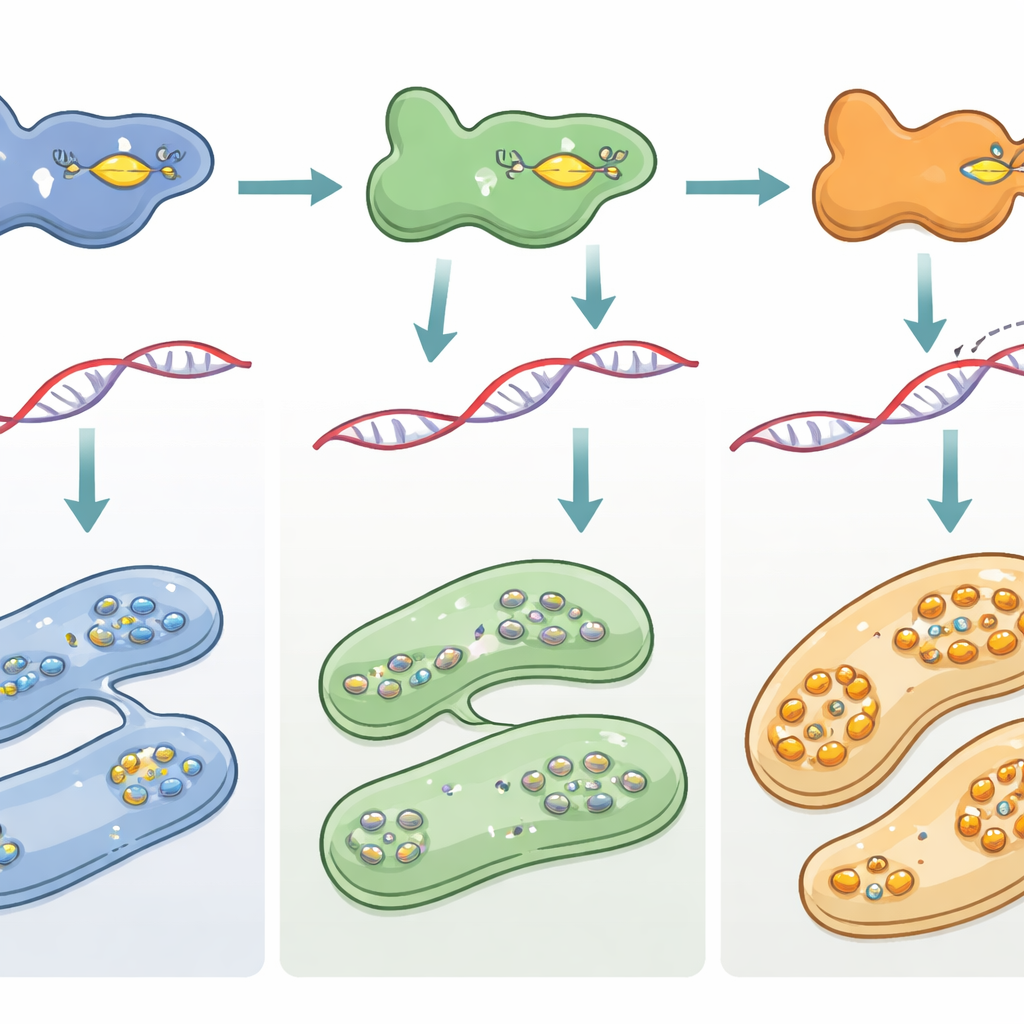
At first glance, one might assume that weakening PLP binding simply makes PipY less functional, yet K26A and R210Q give opposite outcomes: one removes toxicity, the other enhances it. Drawing on structural comparisons and computational predictions, the authors propose that PipY exists in two main shapes, a PLP-bound "holo" form and a PLP-free "apo" form, which expose different surfaces to the cell. Regions that hold PLP and regions predicted to contact RNA overlap, so losing PLP can open up an RNA-binding site. The data fit a model in which the holo form contributes to vitamin B6 balance, while the apo form, if present in excess and still structurally intact at key positions like Lys26, can bind RNA strongly and disrupt normal gene expression. According to this view, P63L and R210Q push PipY toward a toxic apo state, whereas K26A forces a non-toxic conformation with poor RNA affinity.
What This Means Beyond Bacteria
By carefully comparing these three mutations, the study argues that PipY—and by extension its relatives in other organisms—has significant PLP-independent regulatory functions, likely centered on RNA binding and control of gene activity. In cyanobacteria, these roles intersect with a partner protein, PipX, and influence processes like polyphosphate storage, which may help cells cope with changing nutrients. In humans, similar shifts between harmless and harmful forms of PLPHP could help explain why some mutations cause severe vitamin B6-dependent epilepsy while others do not. Overall, the work highlights that proteins best known as vitamin carriers can also act as subtle switches in cellular signaling, with consequences that ripple from bacteria to brain health.
Citation: Llop, A., Tremiño, L. & Contreras, A. Mutational analyses reveal PLP-independent functions at PipY, the cyanobacterial paradigm for pyridoxal-phosphate binding proteins. Sci Rep 16, 13255 (2026). https://doi.org/10.1038/s41598-026-43837-6
Keywords: vitamin B6, PipY, RNA-binding proteins, cyanobacteria, epilepsy-related mutations