Clear Sky Science · en
Filtration characteristics of coconut fiber filter used in emergency rescue of dike piping
Why coconut fibers matter for flood safety
When rivers rise during extreme storms, the earthen banks that hold them back—called dikes or levees—can fail from the inside out. Water can carve hidden tunnels through the sandy foundation, a process known as piping, and once it starts, collapse can follow in hours. This study explores a surprisingly simple, plant-based tool for last-minute protection: mats made from coconut fibers. The researchers ask whether these natural filters can quickly and safely stop escaping sand while still letting floodwater drain away, offering a cheaper, greener backup for aging flood defenses.
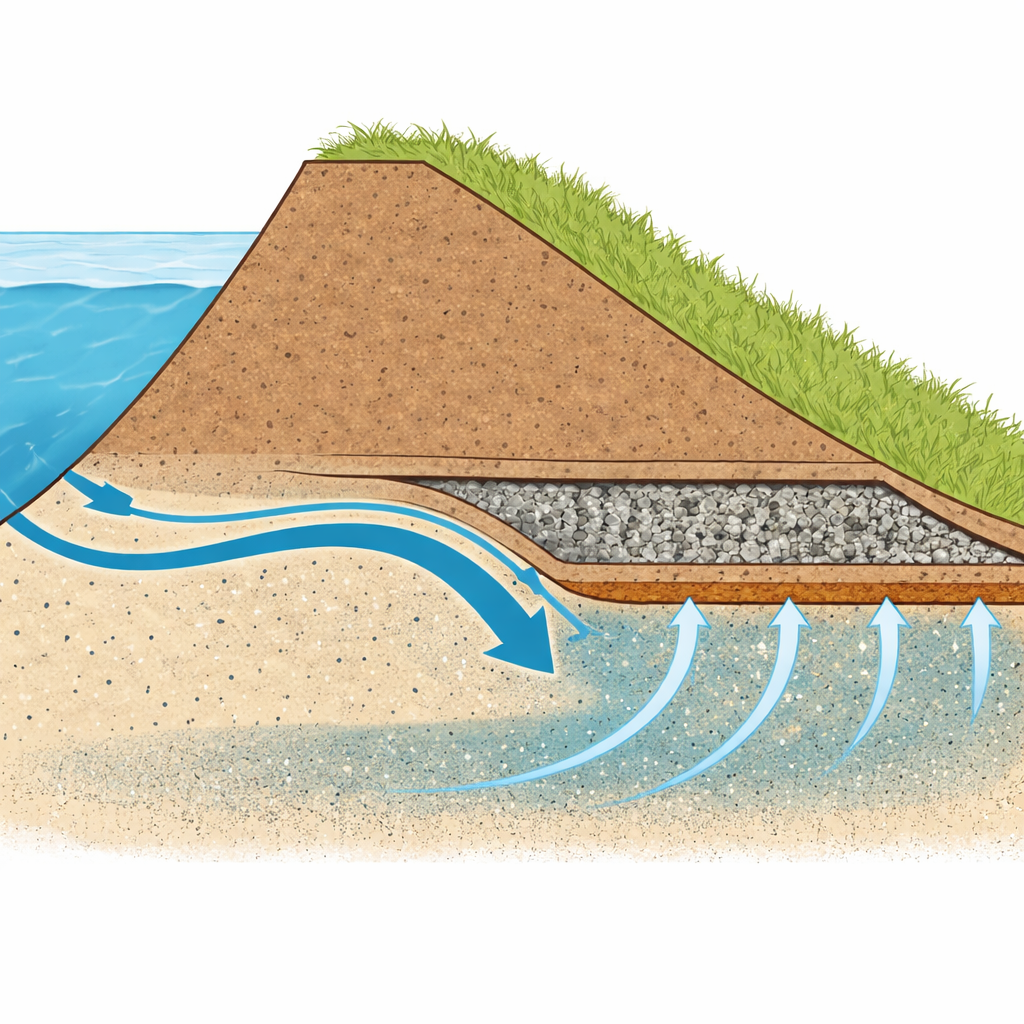
Hidden tunnels under river banks
Dikes protect towns, farms, and infrastructure along rivers, but they are vulnerable to damage that cannot be seen from the surface. When water pressure on the river side becomes high enough, seepage can break through weak spots in the downstream cover layer of the dike. Water then rushes upward through the sand below, pulling sand grains with it and slowly hollowing out a channel that crawls back toward the river. If emergency crews cannot quickly stabilize this process, the bank may suddenly give way. Traditional rescue methods pile sand and gravel over the outlet to build a temporary filter, but this approach is slow, costly, and relies on large amounts of quarried material that may not be readily available during a flood.
A natural mat as an emergency shield
To find a faster and more eco-friendly solution, the authors tested coconut fiber filters—thin, flexible mats made from processed coconut husks. These mats are already used to control soil erosion, clean wastewater, and purify air, thanks to their high porosity, low cost, and ability to break down naturally over time. The team compared two coconut fiber mats of different thicknesses with a standard synthetic fabric filter commonly used in civil engineering. In laboratory experiments, they recreated the conditions at a piping outlet by pushing water upward through real sand taken from the Yangtze River dike foundation and measuring how easily water and sand could pass through each filter.
How the filters handled sand and water
The tests focused on two types of sand: one with a smooth spread of grain sizes and one with a “gappy” mix of coarse and very fine particles. In the more uniform sand, all filters successfully kept the sand in place. None became badly blocked, but the thicker coconut mat allowed much more water to pass through by the end of the 12-hour test—about half again as much as the synthetic fabric. The thinner coconut mat, with even larger pores, did not perform as well: fine grains migrated upward into the filter and nearby sand, slowly reducing its drainage. This showed that bigger openings are helpful only up to a point; once pores exceed a certain size, they can actually promote clogging deeper in the sand layer.
Dealing with difficult, mixed sands
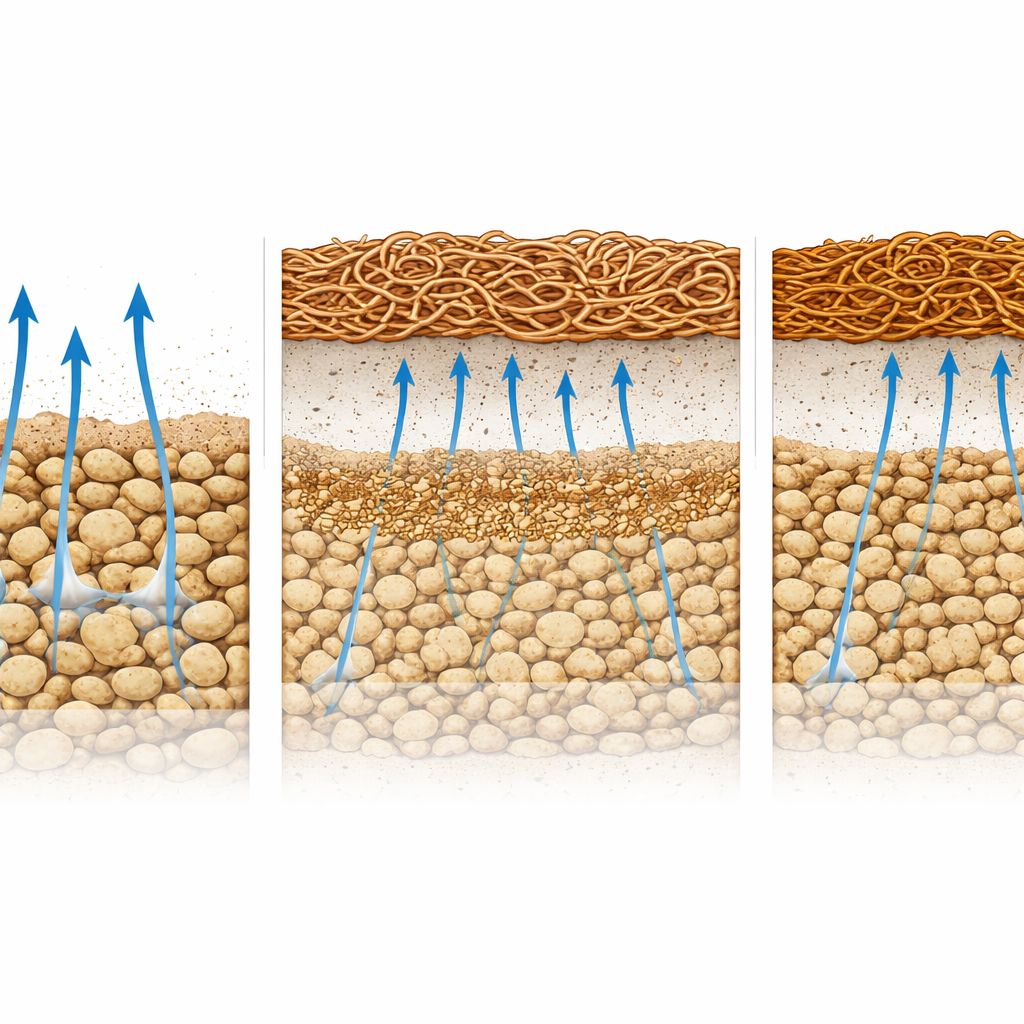
The story changed in the gappy sand, which behaves more unpredictably because its fine grains are more mobile. Here, the thick coconut mat still drained water far better than the synthetic fabric, delivering roughly 70 percent higher flow by the end of the test. However, when the pores of the coconut mat were made too large relative to the sand, it failed to hold back the finest grains, allowing noticeable sand loss and making the setup unsafe for real dikes. Detailed pressure readings and microscope images revealed an important difference in how clogging formed: the synthetic fabric tended to build a dense, low-permeability “cake” of fine particles right on its surface, while the coconut mat encouraged fine grains to settle in a band several millimeters below and partly within its loose fiber network, leaving its surface relatively open.
What the fiber mats reveal about safe design
By tracking how water pressures and flow rates evolved in different sand layers, the researchers showed that coconut fiber filters can combine strong sand retention with high drainage capacity—if their pore size is carefully matched to the soil. Their loose, three-dimensional structure makes it harder for a tight, waterproof crust to form on the mat itself, which is a common failure mode of synthetic fabrics. Instead, any buildup of fine particles tends to occur within the upper sand, where it does less harm to overall drainage. In well-graded sands, a suitably chosen coconut mat outperforms conventional fabric filters; in highly mixed sands, it still drains better but must be designed conservatively to avoid losing fine soil.
What this means for real-world floods
For emergency crews racing to stabilize a leaking dike, these results suggest that pre-stocked rolls of coconut fiber mat could offer a quick, flexible, and environmentally friendly option. Properly selected mats can keep the sandy skeleton of the dike in place while letting dangerous pore water escape fast enough to stop the growth of hidden tunnels. The study concludes that coconut fiber filters, especially at the heavier grade tested, provide better drainage and lower risk of surface crusting than standard synthetic fabrics, as long as engineers respect clear limits on how large the mat pores can be for a given soil. In short, a natural waste product from coconuts may become a valuable line of defense against future flood disasters.
Citation: Feng, D., Luo, F.X. & Liu, S. Filtration characteristics of coconut fiber filter used in emergency rescue of dike piping. Sci Rep 16, 12839 (2026). https://doi.org/10.1038/s41598-026-43828-7
Keywords: dike piping, coconut fiber filter, flood protection, soil filtration, geotextiles