Clear Sky Science · en
The role of early intervention with upper limb rehabilitation robots in upper limb functional reconstruction and improving sarcopenia-related indicators in stroke patients
Why helping weak arms after stroke matters
After a stroke, many people find that one arm no longer does what they want. Everyday actions like lifting a spoon, buttoning a shirt, or opening a door can suddenly become exhausting or impossible. At the same time, the unused muscles of the weakened arm can quickly shrink and lose strength, a condition related to age- and illness‑driven muscle loss called sarcopenia. This study asks a timely question: if we bring in smart rehabilitation robots very early after a stroke, can we not only restore better arm control but also protect and rebuild muscle in the affected limb?
From standard therapy to robot‑guided training
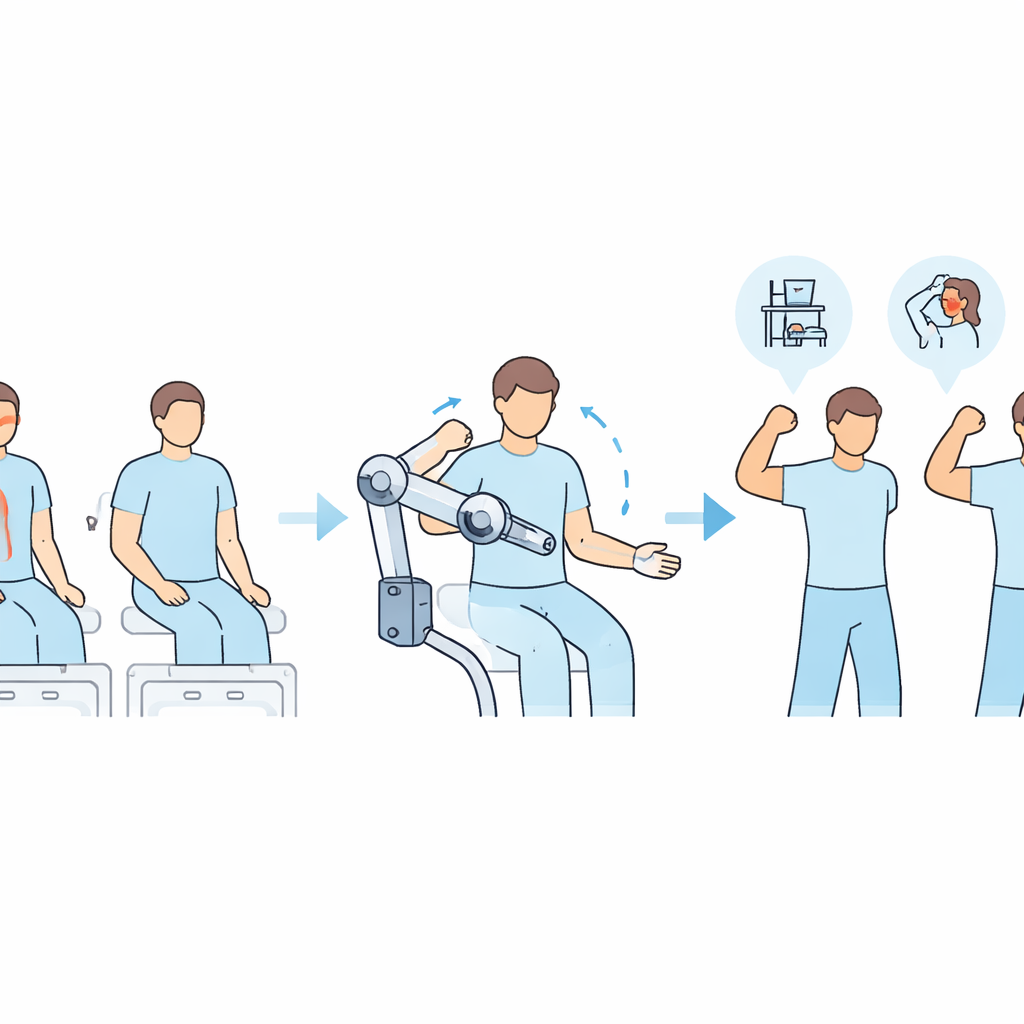
The researchers carried out a carefully planned clinical trial in a rehabilitation hospital in China. They enrolled adults who had suffered a recent stroke—within one to two weeks—and who had clear problems using an arm. Everyone received conventional rehabilitation, including electrical stimulation, exercise therapy, and occupational therapy aimed at daily tasks. On top of this, about half of the patients were randomly assigned to use an upper‑limb rehabilitation robot, while the other half continued with standard care alone. This random assignment, along with concealed group allocation and blinded outcome assessors, was designed to ensure that any differences at the end of the study would likely be due to the robot training rather than to chance or bias.
How the robot helps the recovering arm
The robot used in this study is an “end‑effector” device: the patient’s hand and forearm are fixed to a handle at the tip of a light, motorized arm. Sitting upright in front of a screen, patients practice guided movements of the shoulder and elbow in three dimensions. The system can gently lift part of the arm’s weight, move the limb passively when it is very weak, assist when the patient can generate some effort, or provide resistance as strength returns. Therapists select interactive training modules and adjust difficulty based on regular measurements from the robot itself—such as the volume of space the hand can reach, the maximum force the arm can generate, and how actively the patient participates. Over four weeks, patients in the robot group progressed from supported movement to more active, resisted exercises following a structured progression plan.
Measuring movement, strength, and muscle
To capture the impact of this added technology, the team focused on several practical outcomes. Arm motor function was rated using a widely accepted scale that scores how well patients can perform different movements with the affected arm and hand. Grip strength in the weakened hand was measured with a digital device, because squeezing power is a good snapshot of overall upper‑limb strength and predicts how well people can manage daily tasks. Muscle mass in the limbs was estimated with a body‑composition analyzer, which calculates a muscle index adjusted for height, and muscle thickness in the upper arm was imaged with ultrasound. Finally, independence in everyday activities such as dressing, bathing, and walking was scored with a standard daily‑living scale. All of these measures were taken before therapy and again after four weeks.
Stronger gains with robot‑assisted practice
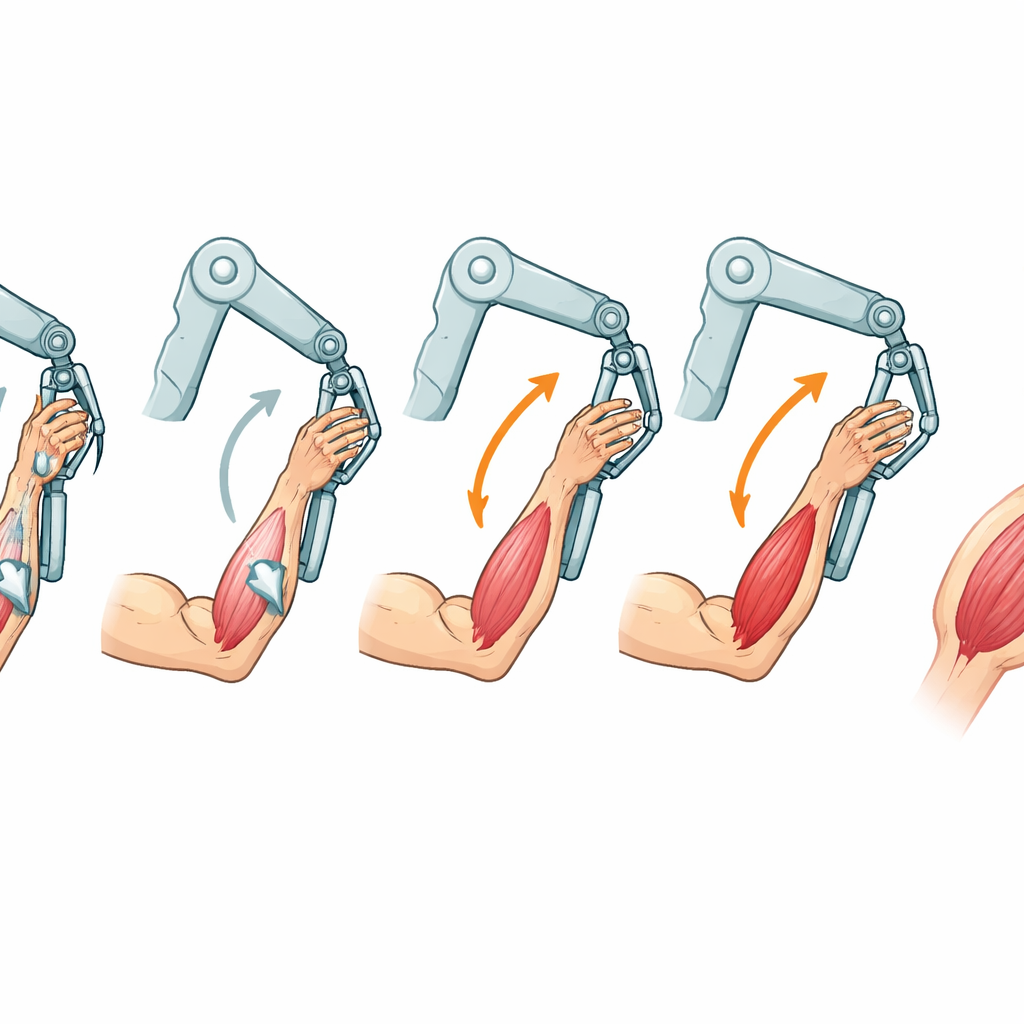
Both groups improved over the four‑week period, reflecting the benefits of rehabilitation in general. However, patients who used the robot gained more on every major measure. Their arm‑movement scores rose more sharply, showing better control and coordination. Grip strength in the affected hand almost doubled on average, and their limb muscle index increased more than in the control group, suggesting real rebuilding of muscle rather than simple fluid shifts. Ultrasound also showed that, although some muscle thinning occurred in all patients during early recovery, those in the robot group preserved significantly more muscle thickness. Importantly, these physical changes translated into everyday life: robot‑trained patients scored higher on the daily‑living scale, indicating greater independence in self‑care.
What this means for life after stroke
For people recovering from stroke, the message of this study is encouraging. Adding early, structured robot‑assisted arm training to standard therapy does not just make exercise sessions more high‑tech—it appears to heighten the recovery of arm movement, boost hand strength, and support the rebuilding of muscle that might otherwise waste away. While longer and broader studies are needed to see if these benefits reduce long‑term disability and fully prevent stroke‑related muscle loss, the findings suggest that rehabilitation robots can be powerful partners in helping patients regain the use of a weak arm and move more confidently through daily life.
Citation: Niu, A., Tao, Y., Wang, X. et al. The role of early intervention with upper limb rehabilitation robots in upper limb functional reconstruction and improving sarcopenia-related indicators in stroke patients. Sci Rep 16, 13363 (2026). https://doi.org/10.1038/s41598-026-43814-z
Keywords: stroke rehabilitation, rehabilitation robots, upper limb recovery, sarcopenia, muscle strength