Clear Sky Science · en
A blockchain-integrated multi-scale convolutional network for accurate recognition and secure tracking of high-difficulty movements in aerobics training
Smarter training for tricky moves
High level aerobics can look effortless, but coaches know how hard it is to judge fast spins, jumps, and balances by eye, or to keep training data safe when videos and sensor logs live on many devices. This study presents a system that watches complex aerobics movements automatically and keeps the records tamper resistant, aiming to help teachers, athletes, and sport programs track progress more fairly and securely.
Why hard moves are hard to measure
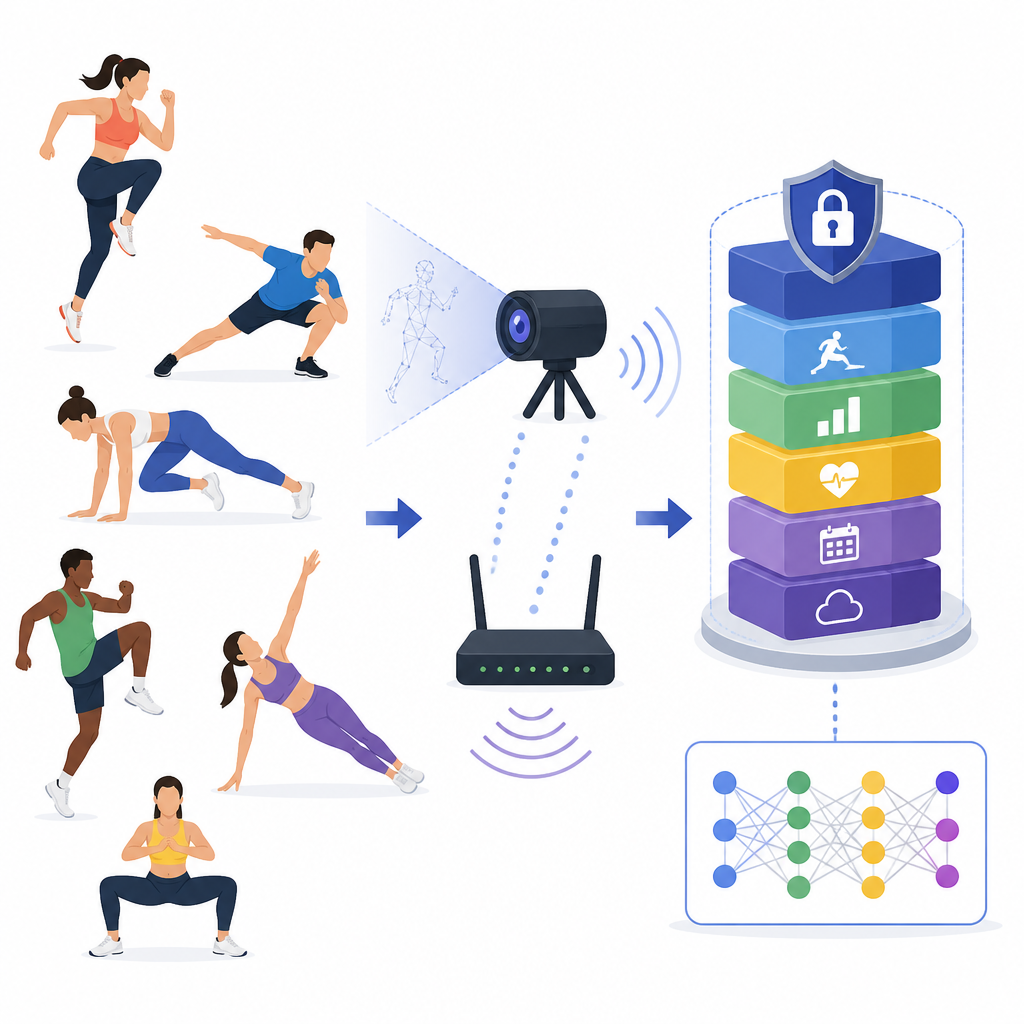
Aerobics routines involve big arm and leg swings, rapid changes in posture, and tightly linked sequences. In real gyms and school halls, this means blurred motion, bodies blocking each other, and uneven lighting. Existing computer vision tools often miss key details, especially in the fastest and most difficult moves, and many programs still rely on people to record scores or notes by hand. At the same time, training data may be collected on phones, cameras, and sensors scattered across locations, making it difficult to keep records consistent, trace who changed what, or guard athletes’ privacy over time.
A two level solution for eyes and records
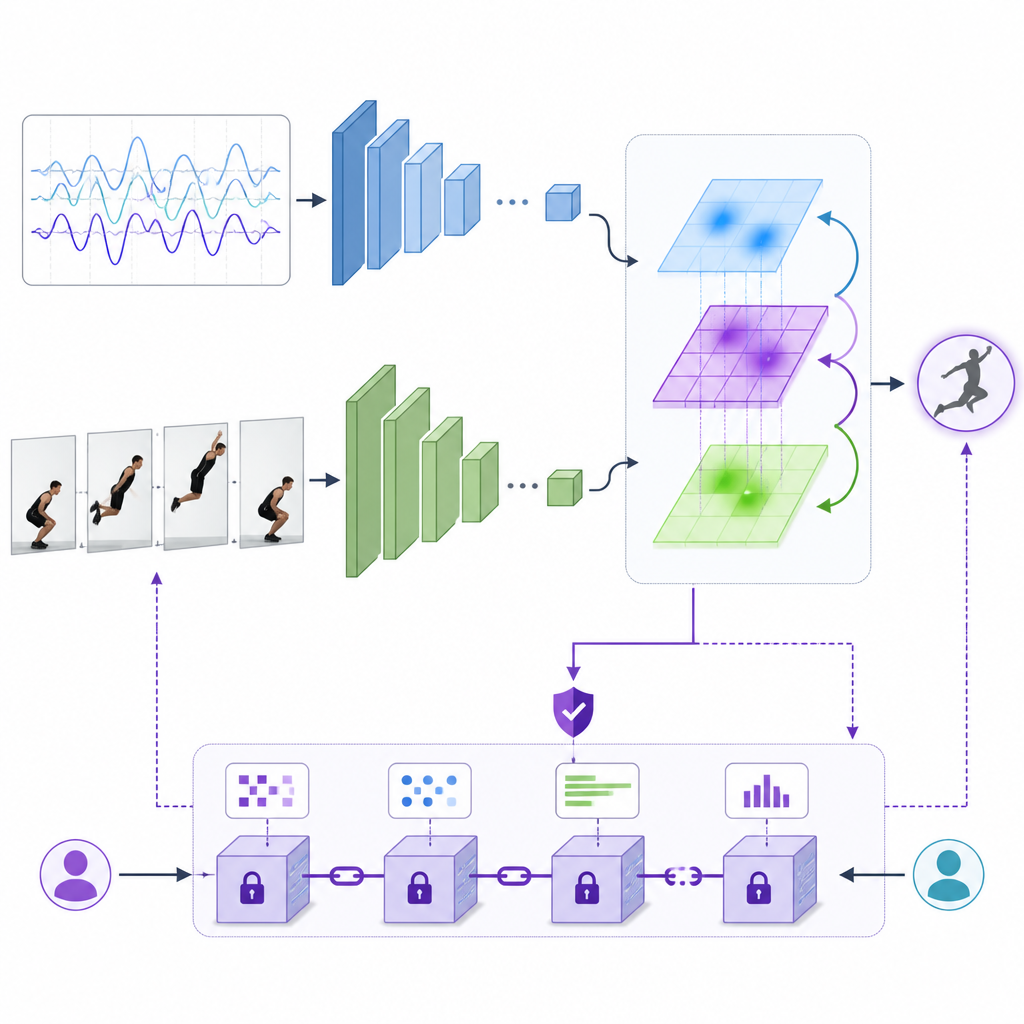
The researchers tackle these problems from two sides at once. First, they build a deep learning model that looks at both video frames and a wireless signal called channel state information, which captures how a person’s motion disturbs Wi Fi like ripples in a pond. By feeding these two streams into a specially designed convolutional network with a dual attention mechanism, the system learns to focus on the most informative moments and regions of each movement. Second, they add a blockchain layer that records compact fingerprints of the data and recognition results, along with who accessed them and under what role. This split between off chain computation and on chain logging is intended to keep recognition fast while making the history of training data harder to alter.
How the smart watcher sees movement
Inside the recognition network, multiple convolution branches look at the same action at different scales, from small local patches to larger body regions. Attention modules then re weight these features, strengthening channels and areas that matter most for telling similar moves apart, such as a foot angle during landing or the path of an arm in a spin. The video stream is paired with the wireless signal stream, which passes through filters and a temporal model so that quick changes in signal strength line up with frames where the body moves fastest. By fusing these sources, the system keeps its bearings even when the view is partly blocked or lighting is poor, since the wireless channel still “feels” the motion.
Keeping training data honest and under control
The blockchain part of the framework is designed as a trusted logbook rather than a heavy computation engine. When new aerobics data or recognition results arrive, the system creates a unique hash and writes it, plus metadata and access events, into a distributed ledger shared across nodes. Smart contracts enforce who may read, write, or request data, based on roles such as administrator, third party device, or guest. Because only fingerprints and records, not raw videos, go on chain, storage demands are kept modest while still allowing coaches or auditors to check that data have not been quietly edited or deleted, and that access followed the agreed rules.
What tests show in lab and gym
The authors evaluate their approach on large public datasets of human actions and on a custom aerobics collection with demanding skills such as single leg spins, somersault jumps, and full turn leaps. Their full system reaches about 96.8 percent accuracy on the aerobics dataset, outperforming several strong deep learning baselines that use only images or more conventional network designs. It also maintains higher recognition quality when the wireless signal is noisy, and when different devices upload data at the same time. The blockchain module adds only a small storage cost per training round while sharply improving measures of data traceability and cross device consistency in simulated multi user training platforms.
What this means for everyday training
For non specialists, the takeaway is that the study shows a way to combine smarter movement analysis with stronger data stewardship in one coherent system. Instead of treating pose recognition and record keeping as separate afterthoughts, the authors design them to work together, so that difficult aerobics moves can be recognized more reliably while the underlying training history stays consistent and auditable. Although some limits remain in unusual settings, such as extreme occlusion or very crowded scenes, the framework points toward future sports tools that not only “see” complex motion better but also protect the people whose motion is being watched.
Citation: Zhang, Q., Lu, Y. & Li, Y. A blockchain-integrated multi-scale convolutional network for accurate recognition and secure tracking of high-difficulty movements in aerobics training. Sci Rep 16, 14910 (2026). https://doi.org/10.1038/s41598-026-43794-0
Keywords: aerobics training, action recognition, deep learning, blockchain data security, sports technology