Clear Sky Science · en
Spiral phase infrared imaging with undetected photons using a visible wavelength spatial light modulator
Seeing the Invisible
Many substances of interest—from biological tissues to industrial materials—reveal their secrets in infrared light, a part of the spectrum our eyes and most everyday cameras cannot see well. The challenge is that sensitive infrared cameras are expensive and noisy, while visible-light cameras are cheap, high‑resolution, and ubiquitous. This work shows how to use clever quantum optics and a programmable light shaper to form sharp, edge‑enhanced infrared images using only a standard visible‑light camera, with the remarkable twist that the detected photons never actually touch the object being imaged.
Light That Looks Without Touching
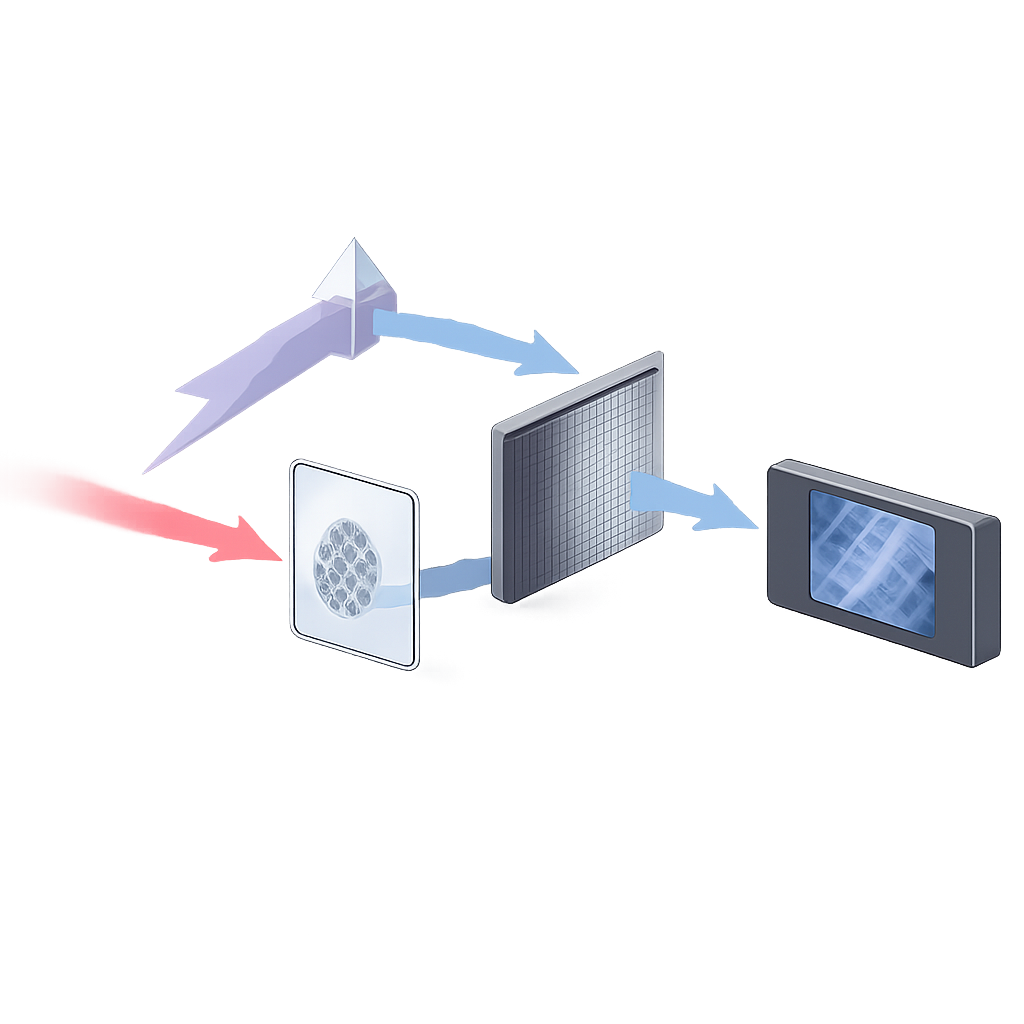
The experiment builds on a technique called imaging with undetected photons. A special crystal converts a high‑energy “pump” beam into pairs of lower‑energy photons: one at a visible wavelength and its partner in the infrared. The setup allows each pair to be created in two different passes through the crystal, and the paths are arranged so that, unless something intervenes, there is no way to tell in which pass a given pair was born. This deliberate indistinguishability causes the visible photons to form an interference pattern that is exquisitely sensitive to what happens to their undetected infrared partners.
Using Hidden Infrared to Draw a Picture
To make an image, the researchers send the infrared partners toward an object—such as a test target or a patterned mask—while guiding the visible partners along a separate route that never encounters the object. Any changes in the infrared beam, such as absorption or phase shifts as it passes through the sample, subtly alter the conditions for interference. Those changes show up as local variations in brightness in the visible‑light interference pattern recorded by a conventional camera. Unlike “ghost imaging,” this approach does not need to record coincidences between the two photons; the mere possibility of learning which path the pair took is enough to sculpt the visible image.
Shaping Light in the Wrong Color on Purpose
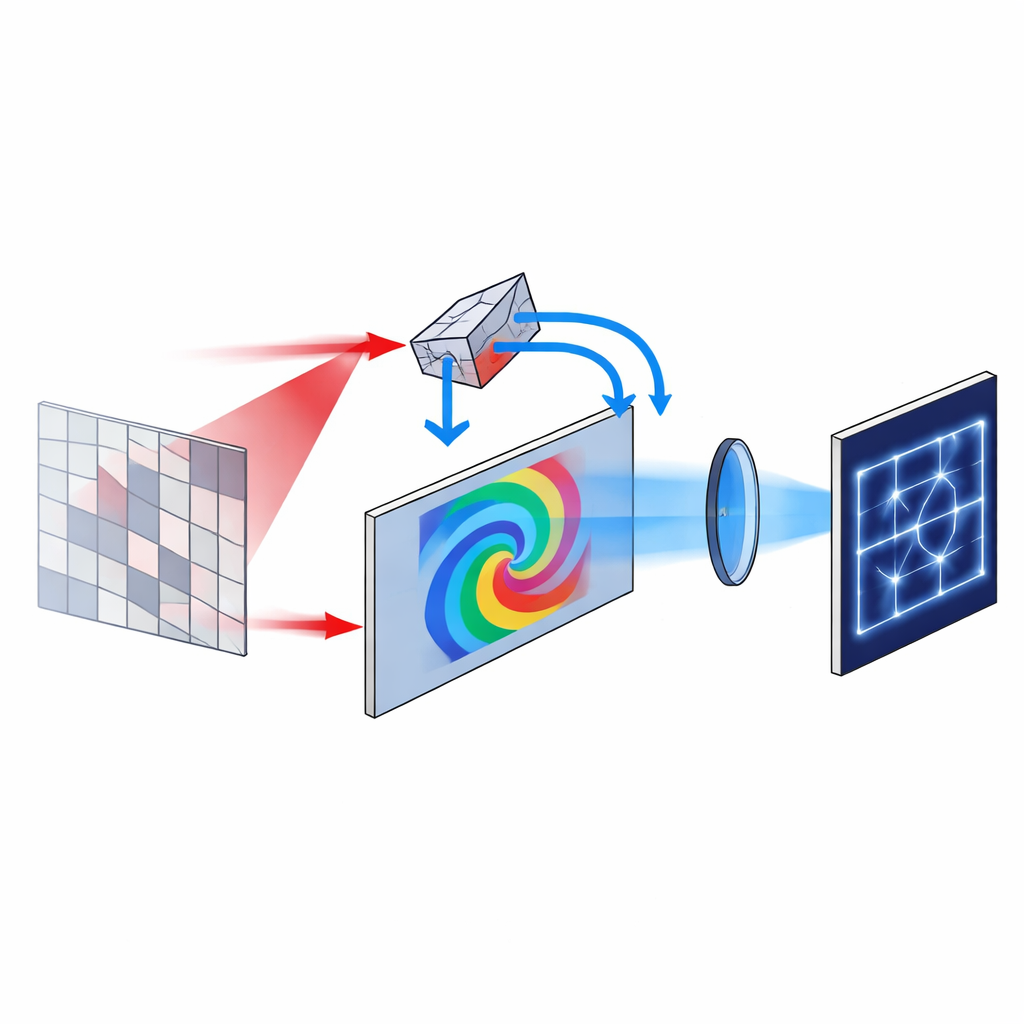
In many modern microscopes, a device called a spatial light modulator (SLM) sits in a Fourier plane—an optical plane where different image details correspond to different spatial frequencies. By changing the phase of these frequencies, one can engineer the point spread function and enhance contrast, correct aberrations, or emphasize edges. However, standard liquid‑crystal SLMs work poorly at mid‑infrared wavelengths. The key innovation here is to place a visible‑wavelength SLM in the path of the visible photons, yet use it to manipulate how the infrared image looks. Because the interference pattern depends jointly on the phase of both beams, a phase mask applied only to the visible beam effectively reshapes how information from the infrared object is transferred to the camera.
Making Edges Pop with a Spiral Trick
The team demonstrates this idea with a particular kind of Fourier filter known as a spiral phase mask, which introduces a smoothly twisting phase around a central point. In conventional optics, this mask causes each point in the object to blur into a doughnut‑shaped pattern whose internal phase leads to destructive interference in uniform regions and constructive interference at sharp changes. As a result, smooth areas go dark while edges become bright, giving omnidirectional edge enhancement. By displaying a spiral pattern on the visible‑light SLM, the researchers obtain the same edge‑highlighting effect for an object that exists only in the infrared beam. Bright‑field images and their spiral‑filtered counterparts show that edges reverse from dark to bright and the background is flattened, all while the infrared light never reaches either the SLM or the camera.
Steps Toward Sharper Infrared Vision
The authors characterize the resolution and field of view of their system, showing close agreement between measured performance and theoretical predictions, and discuss practical issues such as residual fringes and limited contrast due to the finite number of SLM pixels across the beam. They outline ways to improve stability and efficiency, for example by adopting a different interferometer geometry or using finer‑pixel SLMs. Overall, this proof‑of‑concept shows that a visible‑only, programmable light modulator can control how infrared information is converted into a visible image, enabling edge‑enhanced views of samples at wavelengths where suitable cameras and modulators are scarce. In the longer term, this approach could bring powerful contrast techniques like dark‑field and phase‑contrast microscopy into the infrared domain without ever needing to directly detect infrared light.
Citation: Wolley, O., Pearce, E., Mekhail, S.P. et al. Spiral phase infrared imaging with undetected photons using a visible wavelength spatial light modulator. Sci Rep 16, 14130 (2026). https://doi.org/10.1038/s41598-026-43775-3
Keywords: quantum imaging, infrared microscopy, spatial light modulator, edge enhancement, spiral phase contrast