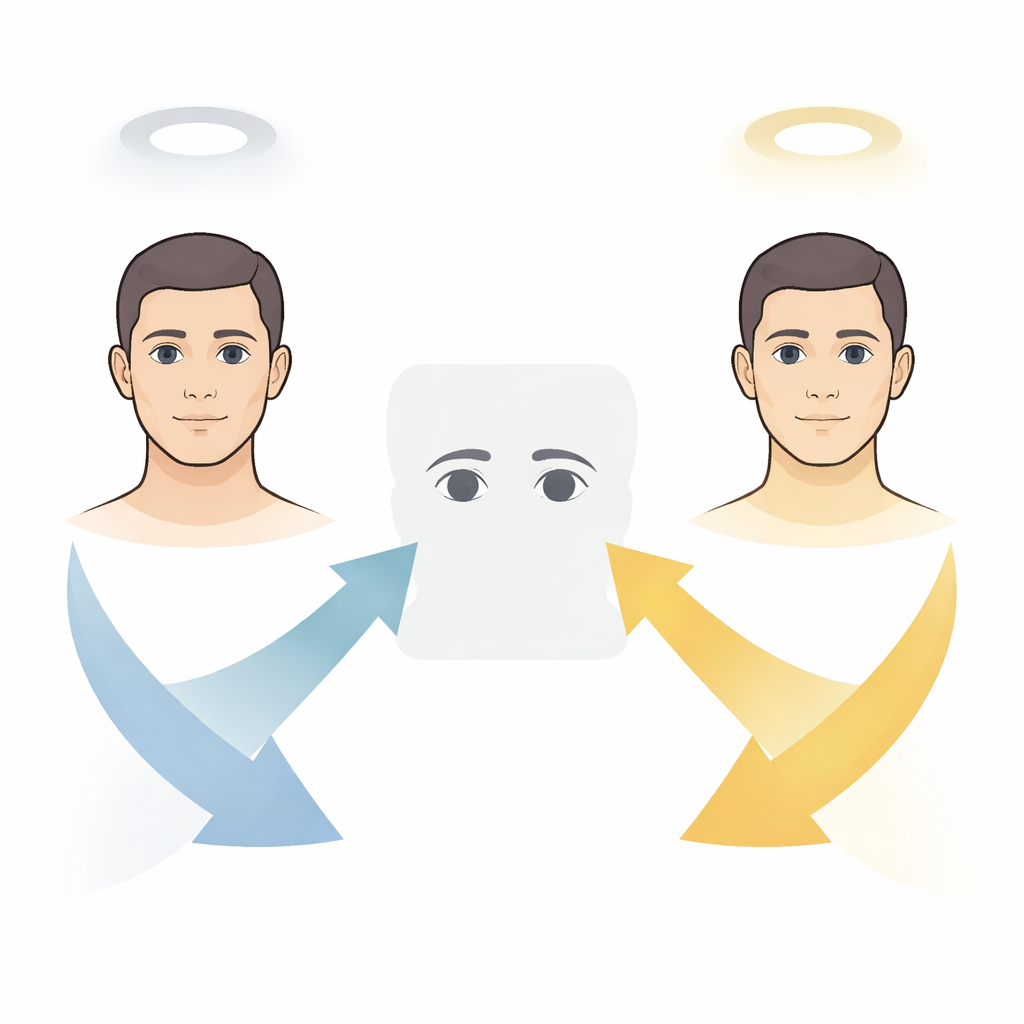
When you look someone in the eye, you probably assume you can tell exactly where they are looking. But the light falling on their face can quietly bend that impression. This study explores how lighting from above or below a person’s face changes the way we read their gaze, and how the brain compensates so that social cues like eye contact remain mostly reliable in everyday life.
How Eyes and Light Work Together
Our eyes have a simple but powerful design: a dark iris and pupil framed by brighter white sclera. As the eyes rotate, the balance of dark and light across each eye shifts, giving the brain clues about where someone is looking. The catch is that shadows and highlights from lighting can mimic these shifts. Lighting from one side, or from above or below, can darken parts of the white of the eye and subtly trick the visual system into thinking the gaze has moved, even when the eyes are physically in the same position.
Testing Gaze Under Different Lights Figure 1.
The researchers used detailed 3D computer models of faces to control both where the eyes were pointing and where the light came from. Volunteers viewed greyscale faces on a monitor and simply reported whether each face was making eye contact. In the first experiment, the faces were lit from above, from below, or from straight ahead, while the eyes moved slightly up, down, left, or right. When the light came from above, people tended to judge faces as looking slightly higher than they really were, so they accepted more downward eye positions as eye contact. Lighting from below produced the opposite shift: faces looked a bit more downward, and eye contact judgments became less precise overall, especially for vertical gaze.
Peeking Inside the Brain’s “Correction” System
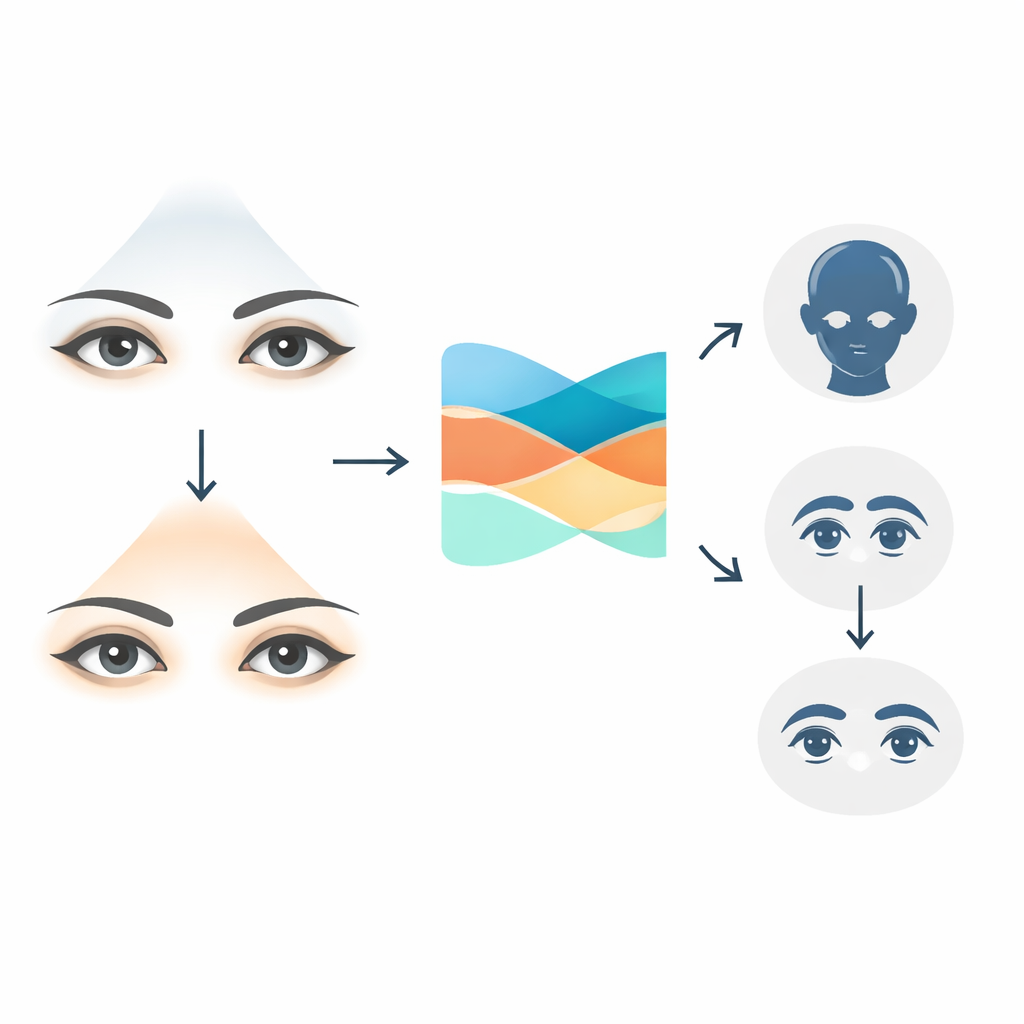
In the second experiment, the team asked whether the brain uses the wider facial shading pattern to compensate for misleading shadows in the eyes. They created composite faces where only the eye region was lit from above or below, while the rest of the face looked as if it were lit straight on. With this mismatch, the same changes in eye shading produced much larger shifts in perceived gaze than in naturally lit faces where the eye and face shared a consistent light source. From this comparison, the authors estimated that the visual system “discounts” roughly three quarters of the lighting-induced distortions when full-face shading is available, using that context to keep gaze perception relatively stable.
Comparing Familiar and Unfamiliar Lighting Figure 2.
Everyday environments are dominated by light from above, whether from the sun or ceiling lamps, so faces lit from below can look eerie or unfamiliar. The third experiment asked whether our correction mechanisms work better for these more natural, overhead conditions. Here, faces moved their eyes horizontally while the light came from above-left, above-right, below-left, or below-right. Again, the direction of light nudged perceived gaze away from the light source, but this effect was strongly reduced when the whole-face shading pattern matched the eye region. Surprisingly, the brain’s ability to use shading to correct for lighting distortions was just as strong for faces lit from below as for faces lit from above.
What This Means for Everyday Eye Contact
Overall, the study shows that lighting direction does indeed bias where we think someone is looking: faces lit from below tend to seem more downward-looking, and judgments of eye contact become noisier. Yet our perception is not easily fooled. The brain automatically reads the broader pattern of shadows and highlights across the face to infer the direction of the light and correct much of the misleading information in the eyes themselves. This finely tuned “perceptual constancy” allows us to maintain a mostly reliable sense of other people’s gaze direction, even as we move between bright sun, dim rooms, and dramatic lighting that reshapes the shadows on every face we see.