Clear Sky Science · en
In vivo evaluation of a soft optical sensor for bleeding detection in colonoscopy
Why Watching for Hidden Bleeding Matters
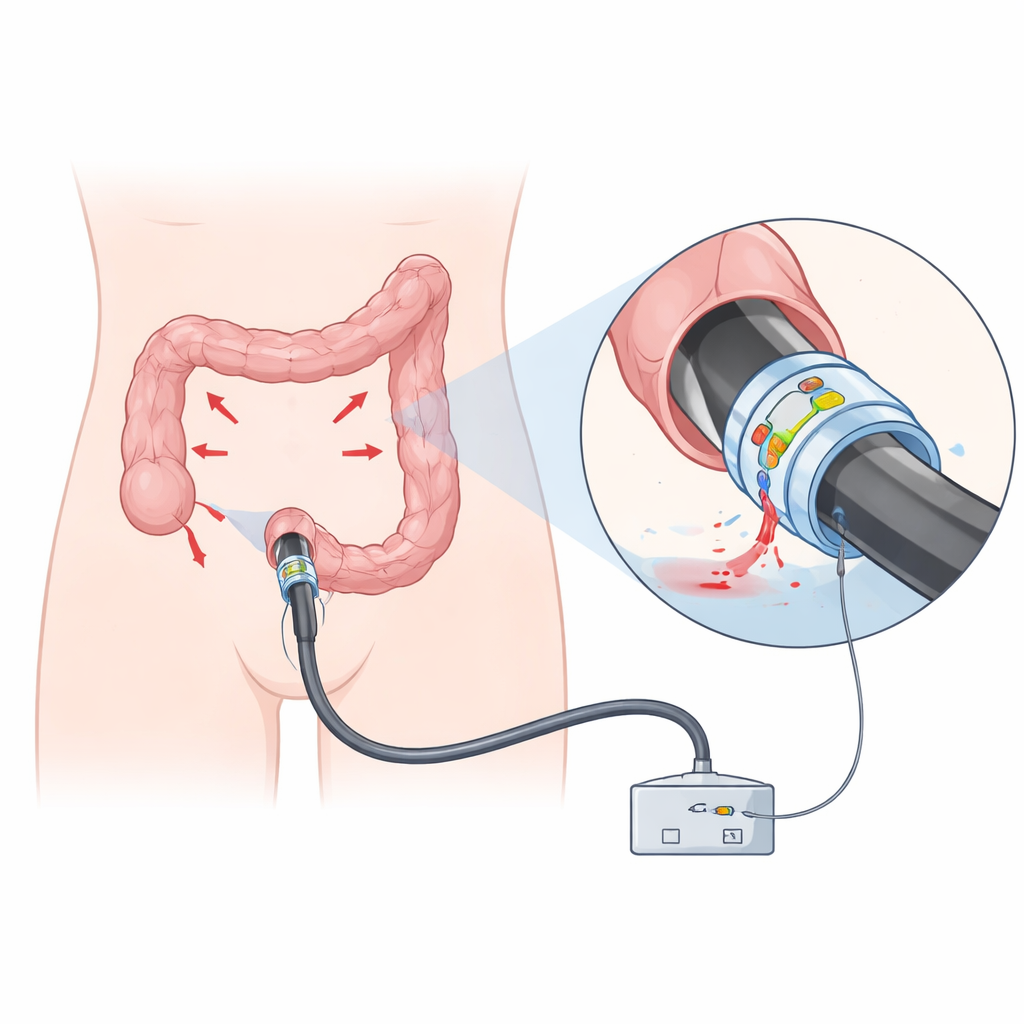
Colonoscopy has become a routine test to find and remove early signs of colorectal cancer and other bowel problems. Yet the very tool that saves lives can, in rare cases, cause bleeding or small tears in the gut wall. Because the camera only sees what is directly in front of its tip, bleeding that starts just behind it can be missed until much later. This study explores a soft, light-based sensor that slips onto a standard colonoscope and quietly watches the surrounding fluid for signs of blood, aiming to make the procedure safer without slowing doctors down.
A Gentle Add-On for a Common Test
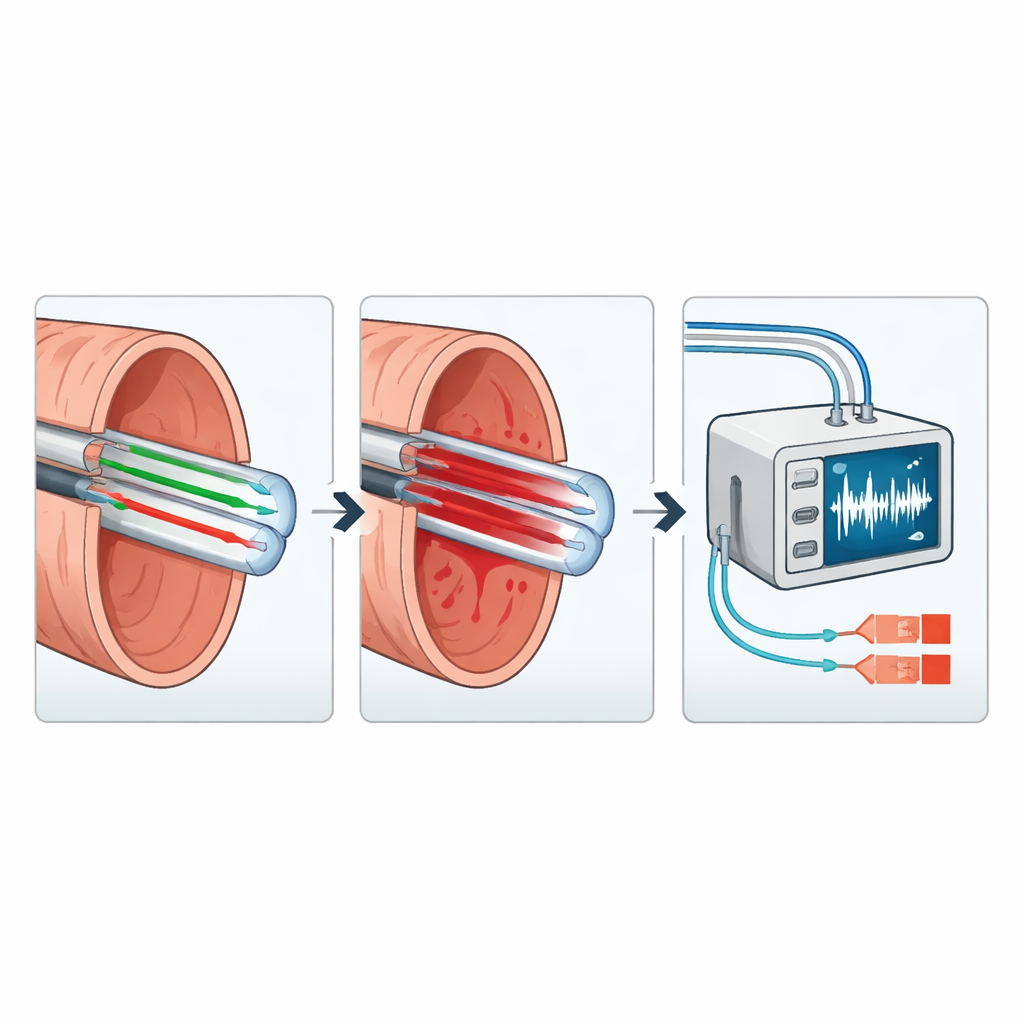
The researchers designed a thin, flexible sleeve that fits around the colonoscope just behind its tip. Embedded in this sleeve are tiny light guides that shine green and infrared light across a narrow channel that continuously samples fluid from inside the colon. Under normal conditions, both colors of light pass through the channel with only minor loss. When blood mixes into the fluid, the green light is strongly absorbed while the infrared light is much less affected. By comparing how much each color of light drops, the system can tell whether the sensor has encountered blood rather than ordinary digestive fluid or brief mechanical disturbances.
Putting the Sensor to the Test in Living Tissue
Earlier work had shown that the sensor could detect artificial blood mixtures in pieces of cow colon outside the body. In the new study, the team moved one step closer to real-world use by testing the device in live pigs, whose intestines resemble those of humans. Two expert endoscopists performed repeated colonoscopies in two pigs. Each session started with standard colonoscopies without the device, followed by procedures with the sleeve attached but no bleeding, and finally procedures in which bleeding was deliberately created inside the colon. The doctors navigated the scope from the rectum to a set point in the distal colon while the sensor drew in fluid and its electronics tracked the light signals in real time.
How Well It Spotted Blood Without Slowing Doctors
Across ten procedures in which bleeding was present, the sensor correctly detected blood every single time, giving a sensitivity of 100%. It did so with an overall accuracy of 92%, a precision of 83%, and a specificity of 87%, meaning false alarms were relatively rare. Two false positives occurred when small clumps of stool and mucus entered the sensor, briefly mimicking the optical effect of blood; the authors suggest that adding a simple filter at the fluid inlet could reduce this problem. Importantly for patients and clinicians, the extra sleeve did not noticeably change how long it took to steer the colonoscope to the target location. Navigation times with and without the device were very similar, and statistical tests found no meaningful difference.
Workload, Safety, and Robustness in the Operating Room
Beyond speed, the team wanted to know whether the added hardware made the procedure feel harder or riskier for the endoscopists. Using a standard questionnaire called NASA TLX, the doctors rated mental effort, physical effort, time pressure, frustration, and their sense of performance after runs with and without the sensor. The overall workload scores were close, and a permutation test showed no significant difference, suggesting that the device can be incorporated without overburdening users. During several hours of repeated colonoscopies, the pigs’ colons were inspected for unexpected tears or bleeding, and none were linked to the sensor. The sleeve, its light guides, and the attached tubing all stayed in place and functional throughout, despite occasional clogging by mucus that was easily cleared by flushing.
From Animal Trials Toward Safer Human Exams
Taken together, the findings show that a soft, light-based sleeve can be added to a standard colonoscope to detect bleeding just out of the camera’s view, without slowing navigation or noticeably increasing the doctor’s workload in a live-animal model. The authors see this as an important step toward human trials, while noting that larger studies, added filters to reduce false alarms, and refinement with medical-grade materials are still needed. If these next steps succeed, future colonoscopies could quietly gain an extra set of “eyes” in the form of an invisible, real-time blood detector, helping doctors catch complications earlier and keep a widely used cancer-screening test even safer.
Citation: Gerald, A., Palkawong-Na-Ayuddhaya, K., Bono, V.D. et al. In vivo evaluation of a soft optical sensor for bleeding detection in colonoscopy. Sci Rep 16, 13671 (2026). https://doi.org/10.1038/s41598-026-43768-2
Keywords: colonoscopy, bleeding detection, optical sensor, microfluidic device, colorectal cancer screening