Clear Sky Science · en
Computational design and geometry-driven modeling of TiN-based plasmonic metasurface absorbers
Turning Light into Useful Heat and Power
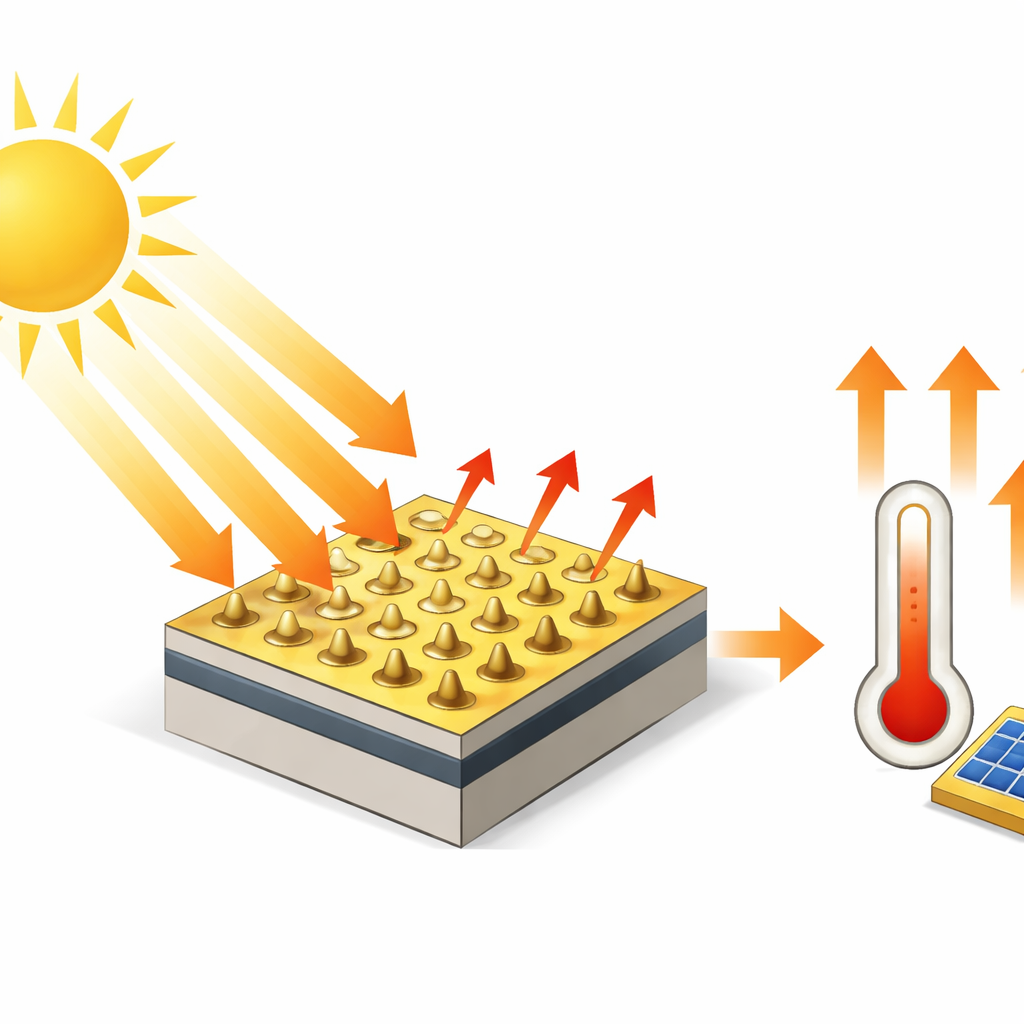
Sunlight and other forms of light carry immense energy, but ordinary surfaces reflect or waste much of it. Engineers are learning to sculpt materials at the nanoscale so that they soak up nearly every incoming photon. This article explores a new way to design such ultra-thin, highly absorbing coatings using a compound called titanium nitride. These smart surfaces could boost solar energy harvesters, improve thermal management of devices, and enable compact sensors that respond to specific colors of light.
Flat Devices that Control Light
Instead of using thick lenses or bulky materials, the researchers work with “metasurfaces” – very thin layers patterned with tiny metallic structures smaller than the wavelength of light. By adjusting the shapes, sizes, and spacing of these nanoscale building blocks, metasurfaces can bend, trap, or cancel light in ways that ordinary materials cannot. In this study, the team focuses on turning these patterned layers into almost perfect absorbers that swallow visible light between 400 and 800 nanometers, the range that spans violet to red in the rainbow.
A Rugged Alternative to Precious Metals
Many earlier designs relied on gold or silver to interact strongly with light, but these noble metals are expensive and can degrade at high temperatures. Titanium nitride offers a more practical option: it is cheaper, compatible with standard chip manufacturing, and remains stable when hot. The authors compare titanium nitride with gold, silver, and aluminum by placing each metal into the same basic structure: a repeating array of tiny hollow antennas sitting on a glass-like spacer, backed by a metal mirror. This mirror blocks light from passing through, so any light that fails to reflect must be absorbed in the patterned layer.

Shaping Tiny Antennas for Better Absorption
The central idea of the work is geometry-driven design: the team systematically varies the shapes and dimensions of the nanoantennas and watches how the average absorption changes. They examine three main forms – hollow squares, hollow cylinders, and cones – each of which can trap light in slightly different ways. For gold and silver, the absorption tends to concentrate into sharp peaks that slide toward longer wavelengths as the antennas grow taller or wider. Aluminum proves more temperamental, with strong sensitivity to size changes and multiple narrow resonances, which can be useful when one wants precise color filtering but less ideal for broad capture of sunlight.
Why Titanium Nitride Stands Out
In contrast, titanium nitride shows a remarkably smooth and stable response. Across many different sizes and shapes, it absorbs most of the visible spectrum without sharp dips or spikes. For hollow cylinders and cones, the average absorption often hovers around 90 percent or more and barely changes when the height or top radius is adjusted. The main geometric factor that still matters is the width of the base: a wider base tends to enhance the coupling between incoming light and the antenna, gently raising the overall absorption. This built-in tolerance means that real-world manufacturing imperfections are less likely to ruin performance, an important advantage for large-area coatings and high-temperature devices.
From Simulations to Simple Design Rules
To turn their detailed simulations into practical design tools, the researchers fit simple mathematical formulas that link a few key geometric parameters—such as antenna height and base radius—to the average absorption. These compact expressions allow engineers to quickly estimate performance without rerunning heavy numerical calculations each time they tweak a design. Although the study is purely computational, it lines up well with previous experimental work on titanium nitride and suggests clear paths toward fabrication using existing thin-film deposition and patterning techniques.
What This Means for Everyday Technology
For a non-specialist, the takeaway is that the authors have found a robust recipe for making very thin, very dark surfaces out of a practical, heat-tolerant material. By carefully arranging tiny hollow and tapered structures of titanium nitride on a reflective backing, they achieve strong, broadband light absorption that hardly changes when the geometry is slightly off. Such metasurface absorbers could one day improve solar energy devices, help electronics shed heat more efficiently, and enable compact optical sensors, all while relying on materials and geometries that are easier to manufacture at scale.
Citation: Nagaty, A., Aly, A.H. & Sabra, W. Computational design and geometry-driven modeling of TiN-based plasmonic metasurface absorbers. Sci Rep 16, 11362 (2026). https://doi.org/10.1038/s41598-026-43764-6
Keywords: metasurface absorbers, titanium nitride, plasmonic nanoantennas, broadband light absorption, solar thermal applications