Clear Sky Science · en
Pioneering oil and nitrogen interfacial tension using evolutionarily optimized gradient boosting machine
Why this matters for future oil production
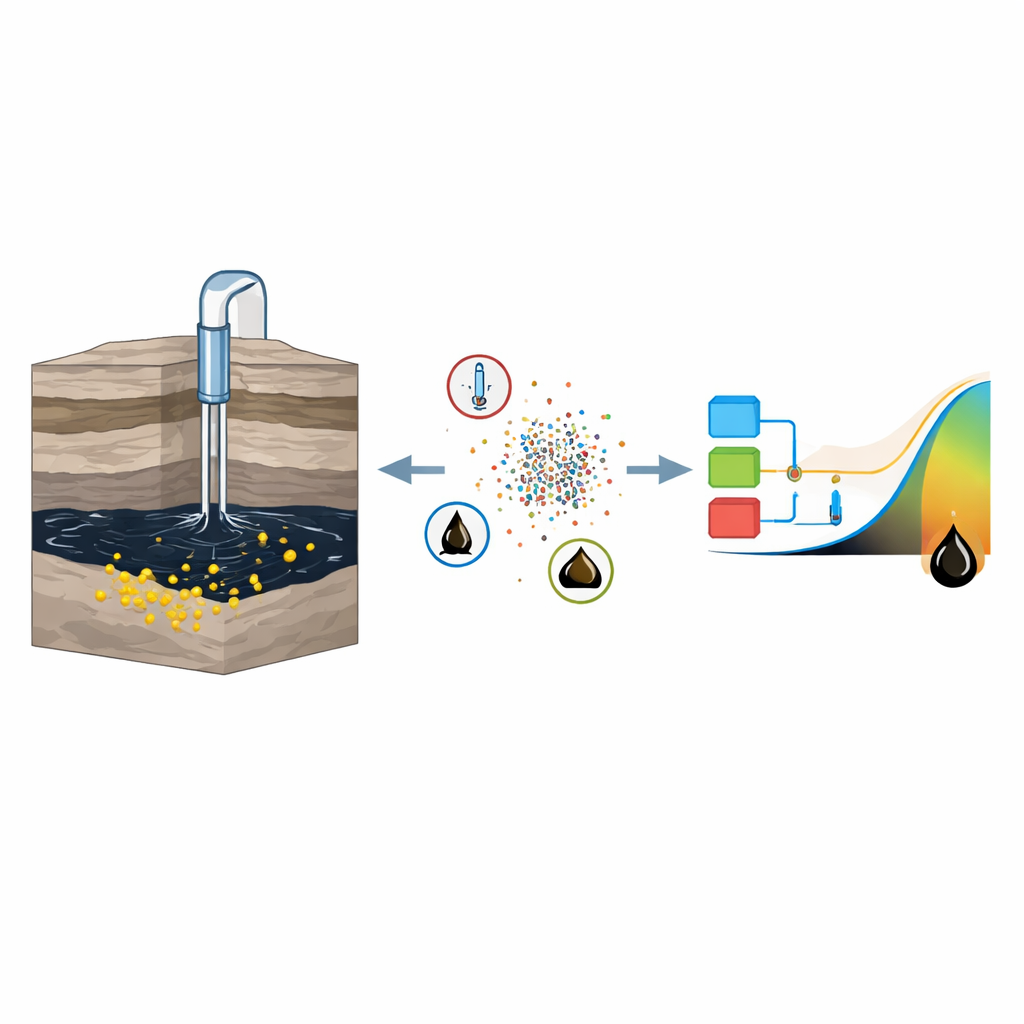
Even after modern drilling and pumping, much of the oil in a reservoir remains stubbornly trapped underground. One way to coax more of it out is to inject gases that help loosen and move the oil. This study shows how a powerful form of artificial intelligence can predict a key property that controls how well injected nitrogen gas can free trapped oil, helping engineers design cleaner and more efficient recovery methods without running endless lab experiments.
Getting more oil with cleaner tools
Oil companies have long used gas injection to push extra oil out of aging fields. Carbon dioxide is especially effective, but it comes with headaches: it can corrode equipment, cause heavy components in the oil to clump and clog pores, and depends on a steady supply of captured CO₂. Nitrogen, by contrast, is cheap, abundant, and chemically inert. It can stabilize pressure, form miscible mixtures with lighter oil components, and sweep oil toward production wells, making it an attractive alternative wherever CO₂ is risky or uneconomical.
The hidden tug-of-war at the oil–gas boundary
At the heart of gas-based recovery lies interfacial tension—the “skin” at the boundary between oil and gas. When this tension is high, oil droplets cling stubbornly to rock surfaces; when it is low, they can move more freely. Interfacial tension depends on pressure, temperature, and the type of oil, and it is costly to measure in the lab under all possible conditions. Traditional equations often need detailed chemical breakdowns of the oil and still struggle to work reliably across different reservoirs. That gap motivates the search for data-driven tools that can make accurate predictions from simpler, widely available measurements.
Teaching a model to learn from scarce data
The authors compiled 148 careful measurements of nitrogen–oil interfacial tension from prior experiments, spanning a wide range of pressures, temperatures, and oil qualities (expressed as API gravity). They first screened the data for outliers using a Monte Carlo–based statistical test, ensuring that rare or erroneous points would not distort the results. They then trained a gradient boosting machine, a type of ensemble model that combines many small decision trees to capture subtle, nonlinear patterns. To avoid overfitting this relatively small dataset, they used five-fold cross-validation, repeatedly shuffling which data were used for training and which for testing.
Letting nature-inspired algorithms fine‑tune the model
Instead of guessing the best settings for the model, the researchers used four “metaheuristic” search methods that imitate behaviors found in nature: the foraging of honeybees, the flocking of birds, the parasitic nesting of cuckoos, and the hunting patterns of whales. Each method explored different combinations of model depth, learning speed, and other knobs, seeking to minimize prediction errors. Across these trials, the bee-inspired approach—Artificial Bee Colony optimization—produced the most reliable model, striking a strong balance between accuracy on known data and performance on new, unseen conditions.
Opening the black box of machine learning
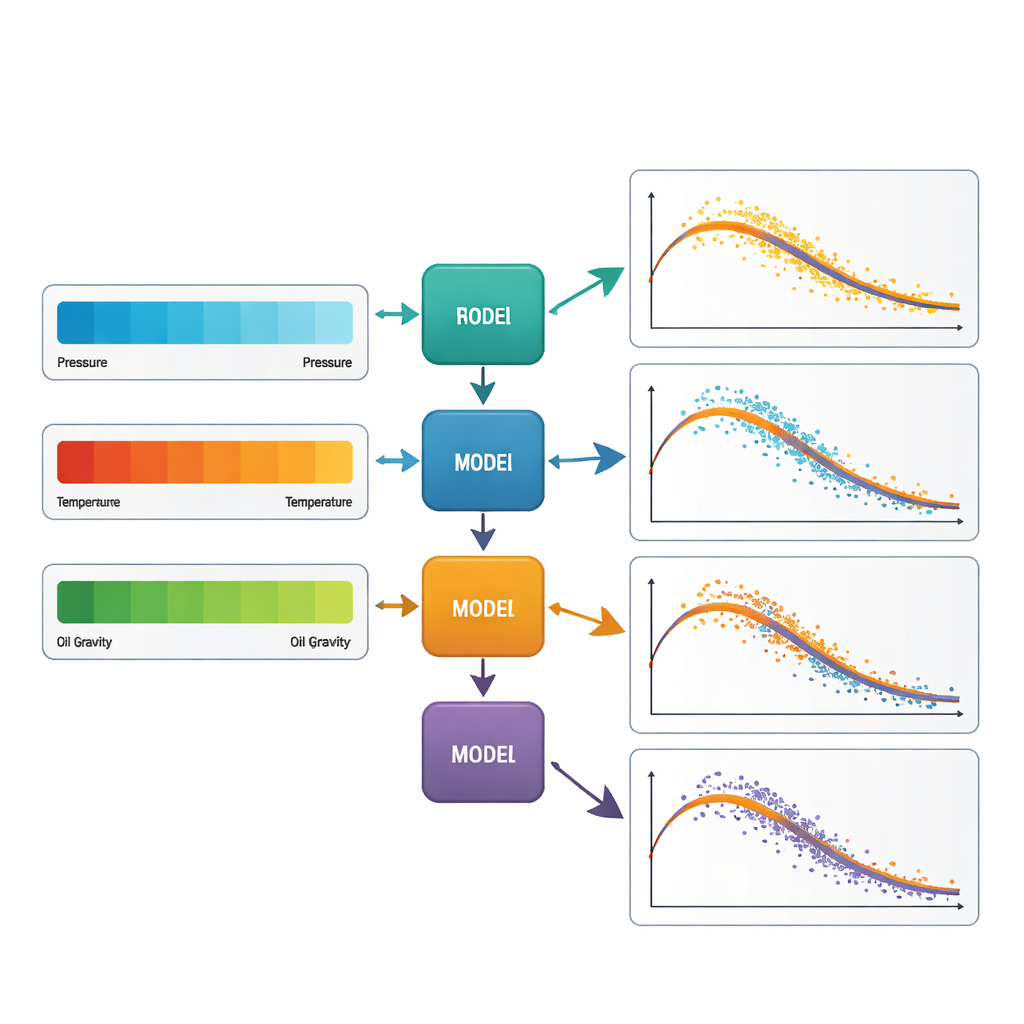
To understand what the model had learned, the team turned to an interpretability tool known as SHAP, which assigns each input a share of responsibility for each prediction. This analysis showed that pressure and temperature overwhelmingly control nitrogen–oil interfacial tension, while API gravity plays a smaller but noticeable role. The learned trends match physical intuition: higher pressure squeezes the gas and encourages mixing, lowering the boundary tension; higher temperature increases molecular motion and weakens the “skin” at the interface; lighter oils, with higher API gravity, tend to have lower cohesion and thus lower interfacial tension.
What this means in practical terms
In everyday language, the study delivers a smart shortcut: a vetted, physics‑consistent AI model that can estimate how “sticky” the boundary between nitrogen and oil will be under many different underground conditions, using only three easily measured inputs. The bee‑optimized version of the model gives the most trustworthy predictions and clearly shows that tuning pressure and temperature is the most effective way to soften this boundary and mobilize trapped oil. With better forecasts in hand, engineers can design nitrogen injection schemes more confidently, reduce their reliance on expensive laboratory testing, and explore cleaner combinations of gases and additives to squeeze more energy out of existing reservoirs with less waste.
Citation: Abushuhel, M., Mohammad, H., Rao P S, R. et al. Pioneering oil and nitrogen interfacial tension using evolutionarily optimized gradient boosting machine. Sci Rep 16, 13086 (2026). https://doi.org/10.1038/s41598-026-43758-4
Keywords: enhanced oil recovery, nitrogen injection, interfacial tension, machine learning models, gradient boosting