Clear Sky Science · en
Transformation method of Φ-OTDR optical fiber strain and tunnel liner strain and its application in tunnel safety monitoring
Watching Tunnels Breathe
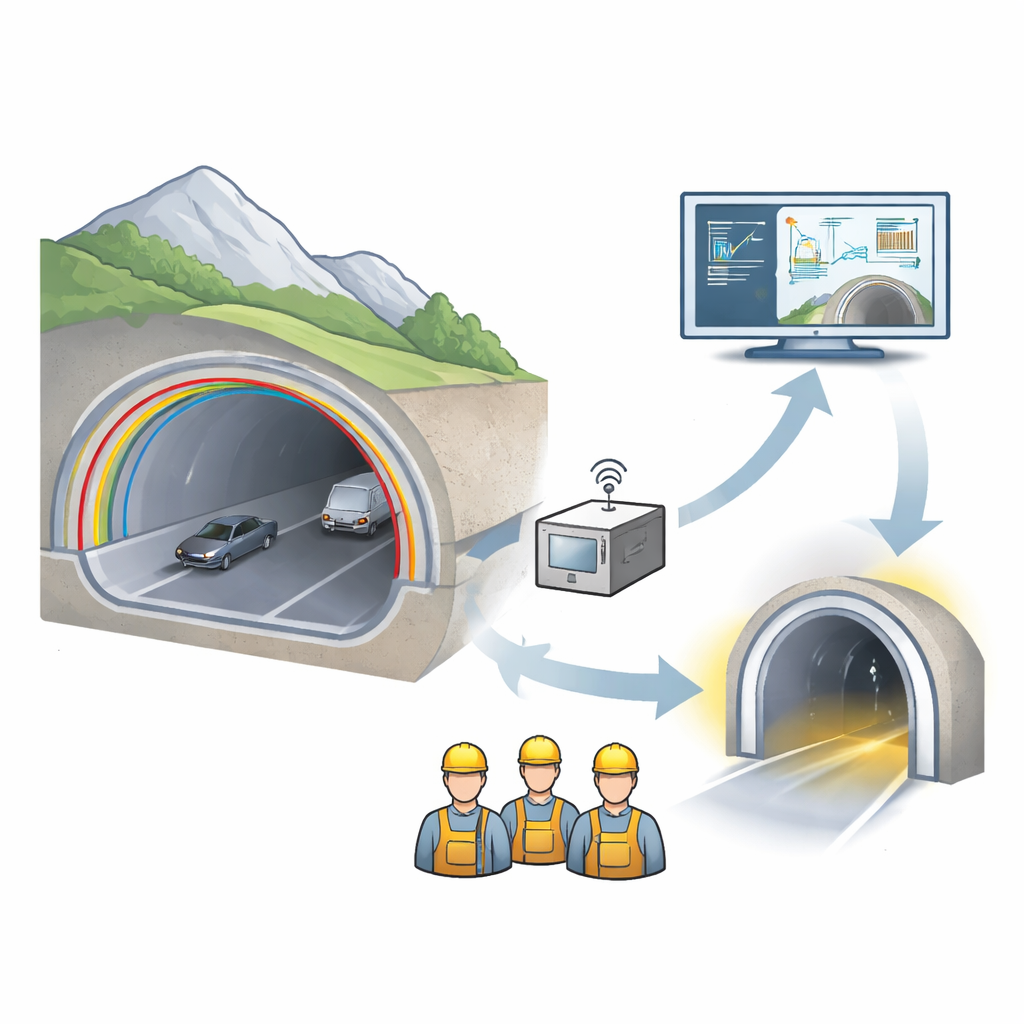
Modern road and rail tunnels run beneath mountains, rivers and crowded cities, where a hidden crack or slow deformation can quickly become a disaster. This study introduces a way to let tunnels "tell" engineers how they are feeling in real time, by turning long strands of optical fiber into continuous nerves that sense how the tunnel lining stretches and compresses. The work not only explains how these fibers react to strain inside concrete, but also shows how their signals can be turned into automatic safety warnings for construction crews underground.
From Single Sensors to Continuous Nerves
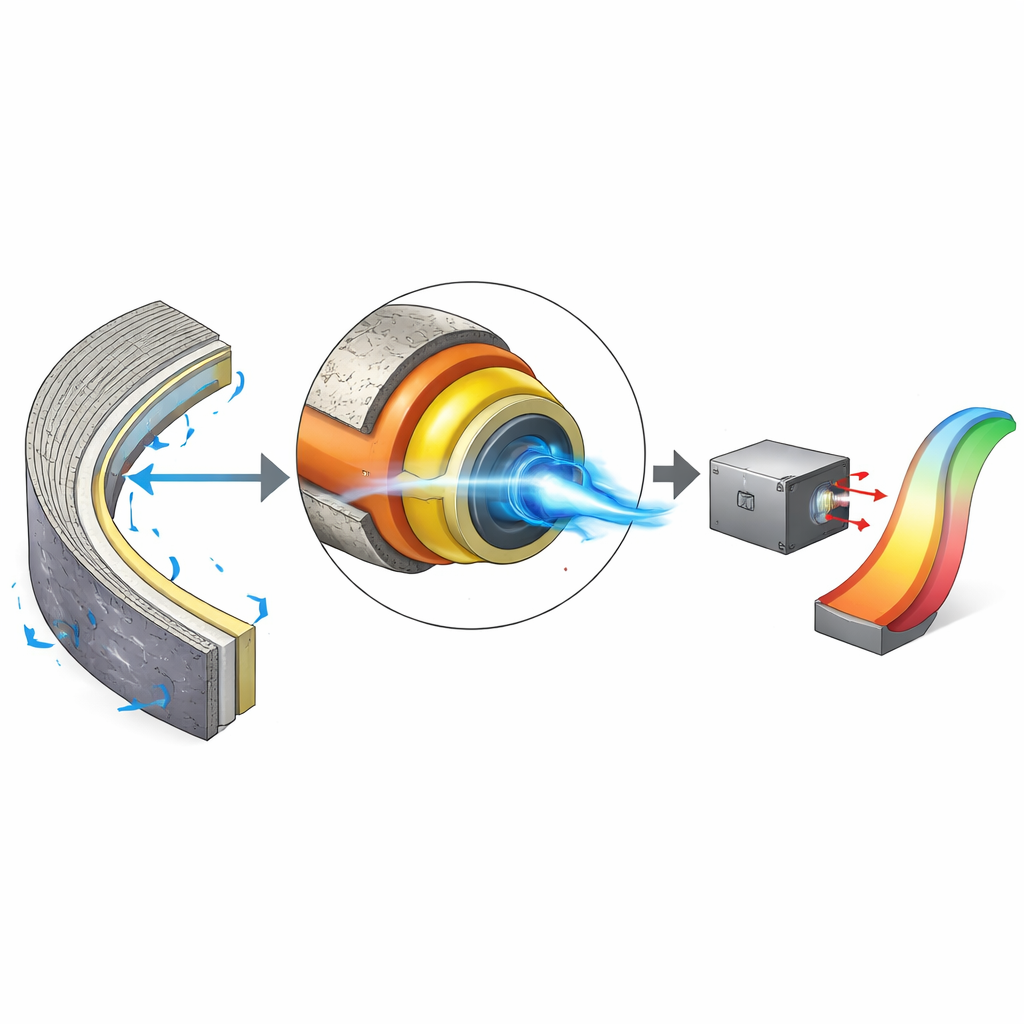
Traditional tunnel monitoring relies on separate instruments bolted to key spots in the lining. These devices can be accurate, but they measure only a few points and often require people on site to read and maintain them. Distributed optical fiber sensing offers a different approach: one cable, glued or cast into the concrete, can measure strain all along its length. The technology used here, called phase-sensitive optical time-domain reflectometry, sends short laser pulses down an ordinary-looking telecom cable and listens to the tiny echoes scattered back from imperfections in the glass. When the tunnel lining deforms, those echoes shift in a way that reveals how much the fiber has been stretched or compressed at thousands of locations.
Why Fiber and Concrete Do Not Move Alike
In real tunnel projects, the optical fiber cannot be left bare. It must be wrapped in protective layers of plastics and steel so it can survive bending, concrete pouring and construction impacts. These layers, however, mean the glass core does not deform exactly as the surrounding concrete does. The fiber is also sensitive to slow changes in temperature and to long-term creep, which cause a gradual drift in its strain readings even when the structure is at rest. If engineers used the raw fiber signals directly, they would misjudge how hard the tunnel lining is actually working. The heart of this paper is a way to translate what the protected fiber “feels” into the true strain of the tunnel concrete around it.
Building and Bending Model Tunnels
To uncover this translation, the team cast three large concrete beams with the same size and steel reinforcement pattern as a real tunnel lining. Inside the beams they installed both the armored optical cable and conventional electrical strain gauges at matching locations. They then carried out two types of tests. In the dynamic tests, the beams were loaded like a miniature bridge, increasing the force at a controlled rate while recording how both the fiber and the gauges responded. In the static tests, the beams were left unloaded for over half an hour to observe how the fiber strain crept over time under the influence of its own materials and the environment. The data showed that both structural strain and fiber strain increased in a nearly straight-line fashion with load and time, but at different rates.
Turning Fiber Readings into Structural Strain
By carefully fitting straight-line equations to the test results, the authors separated the fiber’s response into two parts: one due to the actual bending of the concrete, and one due to slow accumulation from environmental effects. They then derived a simple formula that converts fiber readings into the strain that an ordinary structural sensor would measure, while subtracting the time-dependent drift. On average, the concrete strain equals about 1.26 times the fiber strain, minus a small term that grows with monitoring time. When this conversion was applied in a real highway tunnel in Sichuan, China, the translated fiber results closely matched those from high-grade vibrating-wire gauges installed at the same spots, staying within about 5% of each other.
From Raw Data to Automatic Warnings
With confidence that the fiber readings truly represent tunnel behavior, the researchers went a step further and built a digital safety platform around them. In a demonstration tunnel, cables were laid in a U-shaped pattern along the vault, walls and lower side regions, and connected to a central unit that collected data every minute. Software inside the platform converted strain into stress, calculated how much axial force and bending moment the lining was carrying, and then evaluated a safety factor based on Chinese tunnel and concrete design codes. These values were compared against pre-set thresholds. If any section approached unsafe levels, the system was designed to trigger alarms in the monitoring room and send warning messages directly to workers’ phones, turning the fiber into the backbone of a real-time early-warning network.
Keeping Underground Work Safer
For non-specialists, the key outcome is that a single, rugged optical cable can now act as a continuous health monitor for a tunnel, provided its readings are translated correctly. This study shows how to establish that translation through controlled laboratory tests and confirms it in a real construction project. By combining the calibrated fiber measurements with automated analysis and clear safety thresholds, tunnel operators gain a way to watch the entire lining "breathe" as loads change, and to spot trouble before cracks or collapses occur. The approach points toward a future in which underground construction and operation are guarded by nervous systems of light, quietly tracking the safety of structures that most of us will never see.
Citation: Cao, K., Xie, Z., Zhou, F. et al. Transformation method of Φ-OTDR optical fiber strain and tunnel liner strain and its application in tunnel safety monitoring. Sci Rep 16, 13842 (2026). https://doi.org/10.1038/s41598-026-43749-5
Keywords: tunnel safety, optical fiber sensing, structural health monitoring, strain measurement, early warning systems