Clear Sky Science · en
Earthquakes induced by overpressure methane-bearing fluid in northwest Sichuan Basin, China
Hidden Forces Beneath Our Feet
Most of us think of earthquakes as the result of grinding tectonic plates. But deep underground, trapped fluids can quietly build up pressure until they suddenly break rock and shake the ground. This study focuses on methane-rich fluids more than four kilometers beneath the northwest Sichuan Basin in China. By reading chemical and structural clues locked inside tiny mineral veins, the authors show that extreme underground gas pressure alone can fracture rock and trigger local earthquakes—offering a rare, direct look at an invisible cause of seismic events.
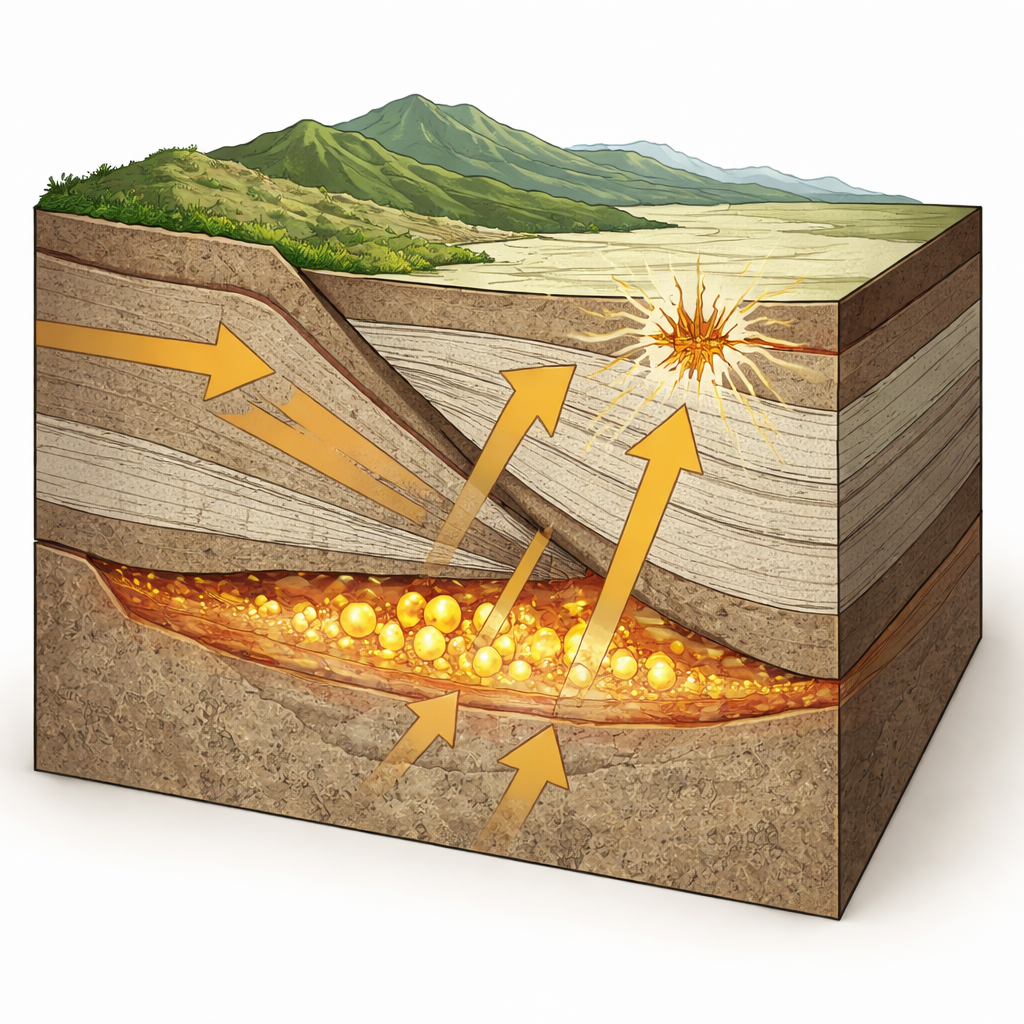
A Basin Shaped by Squeezing and Uplift
The Sichuan Basin lies along the eastern edge of the Tibetan Plateau, in a zone where the crust has been squeezed for tens of millions of years. As nearby mountain belts such as Longmen Mountain rose, they pushed the basin floor downward and sideways, creating a classic “foreland basin” setting. In this environment, thick stacks of sandstones, mudstones, and coal layers from the Triassic Xujiahe Formation were buried, folded, and cut by numerous faults and fractures. These rocks not only host important gas reservoirs, they also preserve abundant signs of past earthquakes, including micro-faults, torn fragments, liquefied sand veins, and shattered zones known as seismites.
Tiny Veins as Underground Pressure Gauges
To understand how fluids interact with earthquakes here, the researchers examined drilling cores from two deep wells. Within these cores, they focused on special horizontal fractures filled by multiple generations of calcite veins. Early veins grew as fibrous layers parallel to the rock bedding, a pattern known to form when fluid pressure is already unusually high. Later, sharp, cone-shaped calcite veins grew into these earlier layers. Under microscopes and cathodoluminescence imaging, the team could reconstruct the sequence: fractures opened under high fluid pressure, veins grew and partially sealed them, and then new pulses of fluid reopened and enlarged the same fractures.
Capturing Methane in Microscopic Pockets
The strongest clues came from fluid inclusions—microscopic pockets of trapped fluid inside the youngest calcite veins. Using laser Raman spectroscopy, the authors showed that many inclusions contained almost pure methane gas, sometimes with tiny amounts of solid bitumen. These methane-only inclusions are effectively sealed pressure capsules. By measuring how the Raman signal of methane shifts, and combining this with the trapping temperature recorded by rare coexisting water inclusions, the team calculated the original gas density and pressure when the inclusions formed. The results revealed extreme pressures between about 115 and 157 megapascals—roughly two times, or more, higher than the normal pressure expected at that burial depth during the Late Jurassic.
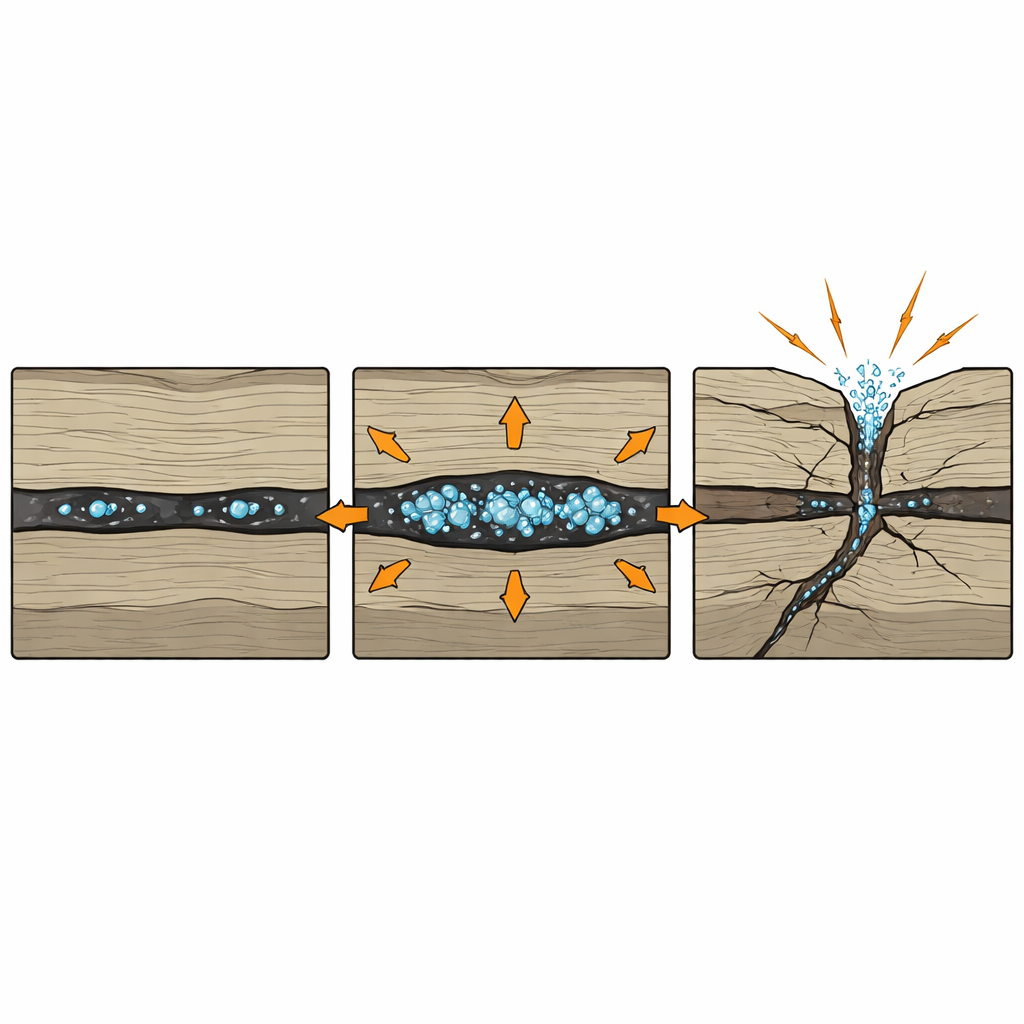
Building to a Breaking Point
The study pieces together how such overpressure developed and what happened when it was finally released. Over time, regional compression from the foreland basin pushed methane-rich fluids into sealed horizontal fractures in the Xujiahe Formation. Because the surrounding rocks were strongly compacted and cemented, they could withstand unusually high internal fluid pressure without immediately failing. As methane kept flowing in, the fractures widened enough to allow the cone-shaped calcite veins to grow, while the trapped fluids became increasingly overpressured. Eventually, the pressure exceeded what the rock could bear. At weak points, the fractures suddenly ruptured, forcing the cone-shaped veins to pierce earlier fibrous veins on the opposite wall—a frozen record of an abrupt pressure drop and fracture closure.
From Silent Gas to Shaking Ground
The authors argue that such sudden releases of overpressured methane would have disturbed the local stress field and generated localized earthquakes. This idea is strongly supported by the abundance of brittle deformation and seismites throughout the same rock layers, which show that earthquakes repeatedly affected already hardened rocks after they formed. Put simply, the rocks of the Xujiahe Formation record both the buildup of extreme gas pressure and the scars of the quakes that followed its release. For non-specialists, the key message is that some earthquakes may be driven not only by the slow movement of plates, but also by the rapid discharge of deeply trapped, high-pressure fluids like methane—an invisible force that can suddenly turn quiet rock into a source of seismic shaking.
Citation: Song, Y., Chen, Y., Zhao, Z. et al. Earthquakes induced by overpressure methane-bearing fluid in northwest Sichuan Basin, China. Sci Rep 16, 13572 (2026). https://doi.org/10.1038/s41598-026-43747-7
Keywords: earthquakes, methane overpressure, Sichuan Basin, fluid-induced seismicity, foreland basin