Clear Sky Science · en
Sustainable synthesis and characterization of high-surface-area activated carbons from walnut and pistachio shell wastes via chemical activation
Turning Nut Shells into a Clean-Water Tool
Every year, food processing leaves behind mountains of walnut and pistachio shells that are usually burned or thrown away. This study shows how those humble leftovers can be transformed into a powerful sponge-like material called activated carbon, capable of trapping pollutants from water and air. By turning waste into a cleanup tool, the work connects everyday snacks with the global challenge of safe drinking water and environmental protection.
Why Cleaner Water Needs Better Sponges
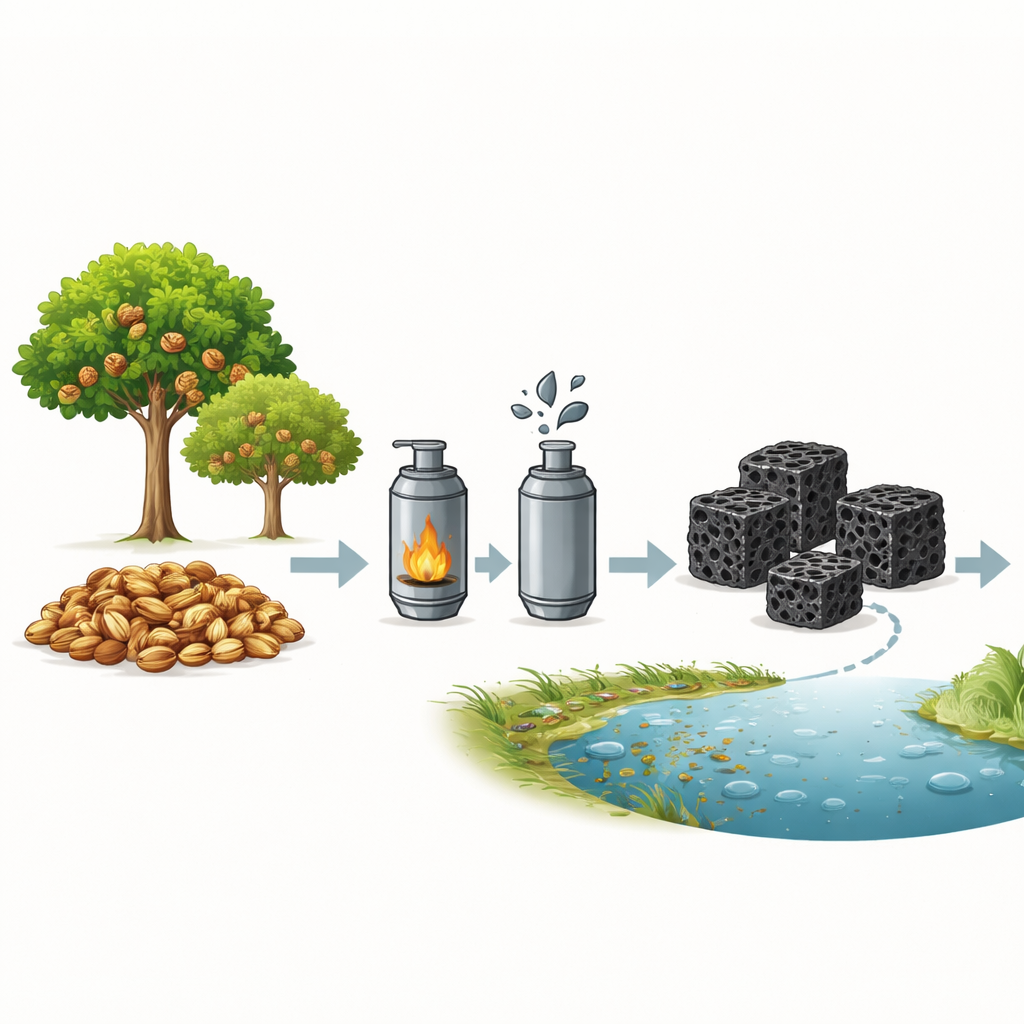
Water pollution is one of the most pressing environmental threats, as chemicals, dyes, and other contaminants seep into rivers and groundwater. One of the simplest ways to clean water is to pass it through a solid material that acts like a sponge, capturing unwanted substances on its surface. The more internal nooks and crannies this material has, the better it can trap pollutants. Activated carbon is a leading candidate because it is full of tiny pores and has an enormous internal surface area packed into a small amount of material. The key question is how to make such high-performance carbon cheaply, safely, and from resources that do not compete with food or fuel.
From Shell Waste to Porous Carbon
The researchers focused on the outer green shells of walnuts and the pink outer shells of pistachios, common agricultural wastes in Türkiye. Without any complex preparation, these shells were first heated in the absence of oxygen to turn them into a basic carbon-rich solid. This intermediate material was then treated with chemical agents and heated again, a step that carves out an intricate network of pores. Two chemicals were compared: potassium hydroxide (KOH), used at three different strengths, and zinc chloride (ZnCl₂), used at a single standard strength. By changing the shell type and the chemical treatment, the team could see which combinations created the best “sponge” structure for capturing pollutants.
Building a Forest of Hidden Cavities
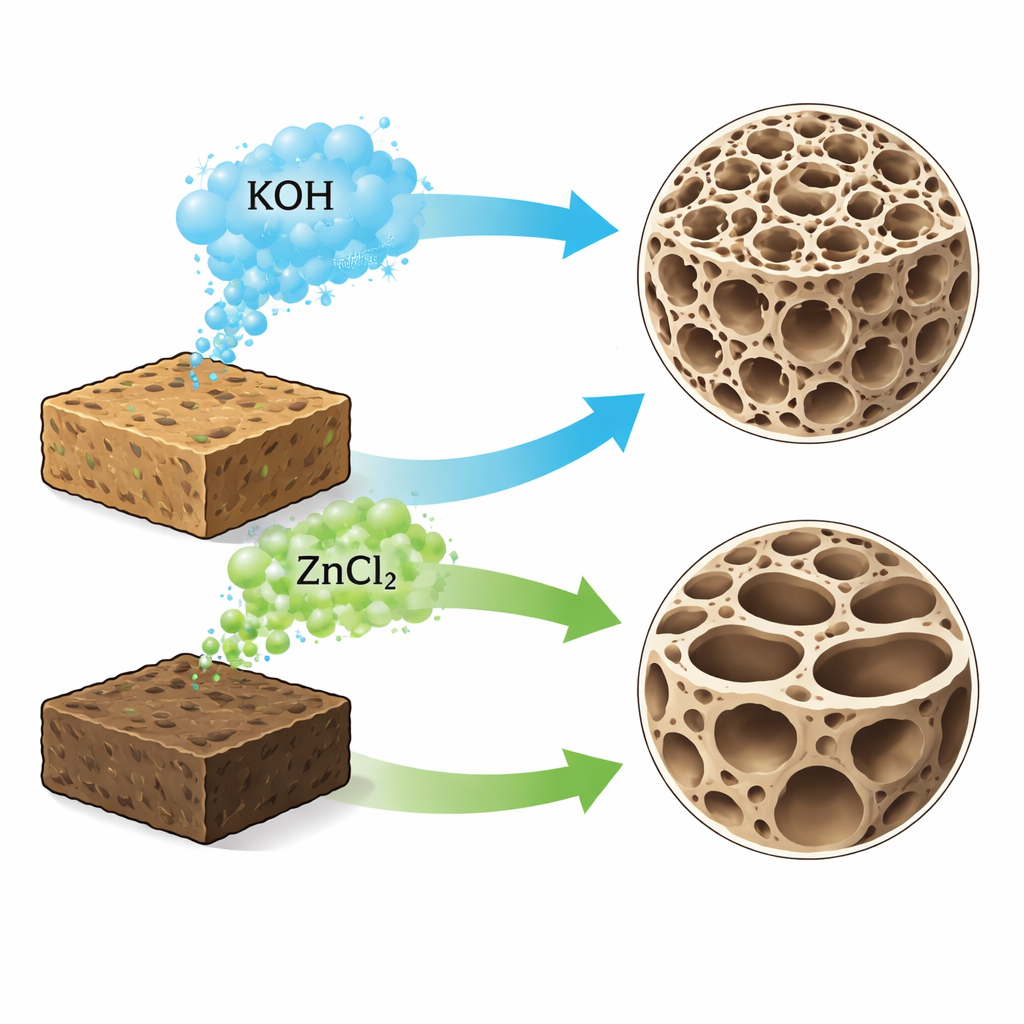
Detailed measurements showed that both the type of shell and the chemical treatment strongly shaped the final material. Walnut shells emerged as the star ingredient: when treated with the strongest KOH recipe, the resulting carbon had an exceptionally large internal surface area, more than 2,300 square meters in a single gram—roughly the area of half a soccer field packed into a pinch of powder. Pistachio shells also produced highly porous carbons, but with somewhat lower surface areas. In contrast, the zinc-based treatment produced fewer and simpler pores in both shell types. Microscopy images revealed that KOH carved deep, interconnected channels and rough surfaces, while ZnCl₂ mainly created shallower, bowl-like pits. Other tests confirmed that the carbons were mostly disordered, defect-rich forms of carbon, which actually helps create more places for pollutants to stick.
Tuning Shape and Chemistry for Better Capture
Beyond the sheer number of pores, their sizes and the chemical nature of the carbon surface also matter. The KOH-treated samples developed a “hierarchical” network: many tiny pores for grabbing small molecules, connected by slightly larger channels that help liquids and gases move through the material. This structure is ideal for real-world filters, where both high capacity and easy flow are important. Element tests showed that KOH treatment removed much of the original oxygen and other elements from the shells, concentrating the carbon and rearranging it into more aromatic, ring-like structures. The zinc-based treatment, by contrast, left more oxygen-containing groups on the surface, which could influence how specific pollutants interact with the carbon but came at the cost of lower overall surface area.
What This Means for Waste and Water
In plain terms, the study demonstrates that discarded walnut and pistachio shells can be turned into advanced filtering materials, with walnut shells plus strong KOH treatment giving the most impressive results. These nut-shell carbons rival or exceed many traditional activated carbons made from coal or other biomass, while starting from a renewable and otherwise troublesome waste. Although the process still relies on high temperatures and chemicals that must be managed carefully, it points toward a future where food industry leftovers help clean up polluted water, capture gases, and support green technologies, closing a loop between waste generation and environmental protection.
Citation: Kuyucu, A.E., Selçuk, A., Önal, Y. et al. Sustainable synthesis and characterization of high-surface-area activated carbons from walnut and pistachio shell wastes via chemical activation. Sci Rep 16, 12776 (2026). https://doi.org/10.1038/s41598-026-43746-8
Keywords: activated carbon, agricultural waste, water purification, biomass valorization, porous materials