Clear Sky Science · en
Advanced mirror shapes for mode enhancement in plano-concave cavities
Sharper Mirrors for Sharper Quantum Light
Many of tomorrow’s quantum technologies, from ultra-secure communication links to powerful new computers, rely on getting single particles of light to interact strongly with individual atoms or other tiny emitters. This paper explores a deceptively simple idea: by slightly reshaping one mirror in a common type of optical cavity, the authors show that you can dramatically boost these light–matter interactions without making the hardware much more complicated or fragile.
Why Quantum Devices Need Better Cavities
In a wide range of quantum experiments, light is bounced back and forth between two mirrors to form an optical cavity. Placing an atom, ion, or quantum dot inside this cavity allows it to exchange energy with a single mode of light much more efficiently, which is essential for tasks like generating single photons on demand or reading out the state of a qubit. Traditionally, experimenters use two curved mirrors facing each other, which can focus light strongly but are extremely sensitive to tiny misalignments. A popular alternative uses one flat and one curved mirror, a “plano‑concave” setup that is far more forgiving to alignment errors and requires only one precision‑machined curved surface. However, this simple geometry normally cannot squeeze the light tightly enough around an emitter placed in the middle of the cavity, limiting its usefulness for high‑performance quantum devices. 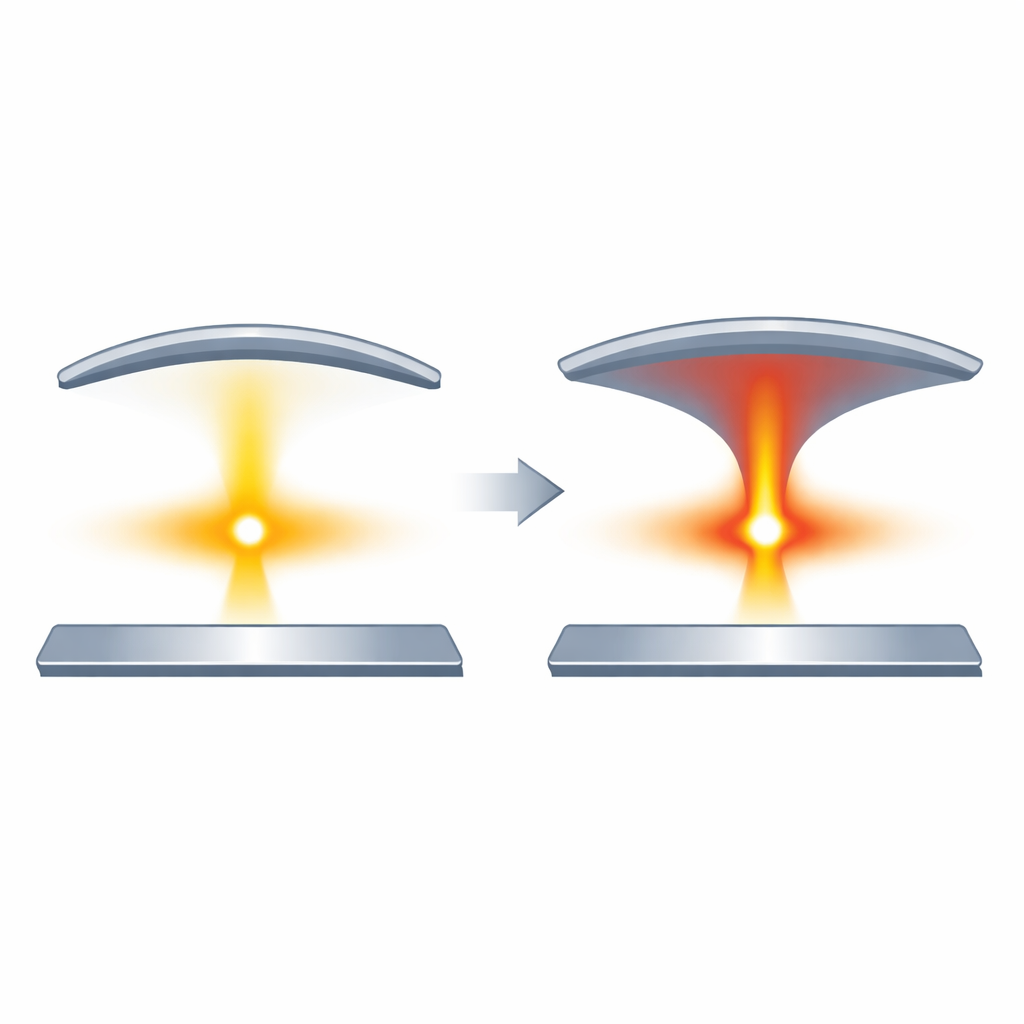
Measuring How Well a Cavity Can Perform
To compare different cavity designs in a fair way, the authors focus on an “internal cooperativity” figure of merit. In everyday terms, this quantity captures how strongly a typical emitter could interact with the stored light, divided by how quickly energy is lost inside the cavity through scattering or absorption. It depends on two main ingredients: how tightly the light is focused where the emitter sits, and how small the unavoidable losses inside the cavity are. Crucially, this metric does not depend on how transparent the mirrors are to the outside world, something experimentalists can usually tune later by choosing different coatings. That makes internal cooperativity a clean yardstick for asking how much performance is fundamentally available from a given geometry and mirror shape.
What Limits Traditional Mirror Shapes
Using standard Gaussian beam optics, the authors first work out how well idealized cavities with simple spherical mirrors can do. In a two‑curved‑mirror design, you can in principle make the light spot at the center very small by choosing the right mirror curvature and spacing, but this rapidly makes the system extremely sensitive to mirror misalignment and causes light to spill over the mirror edges. In a plano‑concave cavity with a spherical curved mirror, the situation is different: because the light naturally focuses on the flat mirror, not at the center, there is a hard limit to how tightly it can be concentrated around a central emitter, even if the mirrors are large and nearly perfect. This basic geometric limitation means that plano‑concave cavities with spherical mirrors fall well short of the best possible interaction strengths set by the cavity’s overall size and numerical aperture.
How Shaped Mirrors Unlock Hidden Performance
To overcome this geometric roadblock, the authors use numerical simulations to explore non‑spherical mirror profiles for the curved mirror in a plano‑concave cavity. Modern fabrication methods, such as focused ion beam milling and laser ablation, already allow experimenters to sculpt micrometer‑scale mirror surfaces with considerable freedom. The team studies two design strategies. In one, they first optimize a target light pattern that would maximize internal cooperativity and then reconstruct a mirror surface that “retroreflects” it back into the cavity. In the other, they restrict themselves to simpler, experimentally friendly shapes—such as Gaussian‑like depressions, mirrors with two smoothly connected curvatures, and parabolic mirrors modified by a spline curve—and adjust only a few parameters. Both approaches show that by letting the light pattern depart from the textbook Gaussian shape and better fill the available mirror area, the cavity can focus much more strongly on a central emitter.
Balancing Performance and Practicality
The simulations reveal that carefully shaped mirrors in a plano‑concave cavity can boost the internal cooperativity by up to an order of magnitude compared with the best spherical plano‑concave design, and can even rival—or surpass—more alignment‑sensitive two‑curved‑mirror cavities when realistic misalignments are taken into account. The most aggressively optimized mirror profiles achieve the highest gains but tend to work only over a very narrow range of cavity lengths, making them hard to tune in the lab. By contrast, the simpler few‑parameter shapes still capture most of the potential improvement while remaining reasonably tolerant to fabrication errors, small changes in cavity length, and modest mirror tilts. The authors map out how this trade‑off plays out as the mirror diameter and other geometric constraints change, and suggest practical criteria for deciding when shaped plano‑concave cavities should be favored over conventional designs. 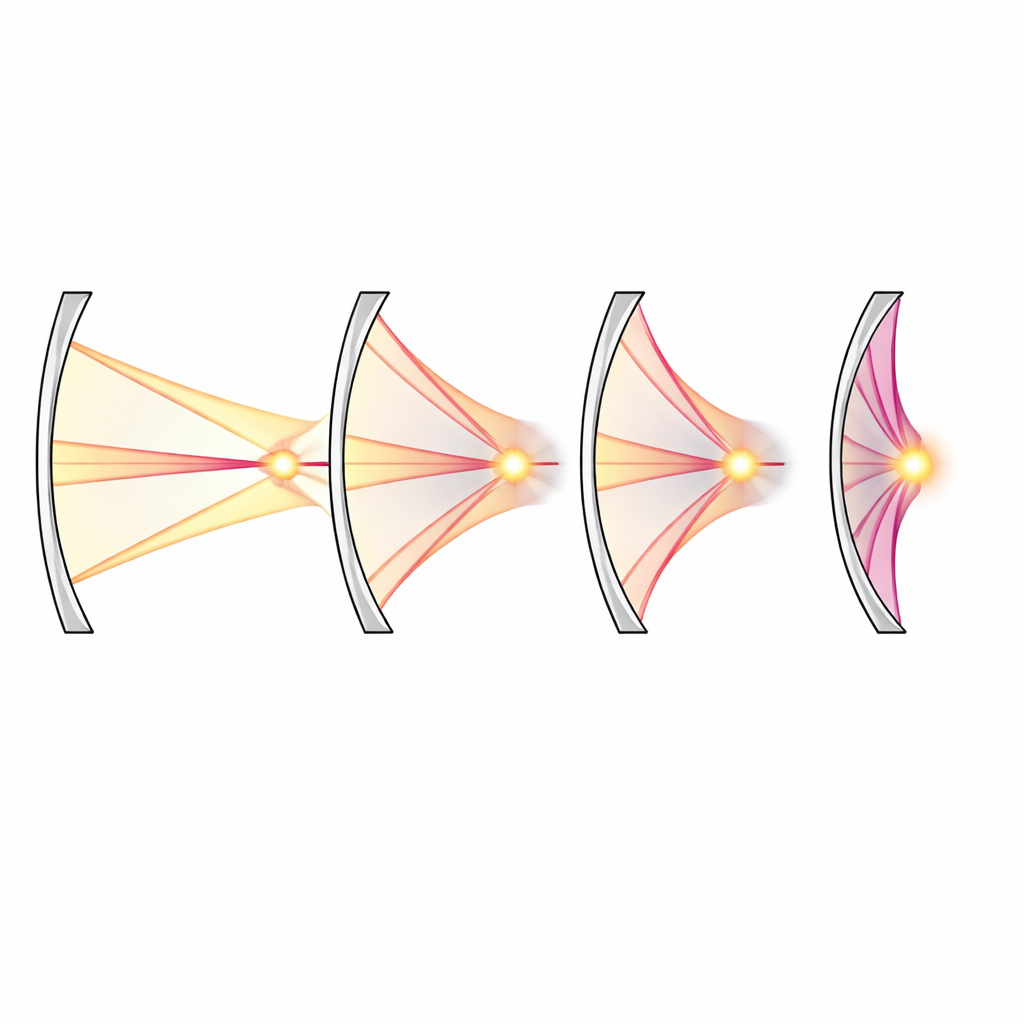
What This Means for Future Quantum Devices
In summary, the work shows that a modest change in mirror geometry can transform a widely used but limited cavity design into a serious contender for demanding quantum applications. By tailoring the shape of a single curved mirror, experimenters can keep the mechanical robustness and simple alignment of plano‑concave cavities while accessing much stronger light–matter coupling at comfortable emitter–mirror distances. This could directly translate into faster, higher‑fidelity single‑photon sources, more reliable qubit readout, and more scalable quantum network nodes. The study thus provides both a roadmap and a set of design tools for making quantum‑ready optical cavities that are easier to build, align, and operate in real‑world laboratories.
Citation: Hughes, W.J., Horak, P. Advanced mirror shapes for mode enhancement in plano-concave cavities. Sci Rep 16, 13101 (2026). https://doi.org/10.1038/s41598-026-43741-z
Keywords: optical cavities, quantum emitters, mirror shaping, plano-concave resonators, cavity quantum electrodynamics