Clear Sky Science · en
The impact of improved export quality on urban green total factor productivity
Why Cleaner Exports Matter for City Life
As more people move into cities, local leaders face a twin challenge: keep the economy growing while cutting pollution and waste. This study explores an underappreciated piece of that puzzle—how the quality of what cities sell to the world, not just how much they sell, can quietly reshape urban economies to be cleaner and more efficient. By looking closely at 120 Chinese cities over a decade, the authors show that better-made, more advanced exports can nudge cities toward greener growth, especially when paired with strong digital technology and innovation.
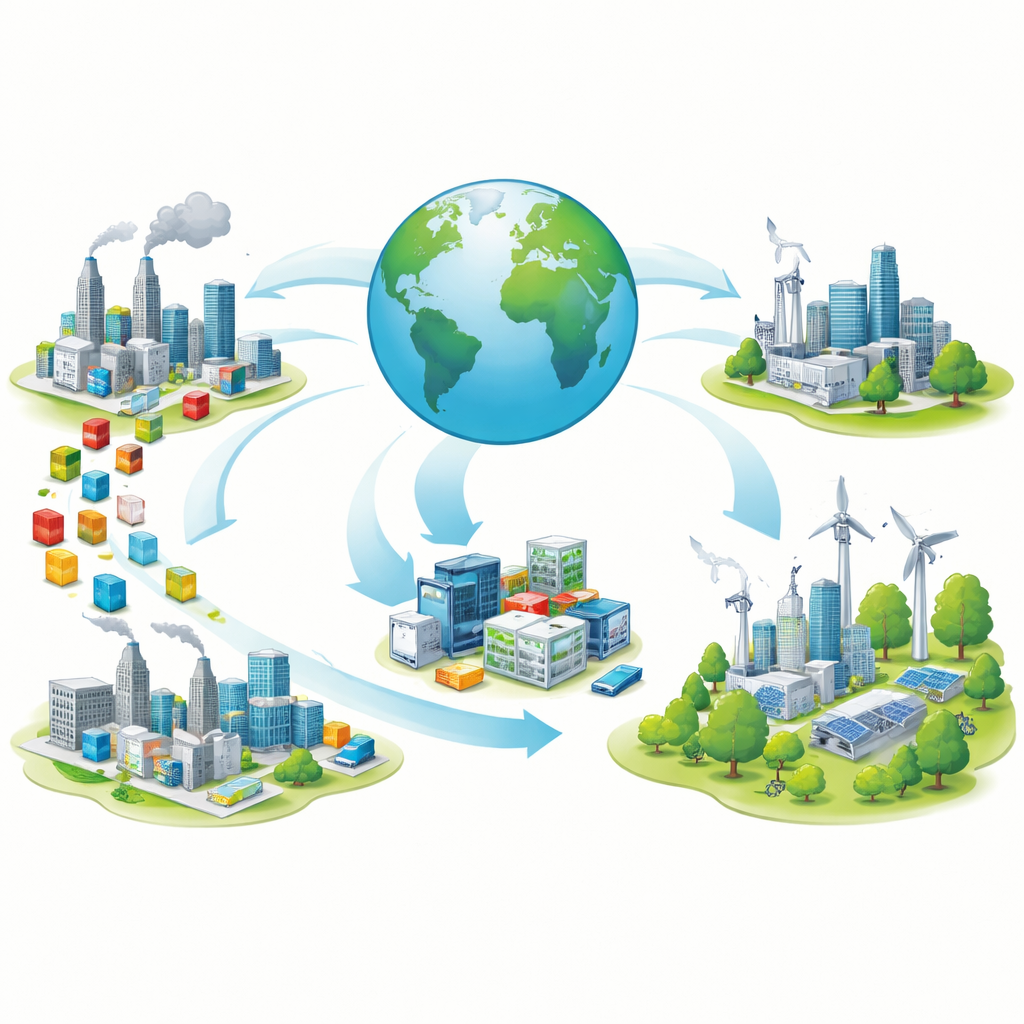
From Factory Exports to Greener Growth
The researchers focus on a concept called “urban green total factor productivity,” which, in simple terms, measures how well a city turns labor, capital, and energy into useful goods and services while limiting pollution. Instead of treating exports as just tons of goods shipped abroad, the study zeroes in on export quality—products that are more technologically advanced, higher value, and often more environmentally friendly. Using detailed trade and city statistics from 2011 to 2021, they track whether places that move up the ladder toward higher-quality exports also become better at growing with less environmental damage.
Measuring Quality, Pollution, and Efficiency
To make this concrete, the authors build a score for each city that blends together export prices, product types, and their share in the city’s overall export mix. Higher unit prices, after careful adjustment, are treated as signs of better product quality, such as more sophisticated machinery or cleaner technologies. On the environmental side, the team uses a method that counts both good outcomes (like economic output and cleaner energy use) and bad ones (like wastewater, sulfur emissions, and solid industrial waste). This allows them to ask not just whether a city is richer, but whether it is getting more output per unit of resource and pollution.
What the Data Say About Quality and the Green Shift
The results reveal a clear pattern: cities that raise their export quality see consistent gains in green productivity. A 1% improvement in export quality is linked to roughly a 0.03% rise in this greener efficiency measure. That might sound small, but for large urban economies the effect adds up over time and is comparable to other well-known policy levers. Importantly, the relationship looks smooth and linear—there is no sign that cities “max out” on the benefits of better exports within the observed range. Extensive checks, including cutting the sample period, dropping China’s biggest municipalities, shuffling the data as a placebo test, and using alternative ways to measure quality, all point in the same direction.

Why Some Cities Benefit More Than Others
The study also shows that context matters. Cities with strong digital innovation—signaled by more digital-related patents—are much better at turning export upgrades into cleaner growth. Green inventions and a shift from heavy industry toward services provide additional, though slightly smaller, boosts. Market openness, captured by how much a city trades relative to its size, further helps by easing the flow of advanced technologies and foreign know-how. Large and coastal cities, which tend to have better infrastructure, more skilled workers, and deeper global links, reap the biggest rewards from higher export quality. Smaller and inland cities benefit too, but their weaker innovation systems and industrial bases limit how far export upgrades can move the environmental needle.
What This Means for Everyday Urban Futures
For non-specialists, the takeaway is straightforward: it is not only how fast a city exports that shapes its environmental future, but what it exports and how prepared it is to use trade as a springboard for cleaner technologies. Better-made, higher-value products go hand in hand with more efficient factories, smarter use of energy, and less waste—especially where digital tools, green research, and open markets are in place. The authors argue that policies that push export quality, support digital and green innovation, and tailor support to different types of cities can help turn trade from a source of pollution into a driver of healthier, more sustainable urban life.
Citation: Tian, L., Kumarusamy, R. The impact of improved export quality on urban green total factor productivity. Sci Rep 16, 14662 (2026). https://doi.org/10.1038/s41598-026-43733-z
Keywords: export quality, green productivity, urban sustainability, digital innovation, China cities