Clear Sky Science · en
Adaptive ultra-short-wave parameter distribution based on ARIMA-predicted fountain codes
Faster setup for emergency radios
When disaster strikes or troops are on the move, mobile radio networks must be set up quickly so teams can talk securely. Before anyone can communicate, each radio needs a bundle of digital settings, or “parameters,” loaded into it. Today this is often done by hand with USB drives, which is slow and labor‑intensive. This paper presents a smart wireless method that sends those settings over rugged ultra‑short‑wave links, cutting the time and radio traffic needed to bring a whole network online.
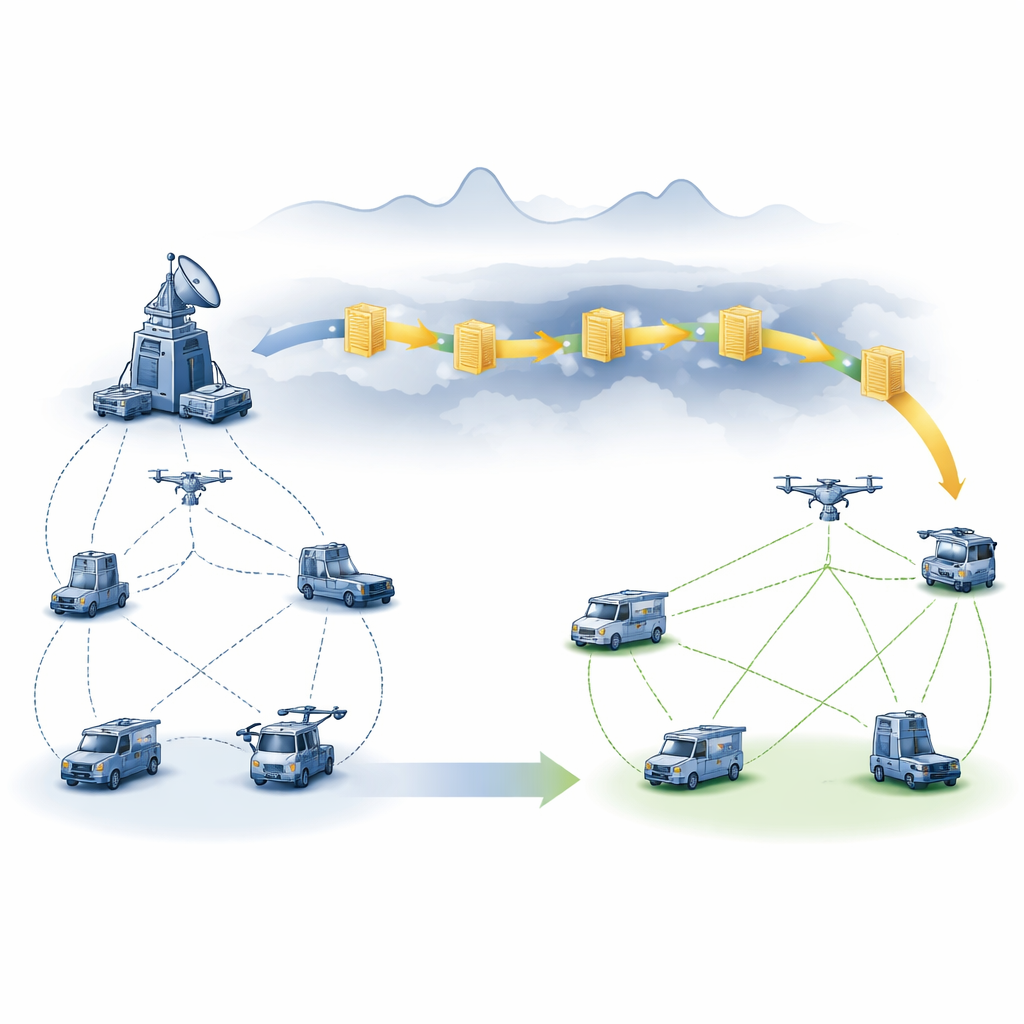
The challenge of talking through a noisy airwave
Ultra‑short‑wave channels are attractive because they reach far and work in rough terrain, but they are also narrow, noisy, and prone to losing packets of data. Traditional internet protocols like TCP constantly ask the receiver to confirm what arrived and resend anything missing. On a fragile radio link, that back‑and‑forth quickly clogs the channel. Even lighter‑weight protocols such as UDP either sacrifice reliability or depend on repeated transmissions from the sender, which again wastes precious airtime. For large sets of configuration files that must reach many mobile units, these approaches make network activation slow and uncertain.
A digital “fountain” for more reliable files
The authors build on a family of techniques called fountain codes, which treat the file to be sent as if it were broken into many tiny droplets. The sender keeps generating mixed droplets, and the receiver only needs to collect slightly more than the original amount to reconstruct the full file. This has two big advantages for shaky radio links: it removes the need for constant feedback, and it tolerates missing packets gracefully. In the proposed system, parameter files are first compressed, sliced into uniform pieces, and then turned into fountain‑coded droplets. These droplets are wrapped in a lightweight message format over UDP and broadcast through the ultra‑short‑wave channel until the receiver has enough to rebuild the compressed file and, after decompression, the original parameters.
Teaching the system to anticipate bad conditions
Simply adding a fixed amount of extra droplets is not ideal. If the air is very noisy and many packets vanish, too little redundancy means the receiver cannot rebuild the file. If the air is clear, too much redundancy wastes bandwidth and time. The key idea of this paper is to let the sender predict how harsh the channel will be in the next round and adapt the amount of redundancy on the fly. To do this, the receiver quietly keeps track of how many packets were lost in each past transfer and sends that summary back. The sender feeds this history into a classic time‑series method called ARIMA, which is well suited to short records and modest processors. The model forecasts the next packet loss rate, and a simple formula converts that forecast into the minimum number of extra droplets needed, with a small safety margin to cover surprises.
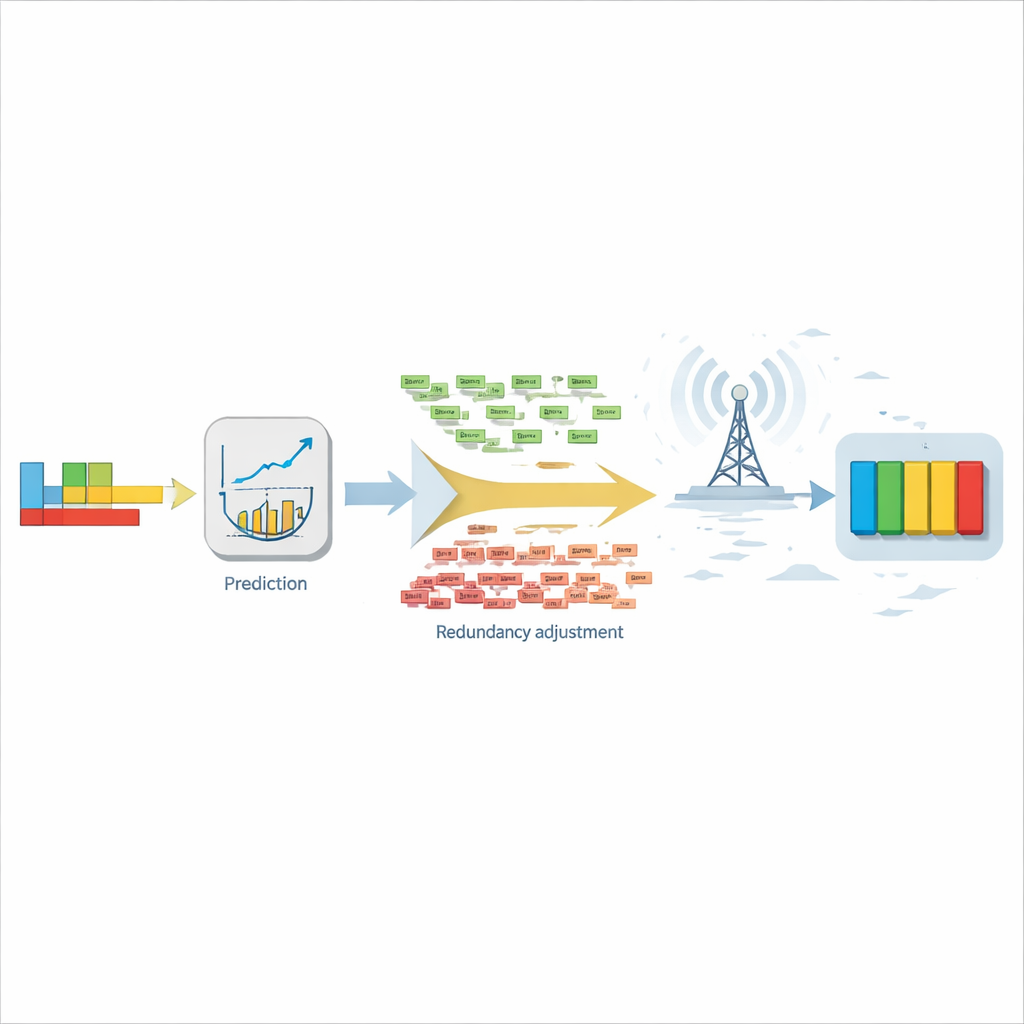
Putting prediction and coding to the test
The researchers evaluate their design through detailed simulations that mimic real ultra‑short‑wave behavior, including clusters of errors and sudden interference bursts. They compare two strategies: one that always assumes a fixed packet loss rate, and their prediction‑based strategy that adjusts redundancy each time. The ARIMA predictor keeps its average error below 9.2% and clearly outperforms simple moving‑average guesses. When coupled to fountain coding, the adaptive scheme keeps the decoding success rate above 99% across a wide range of conditions, even when error bursts strike. Under good channels it can cut the amount of data sent by up to 18%, and over typical loss levels between 0% and 30% it reduces traffic by about 12.4% on average. Because it almost eliminates the need for retransmissions, the overall speed of activating a system improves by roughly 18.3% in the simulations.
Why this matters for real‑world radio networks
For field operators, the bottom line is a method that gets radios configured faster and more reliably over tough links, without demanding powerful hardware. The combination of a lightweight predictor and smart redundant coding forms a closed loop: the channel’s past behavior informs the next encoding decision, which in turn shields against upcoming losses. This makes better use of scarce spectrum, keeps the radios’ processors busy for only a few milliseconds per file, and scales from small to large parameter sets. In practical terms, emergency responders or tactical units could roll out secure communication networks more quickly, with fewer manual steps and less waiting for files to trickle through unreliable airwaves.
Citation: Li, C., Li, Z. Adaptive ultra-short-wave parameter distribution based on ARIMA-predicted fountain codes. Sci Rep 16, 13918 (2026). https://doi.org/10.1038/s41598-026-43727-x
Keywords: ultra short wave communication, fountain codes, wireless parameter distribution, packet loss prediction, adaptive error control