Clear Sky Science · en
Functional and structural connectome-based predictive modelling of balance in elderly adults
Why Staying Steady Matters
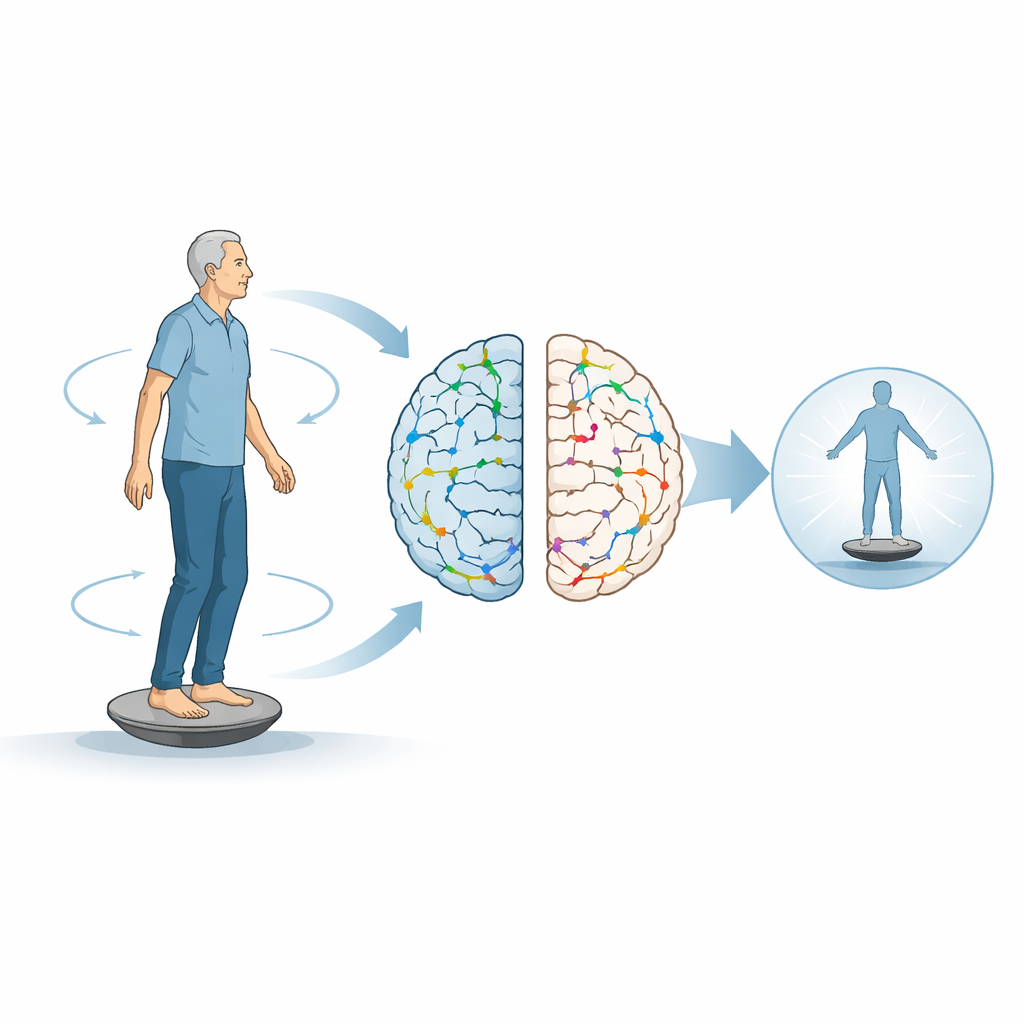
As we grow older, simply standing upright on an uneven surface can become a serious challenge. Loss of balance leads to falls, broken bones, and loss of independence. This study asked a deceptively simple question: can we look at the wiring and activity patterns of the brain at rest and predict how well an older adult will keep their balance on an unstable board? By combining advanced brain scans with a data-driven analysis, the researchers begin to map the hidden networks that help seniors stay on their feet.
Looking Inside the Aging Brain
The team recruited 54 healthy adults between 64 and 82 years old. Each person had detailed MRI scans at an ultra‑high magnetic field, which allowed the scientists to capture two kinds of information. First, they measured the brain’s physical wiring: bundles of nerve fibers that connect different regions, known as structural connections. Second, they recorded spontaneous activity while participants rested quietly, revealing which regions tend to fire together, known as functional connections. Using a standard atlas that divides the brain into 268 areas, they turned these scans into large connection maps, or “connectomes,” for every person.
Testing Balance on Shaky Ground
To measure balance, participants stood on a wobble board placed on a force plate, feet apart and hands on hips, while focusing on a fixed point on the wall. The rounded base of the board made the surface deliberately unstable. From the force plate, the researchers calculated how much each person’s center of pressure wandered over 20‑second trials. This produced a sway area: a smaller area meant steadier balance, while a larger area meant more wobbling. The lowest sway area across two attempts was taken as each person’s balance score.
Teaching Computers to Read Brain Networks
Armed with brain networks and balance scores, the researchers used a machine‑learning approach called connectome‑based predictive modeling. In essence, they let the computer search across all possible connections to find patterns that tracked with better or worse balance, while holding out one person at a time to test prediction accuracy. They built separate models from functional and structural networks, focusing on connections where stronger or weaker links were reliably tied to sway area. Only those edges that consistently helped prediction across cross‑validation runs were kept in a final “consensus” network for each scan type.
The Brain Circuits Behind Steady Steps
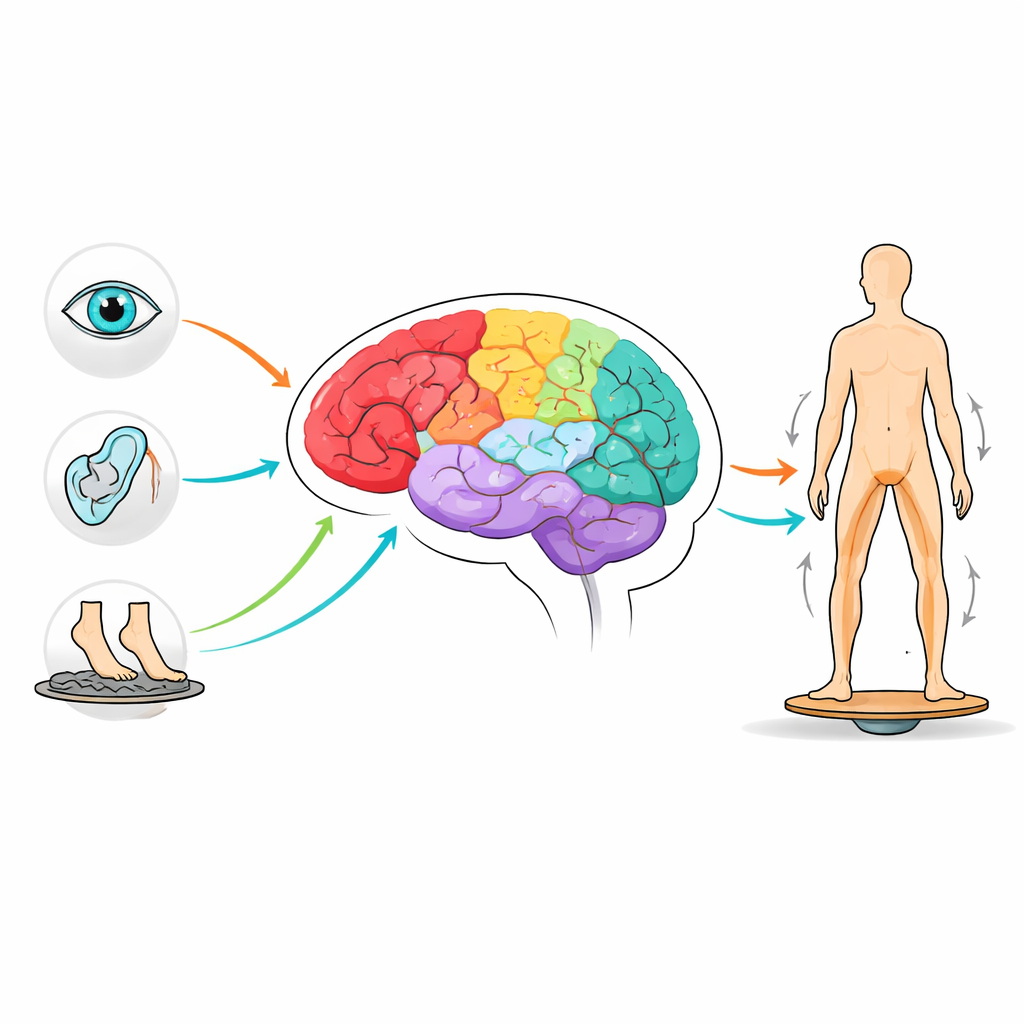
Both types of brain maps turned out to be informative. Specific sets of connections in the resting‑state functional data predicted who would wobble more or less, and a parallel—but not identical—set of structural connections did the same. In both cases, the most important links tied together the brain’s movement regions and deep structures such as the basal ganglia and thalamus, as well as networks in the frontal and parietal lobes involved in attention and control. Interestingly, structural connections that bridged movement and frontal areas with visual regions were strong predictors of balance, whereas their functional counterparts at rest contributed little. Across a second testing session three months later, structural networks provided more stable predictions than functional ones. Crucially, when the same models were asked to predict leg strength in a separate task, they failed—suggesting these brain patterns are specific to balance rather than general physical ability.
What This Means for Everyday Life
In plain terms, this work shows that how well older adults stay upright on a moving surface can be forecast by looking at the architecture and quiet activity of their brain networks. The most informative features are not single “balance centers,” but coordinated pathways linking movement regions, deep relay hubs, frontal control areas, and visual systems. Structural wiring, in particular, seems to offer a stable fingerprint of balance capacity over time. While still preliminary and based on a modest number of participants, these findings point toward a future in which brain‑based measures could help identify seniors at high risk of falling and guide training or rehabilitation programs that strengthen the specific brain circuits needed to keep them safely on their feet.
Citation: Liu, X., Scherrer, S., Egger, S. et al. Functional and structural connectome-based predictive modelling of balance in elderly adults. Sci Rep 16, 13954 (2026). https://doi.org/10.1038/s41598-026-43724-0
Keywords: balance, aging, brain networks, MRI, falls