Clear Sky Science · en
Crack propagation mechanism and life prediction of liner under thermal fatigue loads
Why tiny cracks in jet engines matter
Modern jet engines run hotter than ever to squeeze more power and fuel efficiency from every drop of fuel. But the thin metal shell that lines the combustor—the chamber where fuel burns—pays a price for this heat. With each takeoff and landing, that shell is heated and cooled, again and again, until small cracks can appear and grow. This study investigates how those cracks spread in a real engine liner and introduces a fast way, using a modern machine‑learning model, to predict how long the liner can safely stay in service before a crack becomes dangerous.
Heat, metal, and repeated stress
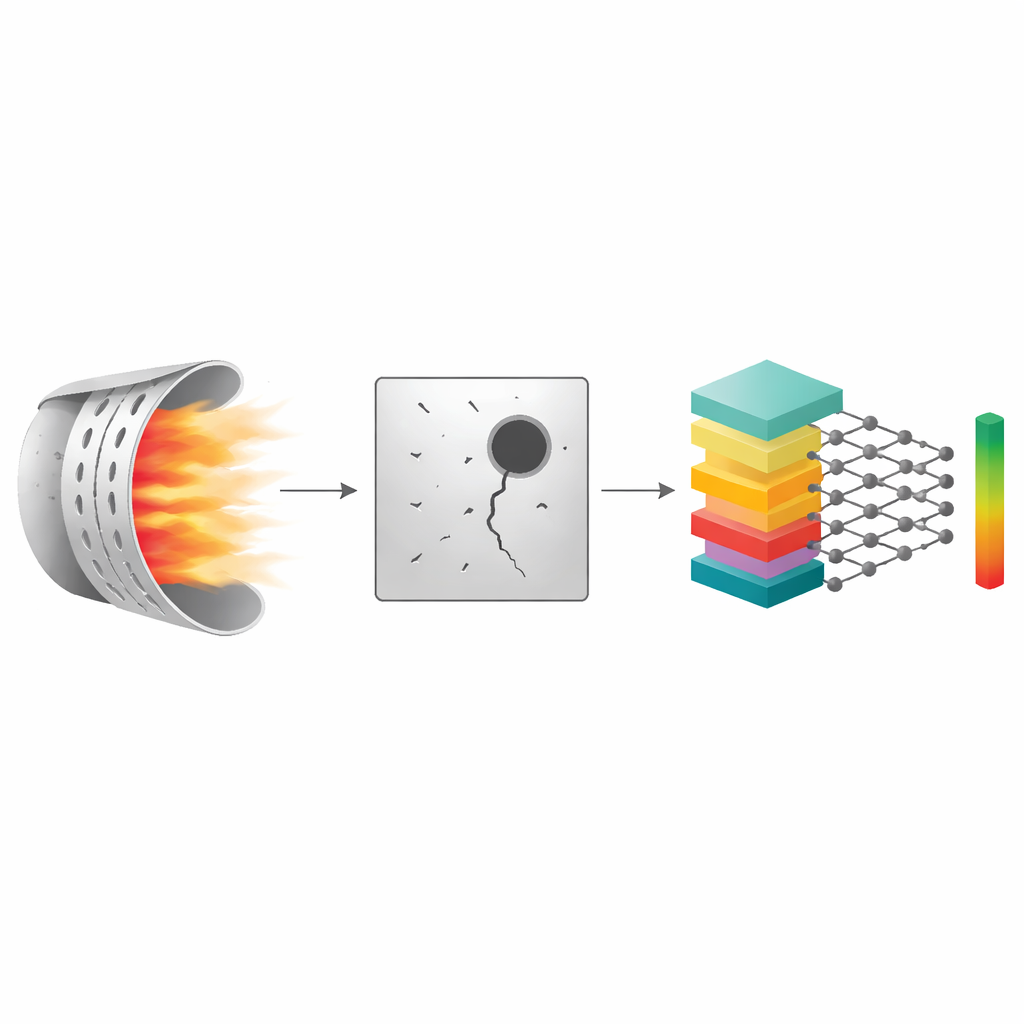
Inside a jet engine combustor, temperatures can exceed 2,000 degrees Celsius, while the metal walls are cooled by air that seeps through many tiny, angled holes. The liner is thin, full of these holes, and exposed to steep temperature swings as the engine cycles between idle and full power. This combination creates intense thermal stresses that concentrate around the edges of the cooling and fuel holes. Past failure records show that most combustor problems originate in the liner, and inspections often reveal cracks starting near these holes. Understanding exactly where these cracks form and how they grow is crucial for designing longer‑lasting engines and planning maintenance before a problem becomes critical.
Building a high‑detail digital twin
The researchers built a detailed computer model of a real combustor liner, capturing the flow of hot gas, the cooling air, and the resulting temperature distribution across the metal. They then converted this temperature field into a map of thermal stresses in the liner wall. Focusing on a small but critical region around a primary combustion hole, they created a fine‑mesh structural model that could follow the growth of a crack step by step. Under simulated engine cycles—alternating between ground idle and maximum takeoff thrust—the model tracked how a crack advanced until it reached about 3 millimeters, a size at which the liner’s cooling performance and structural safety are seriously compromised.
How crack shape and direction change lifetime
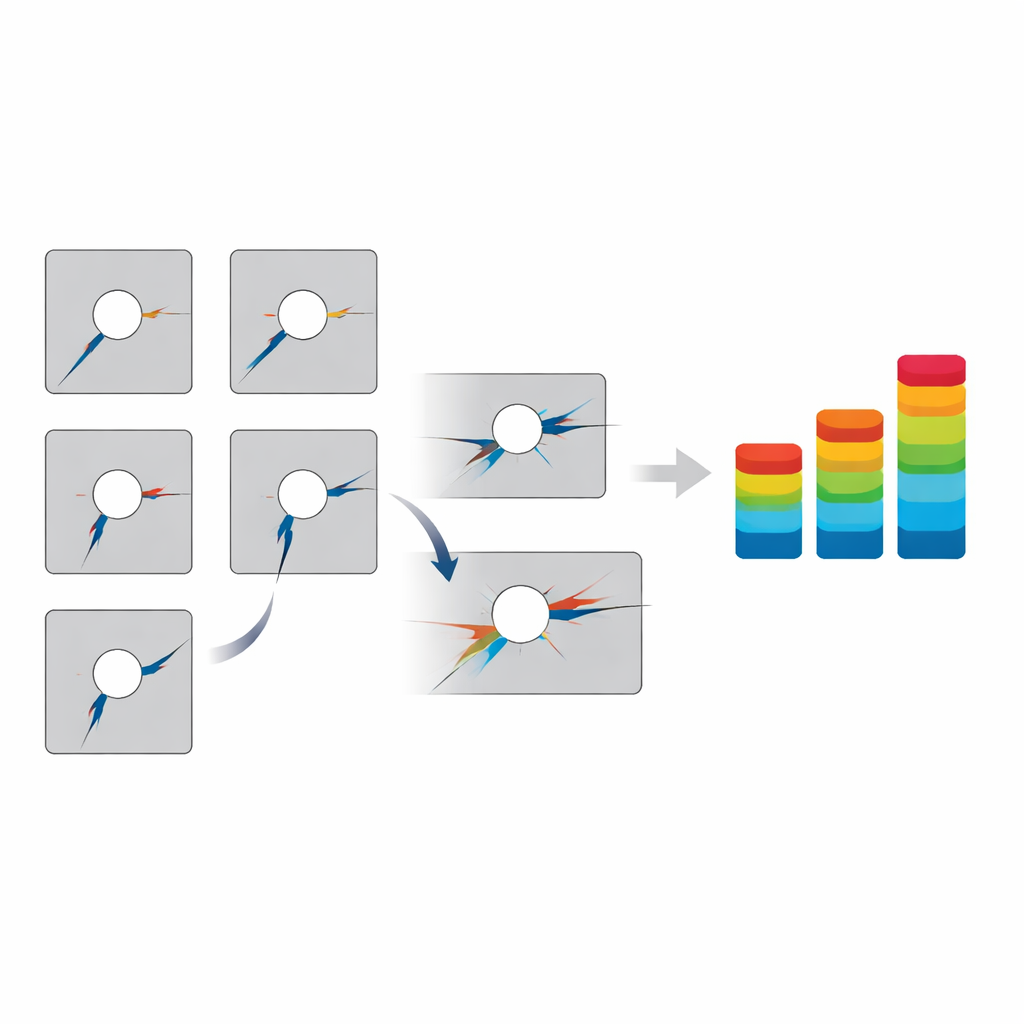
The team explored how three starting features of a crack affect the number of cycles the liner can endure: its initial length, how wide it opens, and the direction it points around the hole. They found that longer starting cracks sharply reduce the remaining life, though the rate of reduction slows as cracks grow longer. In contrast, cracks that open wider or are oriented at certain angles relative to the hole live longer, because the stresses driving them are reduced. For this specific liner and loading pattern, cracks with opening angles between about 45 and 60 degrees, and orientation angles between about 15 and 30 degrees, fell into what the authors call a “life enhancement region,” where the metal survived many more cycles before the crack became critical.
Teaching a smart shortcut to predict life
Running these high‑fidelity simulations is powerful but time‑consuming, so the authors trained a fast surrogate model using an approach called an echo state network, a form of reservoir computing. They fed the network with simulated examples that linked the initial crack geometry to the predicted remaining life. Once trained on just 150 such cases, the model could estimate crack life with an average error under 5 percent—better accuracy and much faster training than a conventional deep neural network tested on the same data. This makes it practical to scan through many possible crack shapes and quickly estimate which ones are still safe and which demand urgent attention.
What this means for safer flights
In everyday terms, this work shows that not all cracks in a jet engine’s combustor liner are equally dangerous: their size, how wide they open, and which way they point can add or subtract thousands of cycles from the part’s remaining life. By combining physics‑based simulation with a nimble machine‑learning tool, the study provides a way to turn a small set of detailed calculations into a quick, reliable predictor of when a cracked liner should be repaired or replaced. Such tools can help airlines and engine makers schedule maintenance more scientifically, reduce unexpected failures, and keep the ever‑hotter engines that power modern air travel operating safely for longer.
Citation: Wang, X., Li, W., Zheng, M. et al. Crack propagation mechanism and life prediction of liner under thermal fatigue loads. Sci Rep 16, 13367 (2026). https://doi.org/10.1038/s41598-026-43714-2
Keywords: aero-engine combustor, thermal fatigue, crack growth, structural life prediction, machine learning surrogate