Clear Sky Science · en
Variations in genotype- and position-dependent seed tuber sprouting linked to skin morphology in white Guinea yam
Why the timing of yam sprouting matters
In much of West Africa, white Guinea yam is both a daily food and a farmer’s savings account. Yet the very tubers that feed households also serve as planting material, and they wake from dormancy on their own unpredictable schedule. That makes it hard for farmers to plan when to plant and how much they will harvest. This study asks a simple but important question: can we predict, or even manage, when yam tubers sprout just by looking at their skin and where on the tuber a piece is cut?
Looking closely at a familiar root
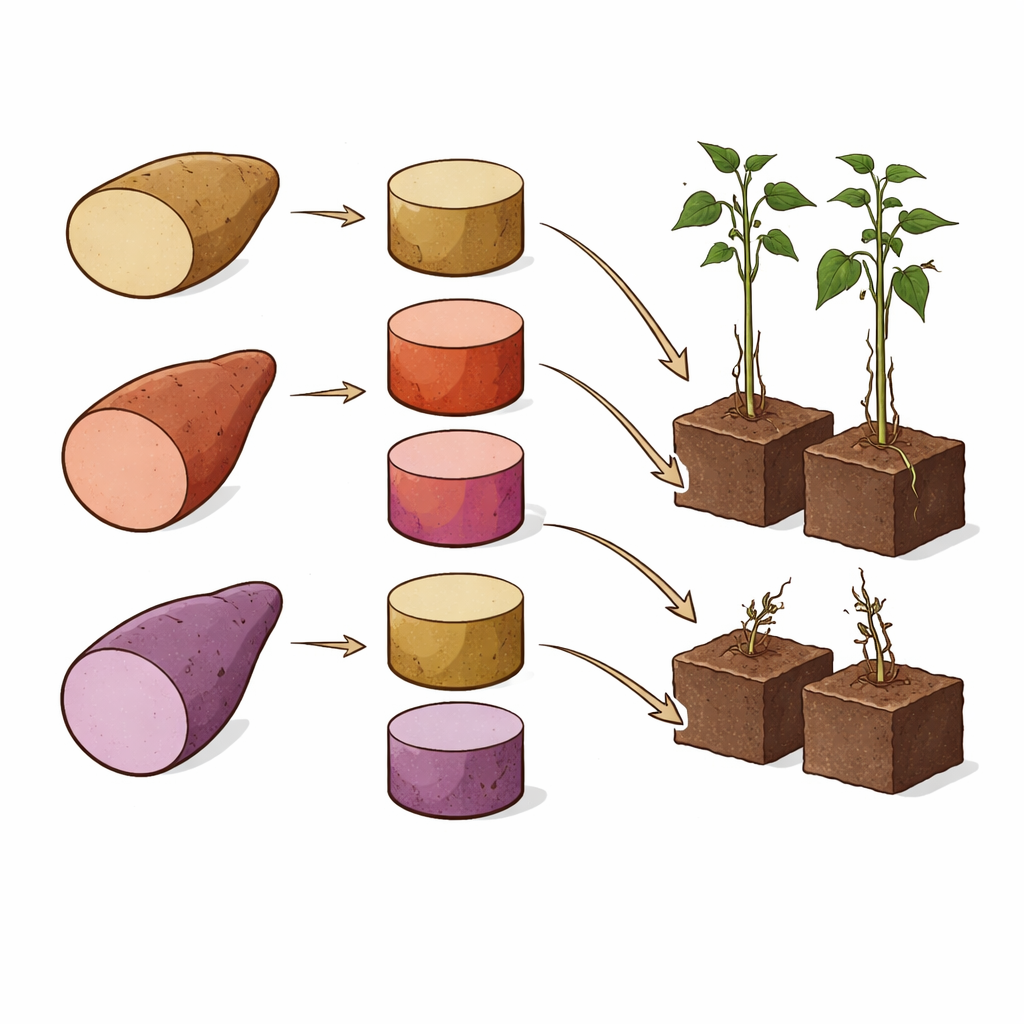
Rather than surveying many unrelated yam varieties, the researchers focused on 20 closely related genotypes, all descended from the same cross. This allowed them to tease apart subtle differences without the noise of wildly different backgrounds. Each tuber was sliced into three parts along its length: the head, which once attached to the vine; the middle; and the tail, at the far end. From these, they measured features of the outer layers—the corky skin (periderm) and the flesh just beneath (cortex)—using microscope images and a hardness tester. They also quantified how rough or intricate the skin surface was, using a mathematical measure of texture.
Watching pieces of tuber wake up
To see how structure linked to behavior, matching pieces from each tuber were planted in pots inside a controlled screenhouse. Conditions mimicked a warm, humid yam barn and field: about 25–28 °C and high humidity. The team recorded how many days each piece took to produce a visible sprout, then measured the fresh weight of shoots and roots ten weeks later. This design let them compare not just different genotypes, but also how head, middle, and tail sections behaved within the same genetic line.
Head starts and stubborn skins
The timing of sprouting turned out to be strongly shaped by both genetics and position on the tuber. Across the 20 genotypes, pieces cut from the head generally sprouted about 10 days earlier than those from the middle or tail. Statistical tests showed that genotype explained roughly 30% of the variation in sprouting time, tuber position about 20%, and their interaction nearly another 20%. In practical terms, this means that whether a piece comes from the head or tail matters—but how much it matters depends on the particular genotype. Despite these shifts in timing, earlier sprouting did not bring bigger plants at ten weeks. Shoot and root weights were only weakly related to when sprouts first appeared, hinting that the processes that start a bud and those that build biomass are partly independent.
What the skin can tell us
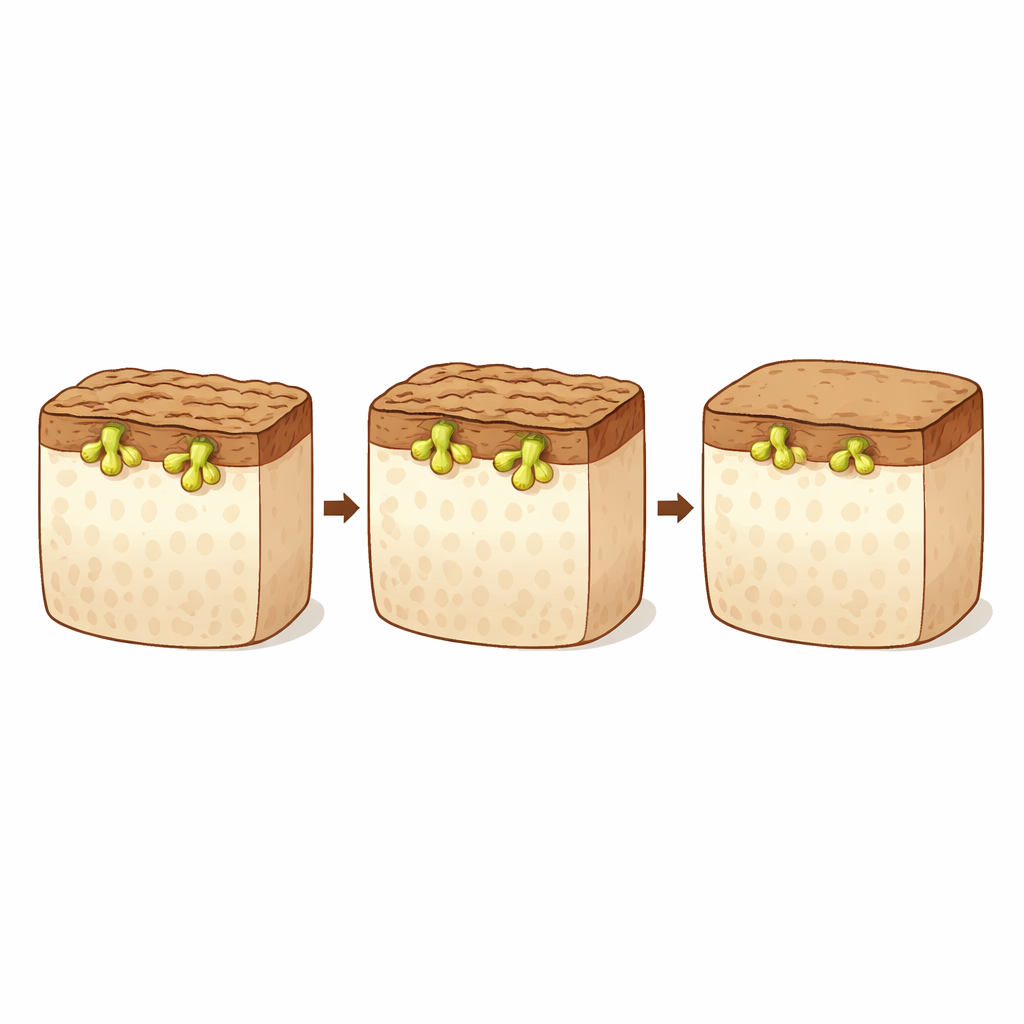
Microscope measurements revealed clear structural differences. Head sections tended to have thinner skin than middle and tail sections, while cortex thickness, surface roughness, and hardness varied more among genotypes than along the length of a tuber. When the researchers used a Bayesian regression model to connect these traits to sprouting time, some patterns emerged. Thinner skin and rougher surfaces were generally associated with earlier sprouting, suggesting that a more open, textured skin may ease gas exchange and water movement needed to break dormancy. In contrast, harder skin was linked with delayed sprouting, consistent with the idea that a rigid barrier can slow bud emergence. Still, these structural traits together accounted for only about 10–25% of the differences in sprouting time, implying that internal water status, hormones, and other physiological factors play larger roles.
Turning tuber quirks into practical choices
For farmers and breeders, the study’s message is both modest and useful. Tuber skin features are not the main drivers of yam dormancy, but they provide visible clues and small levers for improvement. Choosing seed pieces from the head of the tuber, where skin is typically thinner and more favorable to sprouting, can help reduce delays and variation in field emergence. Breeding programs can also use skin thickness and surface texture as simple screening traits when selecting lines that sprout more uniformly. By paying attention to the outer millimeters of the yam, this work offers concrete steps toward more predictable planting, better stand establishment, and more efficient seed-yam production.
Citation: Olaleye, O., Iseki, K. Variations in genotype- and position-dependent seed tuber sprouting linked to skin morphology in white Guinea yam. Sci Rep 16, 13233 (2026). https://doi.org/10.1038/s41598-026-43709-z
Keywords: yam sprouting, tuber dormancy, seed yam, skin morphology, West African agriculture