Clear Sky Science · en
Explainable artificial intelligence for early Alzheimer’s diagnosis using enhanced grey relational features and multimodal data
Why this matters for families and aging societies
Alzheimer’s disease slowly erodes memory, independence, and quality of life, yet by the time it is clearly diagnosed, much damage is already done. This study explores how a new kind of transparent artificial intelligence can spot early warning signs of Alzheimer’s years sooner, using everyday medical and lifestyle information rather than expensive scans. By showing not only who is at higher risk but also which habits and health factors matter most, the work points toward practical, behavior-focused ways to delay or prevent decline in aging populations.
Many small clues hidden in everyday data
Alzheimer’s does not arise from a single cause. Age, genes, blood vessel health, smoking, exercise, sleep, and early memory slips all play a part. The authors assembled a real-world dataset of 2,149 people, each with 35 pieces of information spanning demographics, blood pressure, cholesterol, diabetes, heart disease, lifestyle habits, and simple cognitive test scores. Rather than looking at each measure in isolation, they engineered composite scores that better capture overall patterns, such as the ratio of good to bad cholesterol, a blood pressure ratio, a combined vascular risk score, and a “cognitive decline” score blending forgetfulness and orientation problems. These richer signals help reflect how multiple small issues add up to meaningful risk.

Teaching computers to be both smart and understandable
Modern artificial intelligence can find subtle patterns far beyond human intuition, but it is often criticized as a “black box.” The researchers compared a wide range of approaches, from simple logistic regression to advanced tree-based methods and deep neural networks. To avoid bias from having fewer Alzheimer’s cases than non-cases, they used a technique called oversampling to create realistic synthetic examples of underrepresented patients, balancing the dataset before training. Their best deep neural network, which passed information through several layers of virtual “neurons” with safeguards against overfitting, correctly distinguished people with and without Alzheimer’s in about 98% of cases on development data and around 95% in a separate clinical test group.
Ranking what really drives risk
High accuracy alone is not enough in medicine; doctors also need to know why a model flags someone as high risk. The team tackled this in two complementary ways. First, they adapted a method known as Grey Relational Analysis, which compares how closely each factor’s pattern tracks the pattern of true diagnoses. By carefully normalizing the data and enhancing the scoring scale, they sharpened the contrast between more and less informative features. This revealed that memory complaints, everyday behavioral changes, high blood pressure, cardiovascular disease, and diabetes are especially closely tied to Alzheimer’s status, echoing long-standing clinical experience while providing a clearer, data-driven ranking.
Opening the “black box” with visual explanations
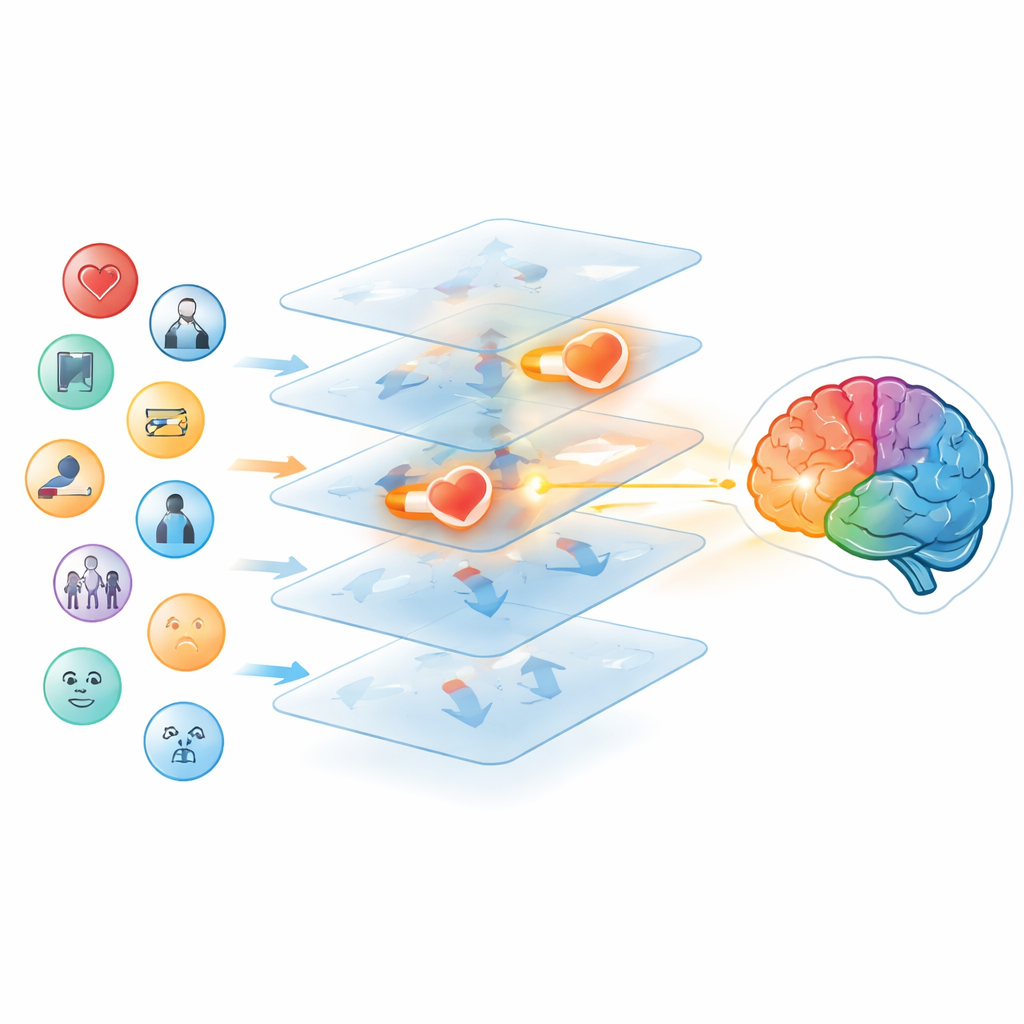
Second, the authors applied SHAP, a leading explainable-AI technique, to both tree-based models and the deep network. SHAP assigns each factor a kind of “credit score” for pushing a prediction toward higher or lower risk in individual patients. Visual summaries showed that difficulties with daily activities, functional assessments, memory complaints, and the age-adjusted cognitive test score were among the strongest signals. Vascular risk, blood pressure ratio, lifestyle score (combining exercise, diet, sleep, smoking, and alcohol), and family history also played major roles. These patterns match what clinicians already see in practice, which builds trust that the model is capturing meaningful biology rather than noise. The authors further checked performance across gender, ethnic groups, and education levels, identifying where the system is balanced and where future fairness improvements are needed.
What this could mean for prevention and care
In plain terms, this work shows that a carefully designed, explainable AI system can use common clinic and lifestyle data to flag people at risk of Alzheimer’s with high reliability while clearly indicating which levers—such as blood pressure control, smoking cessation, physical activity, and early cognitive symptoms—are most important. Rather than replacing doctors, such tools could become early-warning dashboards that help clinicians and families focus on modifiable risks long before severe memory loss sets in. With further validation on larger and more diverse populations, this framework could support more personalized, prevention-oriented care for the millions of people facing the threat of dementia worldwide.
Citation: Ullah, W., Dai, Q., Zulqarnain, R.M. et al. Explainable artificial intelligence for early Alzheimer’s diagnosis using enhanced grey relational features and multimodal data. Sci Rep 16, 13856 (2026). https://doi.org/10.1038/s41598-026-43707-1
Keywords: Alzheimer’s disease, explainable AI, early diagnosis, lifestyle risk factors, machine learning