Clear Sky Science · en
Strength and cost analysis of geopolymer concrete using rice husk ash and GGBS as sustainable cement alternatives
Turning Waste into Stronger Buildings
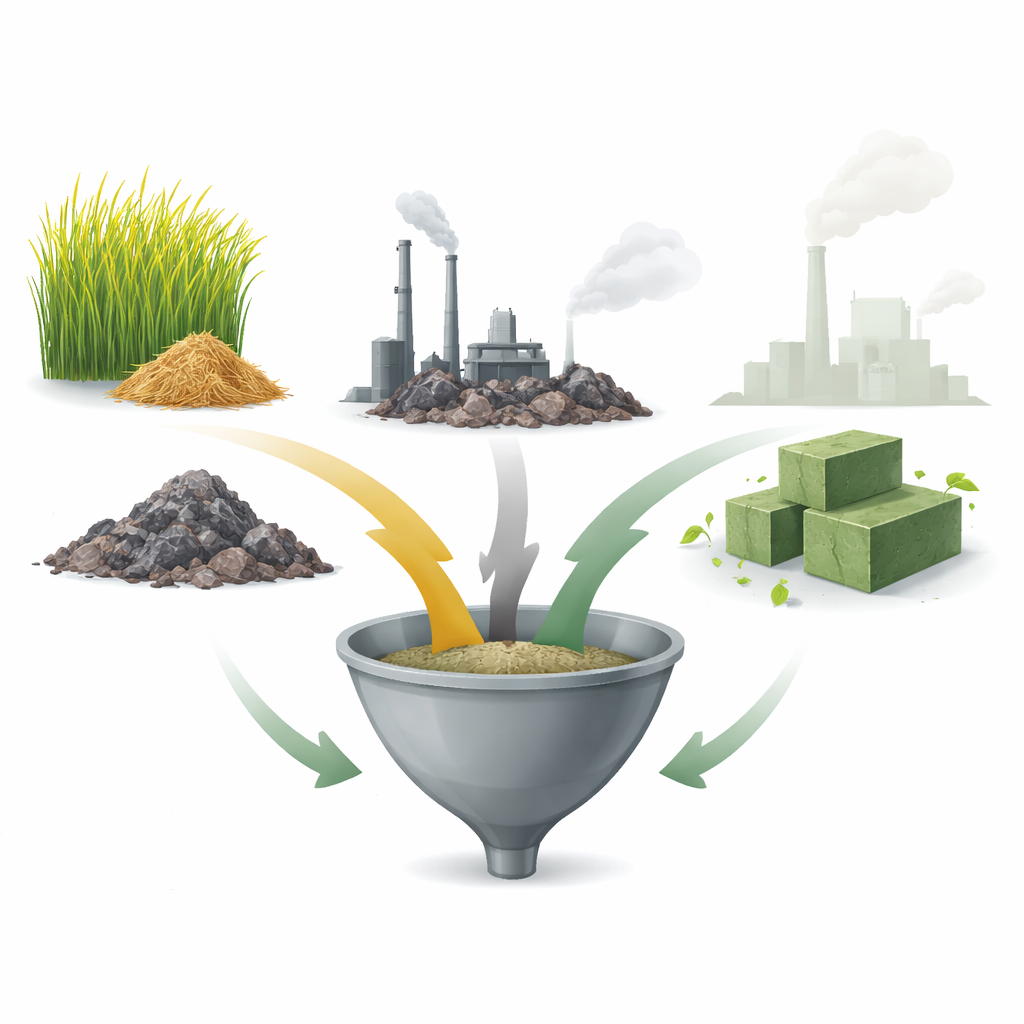
Concrete is the backbone of modern cities, but making its main ingredient—ordinary Portland cement—pumps large amounts of carbon dioxide into the atmosphere. This study explores a cleaner way to build: replacing much of that cement with industrial and agricultural waste, specifically ground granulated blast furnace slag (GGBS), a by-product of steel making, and rice husk ash (RHA), left over after burning rice husks for energy. The researchers ask a simple but crucial question: can these wastes produce concrete that is strong, durable, economical, and kinder to the planet?
Why Rice Husks and Steel Slag Matter
Rice is grown in vast quantities worldwide, especially in countries like India, leaving behind mountains of husks that are often burned, creating ash that mostly ends up in landfills. At the same time, steel production generates fine slag powder that can react in concrete. Both RHA and GGBS are rich in the same basic ingredients that help bind concrete together, which makes them promising candidates to replace cement. Using these materials not only recycles waste but also reduces the need for new cement, potentially cutting carbon emissions dramatically while easing pressure on landfills.
Designing a New Kind of Green Concrete
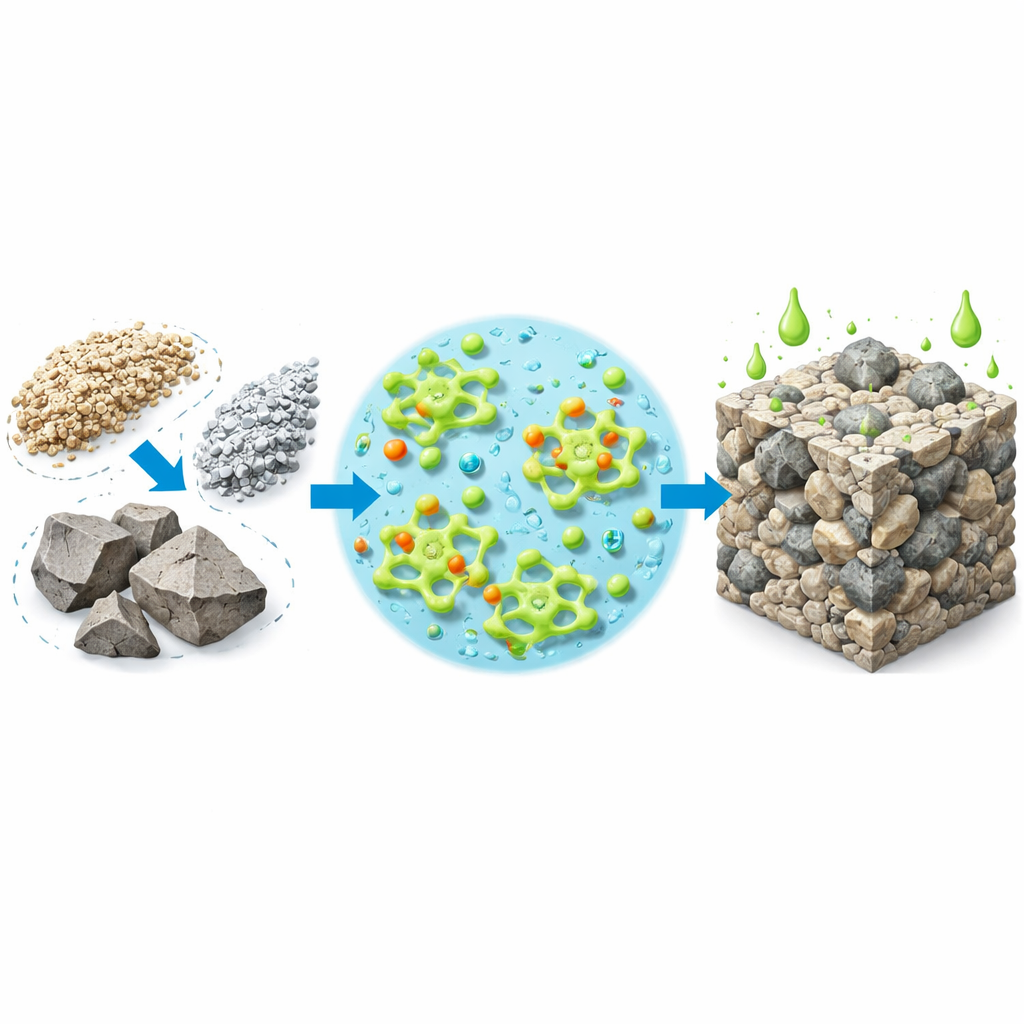
The team produced a type of binder known as geopolymer concrete, which uses alkaline liquids instead of cement to activate powders like GGBS and RHA. They designed mixes for three common strength levels, called M40, M50, and M60, roughly corresponding to normal to high-strength structural concrete. For each grade, they replaced GGBS with rice husk ash at four levels: 0%, 10%, 20%, and 30%. They then varied the strength of the sodium hydroxide solution that activates the powders and cured the test cubes at room temperature. By carefully measuring how hard the cubes became over 1, 3, 7, and 28 days, they could see which combinations gave the best performance.
Finding the Sweet Spot for Strength
The results showed a clear pattern. Concrete made only with GGBS already gained strength quickly over time, but adding a modest 10% of RHA made it even better. Across all three grades, mixes with 90% GGBS and 10% RHA reached the highest compressive strengths by 28 days, slightly outperforming mixes with no rice husk ash. The fine, silica-rich ash helps fill tiny gaps and reacts with the slag to form additional binding gel, leading to a denser, stronger material. However, when the RHA content climbed to 20% and 30%, strength dropped sharply—by up to 30–60% compared with the 10% mix—because too much GGBS, which supplies key calcium for early strength, had been removed.
Standing Up to Harsh Conditions
Strength alone is not enough; concrete must also survive harsh environments. To test durability, the researchers immersed the cubes in a strong sulphuric acid solution for up to 60 days and tracked both strength loss and weight loss. All mixes lost some strength over time in acid, but those with 10% RHA consistently performed best, with only about 2% strength loss and roughly 1.9% weight loss after 60 days. Mixes with 20% and 30% RHA suffered far greater damage, confirming that excessive ash content makes the material more vulnerable to chemical attack. The study also examined how the concentration of the alkaline activator affected performance and found that higher molarity solutions generally led to higher strengths, especially for the higher-grade mixes.
Building Greener for Less Money
Alongside performance, the team compared material costs for geopolymer concrete and conventional cement concrete for the same strength grades. Even though geopolymer mixes require alkaline solutions and slightly more aggregate, they use far less cement, which is the costliest and most carbon-intensive component. When optimized at 10% RHA replacement, the green concrete mixtures cut production costs by about 13%, 16%, and 30% for the M40, M50, and M60 grades, respectively, compared with ordinary cement concrete. In other words, the greener option is also cheaper, especially for higher-strength applications.
What This Means for Everyday Construction
To a non-specialist, the message is straightforward: by carefully blending steel industry slag and rice-farming waste into geopolymer concrete, engineers can make structural materials that are strong, reasonably resistant to acid attack, and significantly more economical than conventional cement concrete. The study identifies a practical “sweet spot” around 10% rice husk ash replacement, where performance and durability are maximized while costs and environmental impact are minimized. If adopted at scale, this approach could turn two major waste streams into valuable building resources, helping cities grow while cutting both pollution and construction expenses.
Citation: Reddy, N.G., Karikatti, V.B., Pratap, B. et al. Strength and cost analysis of geopolymer concrete using rice husk ash and GGBS as sustainable cement alternatives. Sci Rep 16, 12922 (2026). https://doi.org/10.1038/s41598-026-43705-3
Keywords: geopolymer concrete, rice husk ash, GGBS, sustainable construction, cement alternatives