Clear Sky Science · en
Land-use types shape soil bacterial communities, co-occurrence networks, and predicted functions in karst ecosystems
Hidden Life Beneath Rocky Farmlands
In many parts of the world, including southwest China, farmers work on karst landscapes—rugged regions of limestone hills, thin soils, and exposed rock. These areas are easily damaged by erosion and overuse, yet they must still support crops and local livelihoods. This study asks a simple but far-reaching question: how do different types of farmland and restored vegetation change the tiny soil organisms that quietly keep these fragile systems alive, and what farming style best protects that underground life?
Rocky Hills, Shallow Soils, Many Land Uses
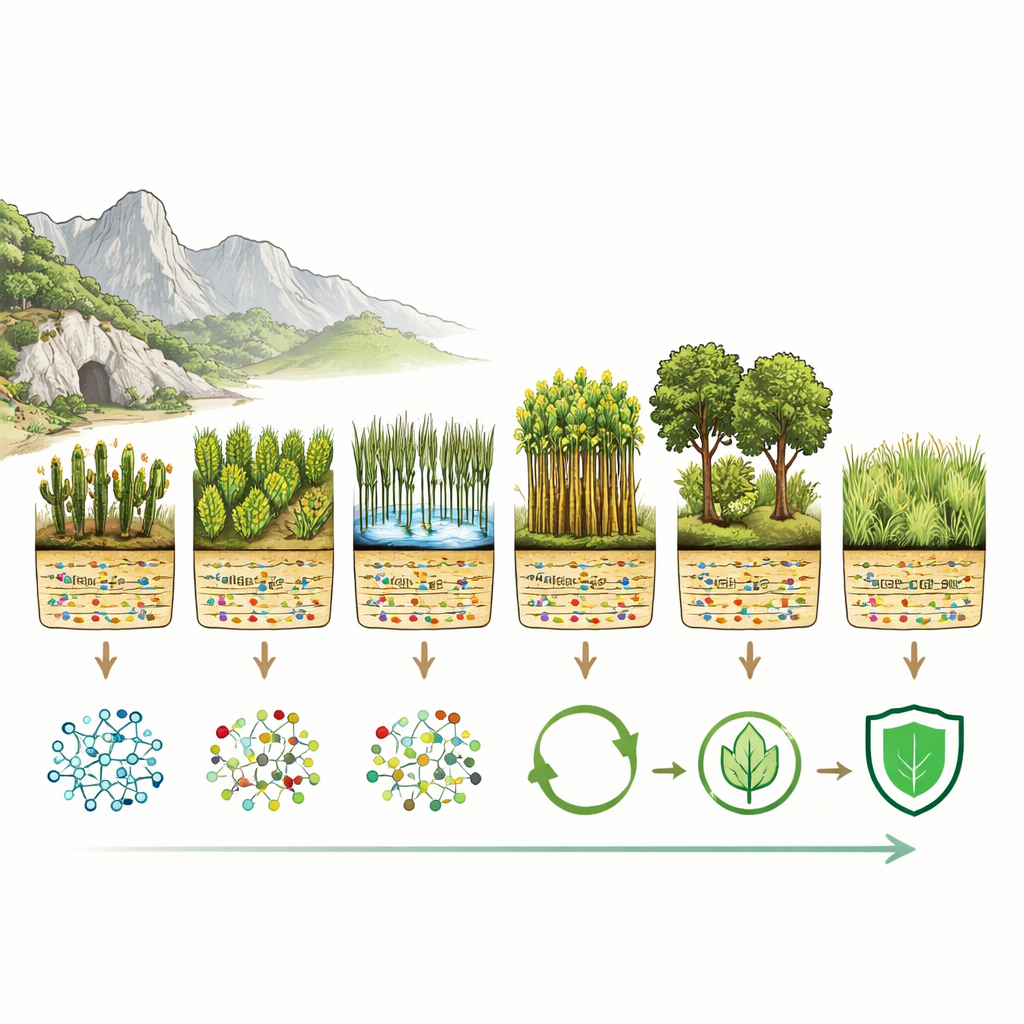
The researchers worked in a karst region of Guangxi, China, where steep slopes and stony ground once suffered severe “rocky desertification” before large restoration projects increased vegetation cover. Today the landscape is a mosaic: pitaya (dragon fruit) orchards managed without plowing, maize fields and paddy rice fields tilled in the usual way, sugarcane fields with minimal tillage and straw left on the soil, plus restored forestland and naturally recovering grassland. Because karst soils are shallow, the team focused on the upper 20 centimeters, sampling both the 0–10 cm and 10–20 cm layers to see how conditions change with depth.
Soil Conditions Steer Microbial Diversity
The scientists measured basic soil properties such as acidity (pH), salts, organic matter, and texture, and then used DNA sequencing to identify bacteria living in each soil. They found that land use and soil depth strongly shaped both the variety of bacteria and the make‑up of bacterial communities. Pitaya, maize, and paddy fields supported the highest bacterial diversity, while sugarcane fields had the lowest—likely a legacy of continuous cropping and heavy fertilization. Across all sites, a few large bacterial groups dominated: Acidobacteria, Proteobacteria, Chloroflexi, and Actinobacteria. Statistical analyses showed that land use influenced microbes mainly by altering soil chemistry and structure, especially pH and the balance of sand and silt. In other words, what grows above ground and how it is managed matters because it changes the habitat that soil microbes experience.
Different Fields, Different Underground Jobs
To understand what these bacteria might be doing, the team used a tool that links known bacterial types to likely ecological roles. They found clear “functional fingerprints” for each land use. Pitaya orchards, with their no‑till management and clay‑rich soils, favored bacteria involved in nitrogen cycling—processes like nitrification and ammonia oxidation that help convert nitrogen into forms plants can use. Sugarcane fields, enriched with returned straw, encouraged bacteria that feed on carbon‑rich material and break down cellulose, highlighting a strong role in carbon processing. Flooded paddy soils, by contrast, favored bacteria that use iron and sulfur in their metabolism, reflecting the oxygen‑poor, waterlogged conditions. Although these functions are predictions rather than direct measurements, they point to distinct underground “jobs” associated with each farming style.
Microbial Social Networks in the Soil
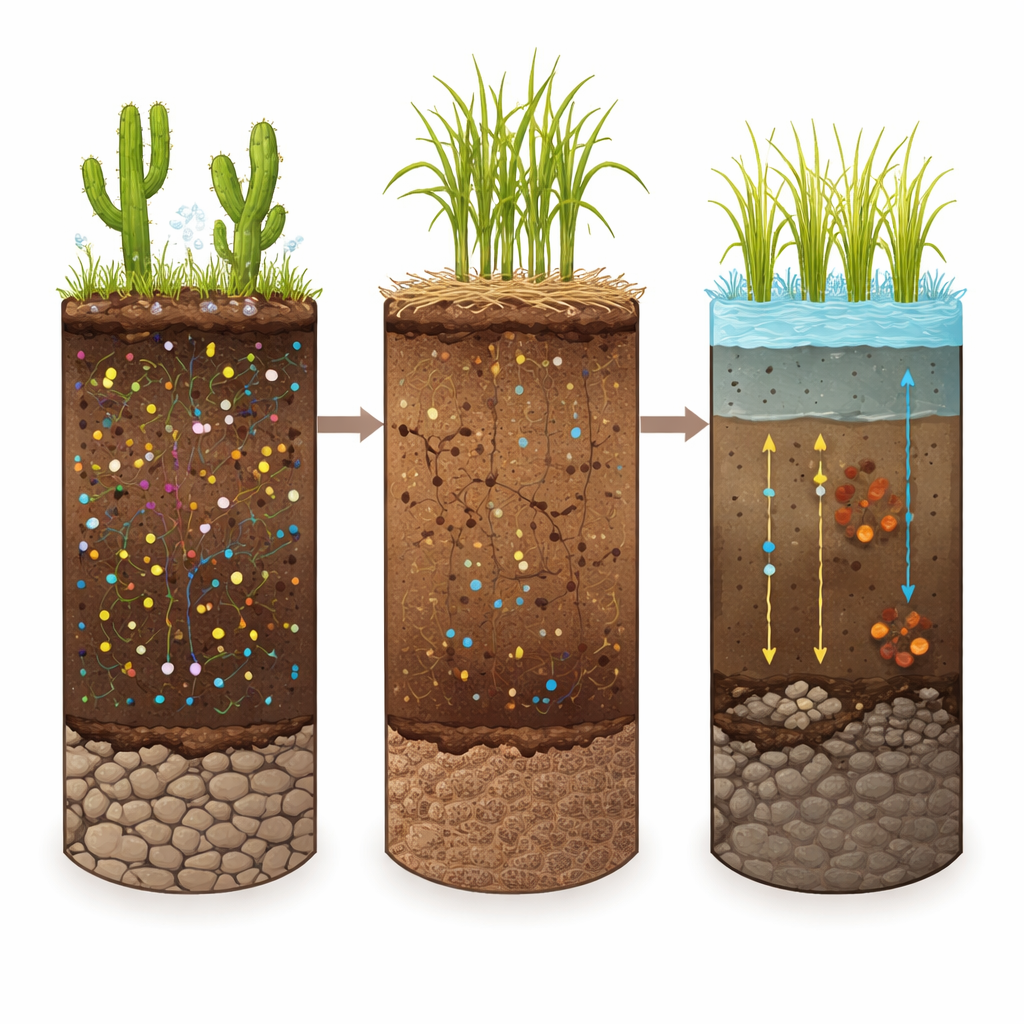
The study also explored how bacteria co‑occur and interact, building network diagrams where nodes represent bacterial groups and connections represent strong positive or negative associations. In all land uses, positive links—suggesting cooperation or shared niches—greatly outnumbered negative ones. Pitaya fields stood out with the most complex and densely connected networks, hinting at a resilient, well‑organized microbial community, while paddy fields showed the simplest and least connected networks, possibly stressed by alternating wet and dry cycles and regular tillage. Forest and grassland soils, though less diverse than some croplands, enriched special “keystone” bacteria that help hold the network together. Across all systems, the same major phyla that were most abundant also tended to serve as keystones, underscoring their central role in nutrient cycling and soil stability.
What This Means for Fragile Farmlands
Overall, the work shows that in thin, vulnerable karst soils, the choice of land use and management practice powerfully reshapes the living fabric of the soil. No‑till pitaya orchards combined relatively high bacterial diversity, strong nitrogen‑related functions, and especially robust microbial networks, suggesting that this style of farming can support both production and soil stability. Sugarcane fields, in contrast, appeared biologically strained under continuous use, and paddy fields, while diverse, hosted simpler interaction webs shaped by flooding. Restored forests and grasslands added their own benefits by fostering key microbial groups important for long‑term health. The authors conclude that conservation‑minded farming, especially no‑till pitaya combined with targeted vegetation restoration, offers a promising path to keep karst soils fertile and resilient—so long as land managers keep monitoring these underground communities over time.
Citation: Fang, D., Chen, D., Zhang, J. et al. Land-use types shape soil bacterial communities, co-occurrence networks, and predicted functions in karst ecosystems. Sci Rep 16, 12682 (2026). https://doi.org/10.1038/s41598-026-43695-2
Keywords: karst soil, land use, soil bacteria, no-till agriculture, ecosystem restoration