Clear Sky Science · en
Altermagnetism and chiral order in a collinear antiferromagnet (MnF2)
Why This Hidden Magnet Matters
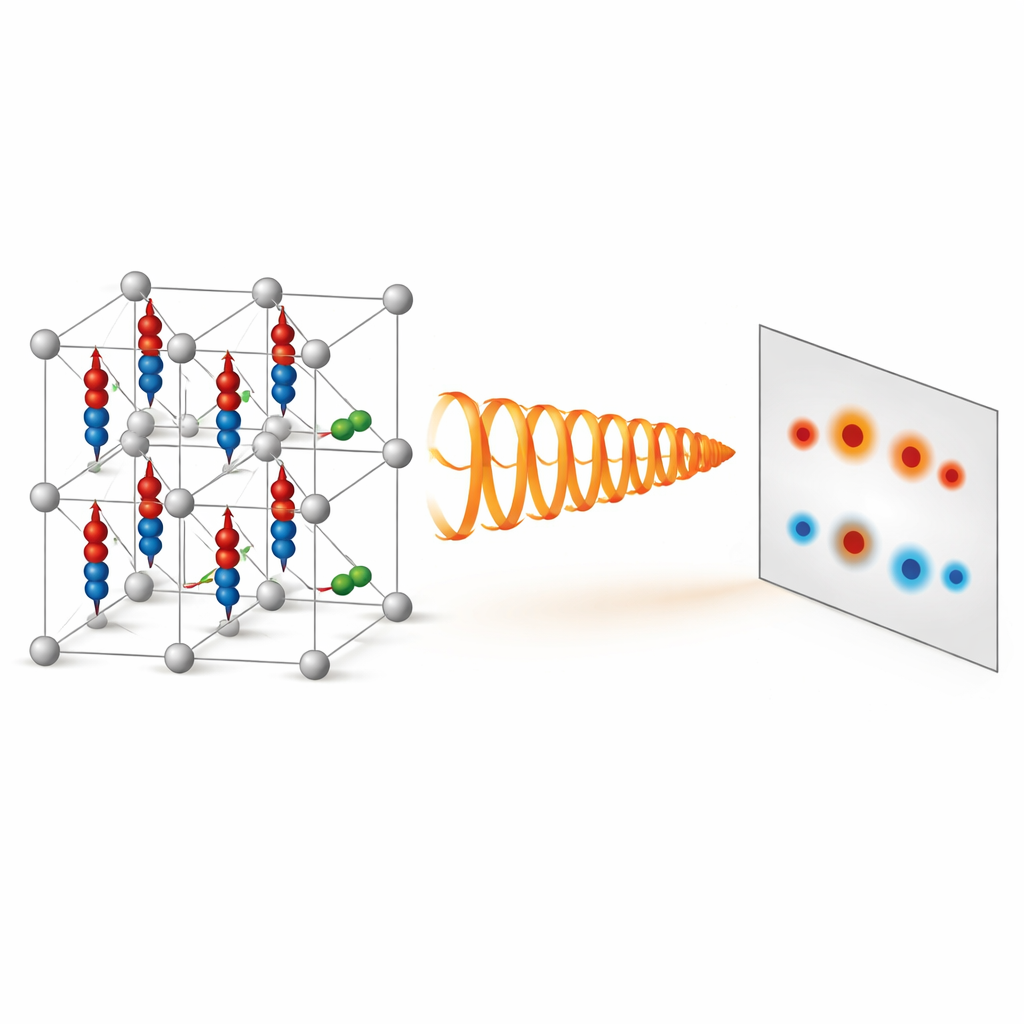
Inside many modern technologies, from computer memories to ultra-fast sensors, magnetism quietly does much of the work. Most people have heard of ordinary magnets and maybe of antiferromagnets, where tiny atomic magnets cancel each other out. This paper explores a newer and more subtle form of magnetism known as altermagnetism in a well-known material, manganese fluoride (MnF₂). The authors show that this crystal, long treated as a textbook antiferromagnet, actually hides more intricate magnetic behavior, including a handed, or chiral, magnetic pattern that can be revealed using advanced x‑ray and neutron scattering techniques.
A Different Kind of Magnetism
In a simple magnet, many atomic spins line up, producing a net magnetic field you can feel. In an antiferromagnet like MnF₂, neighboring spins point in opposite directions, so their fields cancel and no overall magnetization appears. Altermagnets lie in between these familiar pictures. They have no net magnetization, yet the electronic bands that carry current are split according to spin, which offers exciting possibilities for spin-based electronics without the drawbacks of stray magnetic fields. The key idea is that complex patterns of higher-order magnetic shapes, called multipoles, can organize in the crystal in a way that keeps the overall magnetization zero but still treats up and down spins differently in momentum space.
Probing the Hidden Magnetic Pattern
To uncover these hidden patterns, the author turns to two powerful scattering probes: resonant x‑ray diffraction and polarized neutron diffraction. In resonant x‑ray diffraction, the x‑ray energy is tuned to a strong absorption feature of manganese, so that the x‑rays become especially sensitive to the detailed arrangement of electrons and spins. By calculating how Bragg spots—the bright points in a diffraction pattern—change when the x‑ray beam’s circular polarization is reversed from left‑handed to right‑handed, the paper shows that MnF₂ must possess a chiral magnetic structure. Although the magnetic ions sit at inversion-symmetric positions, the way their multipoles combine in the crystal leads to a handed response that only shows up when the x‑ray beam itself has a handed twist.
Chirality, Multipoles, and Neutrons
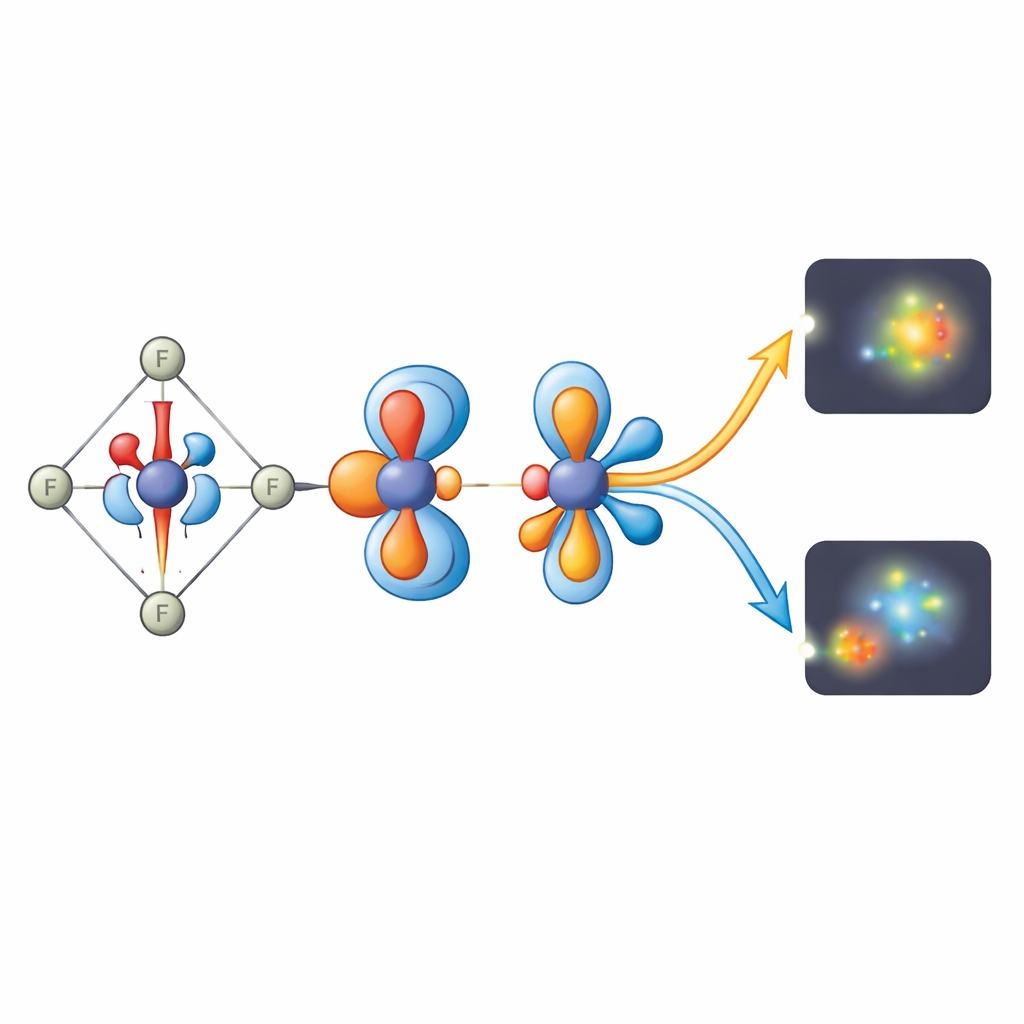
Chirality here means that the magnetic arrangement distinguishes between left and right, much like a human hand. The calculations demonstrate that contributions to the diffraction signal coming from ordinary magnetic dipoles and those coming from more complex multipoles are out of phase with each other. This phase difference produces a measurable change in intensity when the helicity of the incoming x‑rays is switched. The same multipoles also affect how polarized neutrons scatter from the crystal. Because neutrons carry spin, they can flip their spin state when they encounter magnetic structures. The paper shows that the spin-flip patterns depend sensitively on higher-order magnetic multipoles, such as magnetic octupoles, that would vanish in a simple ionic picture of Mn²⁺. Detecting these terms would reveal subtle deviations from that idealized electronic configuration.
Revealing Altermagnetism in a Classic Crystal
The study goes further by connecting these complex multipoles directly to altermagnetism. In MnF₂, the relevant order parameter—that is, the quantity that characterizes the altermagnetic state—is an axial magnetic octupole that orders in a uniform, or ferroic, manner even though the ordinary magnetic dipoles form a perfectly compensated antiferromagnet. The author shows that this octupolar order leaves clear fingerprints in both x‑ray and neutron diffraction. In x‑ray experiments, it appears in allowed Bragg reflections where magnetic and non-magnetic contributions are exactly ninety degrees out of phase. In neutron experiments, specific spin-flip conditions pick out the same octupolar contribution. Together, these predictions provide a roadmap for experiments to confirm altermagnetism and to quantify chiral magnetic order in this prototypical material.
What This Means for Future Materials
For a non-specialist, the main message is that a very familiar antiferromagnet, MnF₂, is not as simple as once thought. It supports a hidden, handed magnetic structure and a form of magnetism—altermagnetism—that can split spin states without producing a conventional magnetic field. Because such materials can, in principle, generate and manipulate spin currents without stray magnetization, they are attractive for low-power spintronic devices. The methods outlined here—carefully designed x‑ray and neutron diffraction measurements guided by symmetry analysis—offer a general strategy to detect and characterize altermagnetism and chiral order in other crystals, helping researchers identify and engineer the next generation of spin-based materials.
Citation: Lovesey, S.W. Altermagnetism and chiral order in a collinear antiferromagnet (MnF2). Sci Rep 16, 14058 (2026). https://doi.org/10.1038/s41598-026-43686-3
Keywords: altermagnetism, manganese fluoride, chiral magnetism, resonant x-ray diffraction, polarized neutron scattering