Clear Sky Science · en
Achieving near-net-zero energy in hot climates through synergistic retrofit interventions and uncertainty quantification
Why cooler buildings matter
In hot regions, keeping offices comfortable often means big electricity bills and lots of climate‑warming emissions. This study looks at whether a typical office building in Abha, a city in southwestern Saudi Arabia, could be upgraded so that it uses almost no net energy over a year. By mixing better insulation, a planted roof, and rooftop solar panels—and by carefully checking uncertainties—the researchers show how existing buildings can move much closer to climate goals without tearing them down and starting over. 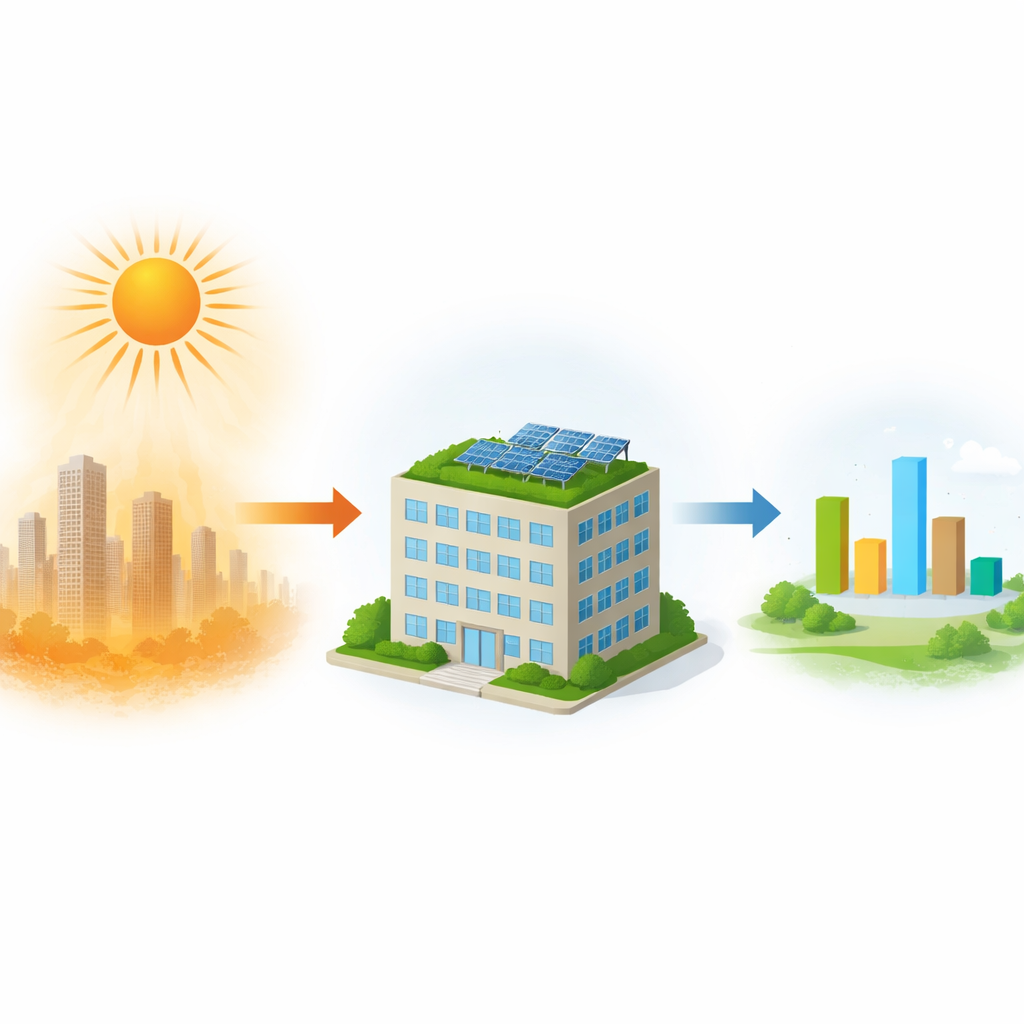
The starting point: a hot‑weather office
The team focused on a two‑story, 250‑square‑meter office built in 2010 in Abha. Using detailed architectural drawings, site visits, and local weather records, they created a computer model of the building’s energy use. The model tracked heating, cooling, lighting, and equipment hour by hour across an entire year. They then checked the model against real utility bills and data from similar local offices. The simulated annual electricity use matched the measured totals within a few percent, giving confidence that the virtual building behaved like the real one.
Three upgrade ideas working together
The researchers tested three main retrofit strategies, alone and in combination. First, they added a green roof: a layer of soil and plants on top of the existing roof that shades the surface and uses water evaporation to keep it cooler. Second, they covered most of the roof with solar panels, feeding their electricity straight into the grid‑connected building. Third, they applied modern energy‑efficiency standards similar to those promoted by ASHRAE, which meant thicker insulation, better windows that let in less unwanted heat, more efficient lights, and improved heating and cooling equipment. Each scenario was run through the simulation to see how much annual electricity it would save compared with the original office.
How much energy and money can be saved
Each approach helped, but by very different amounts. On its own, the green roof trimmed the building’s net annual electricity use by about 9.5%, easing both summer cooling and winter heating needs. The solar panels provided nearly one‑fifth of the original annual energy demand as clean electricity. The biggest single impact came from meeting the modern efficiency standard: better insulation, windows, lighting, and HVAC cut annual use by about 70%. When all three measures were combined, net annual energy use dropped by 91%—from nearly 49,000 kilowatt‑hours to just 4,391 kilowatt‑hours, which falls within the study’s definition of “near‑net‑zero” for this building. An economic analysis over 25 years showed that the efficiency package paid back its cost in about 3 years, while the full combined solution did so in 5 years and still delivered the highest overall financial return. 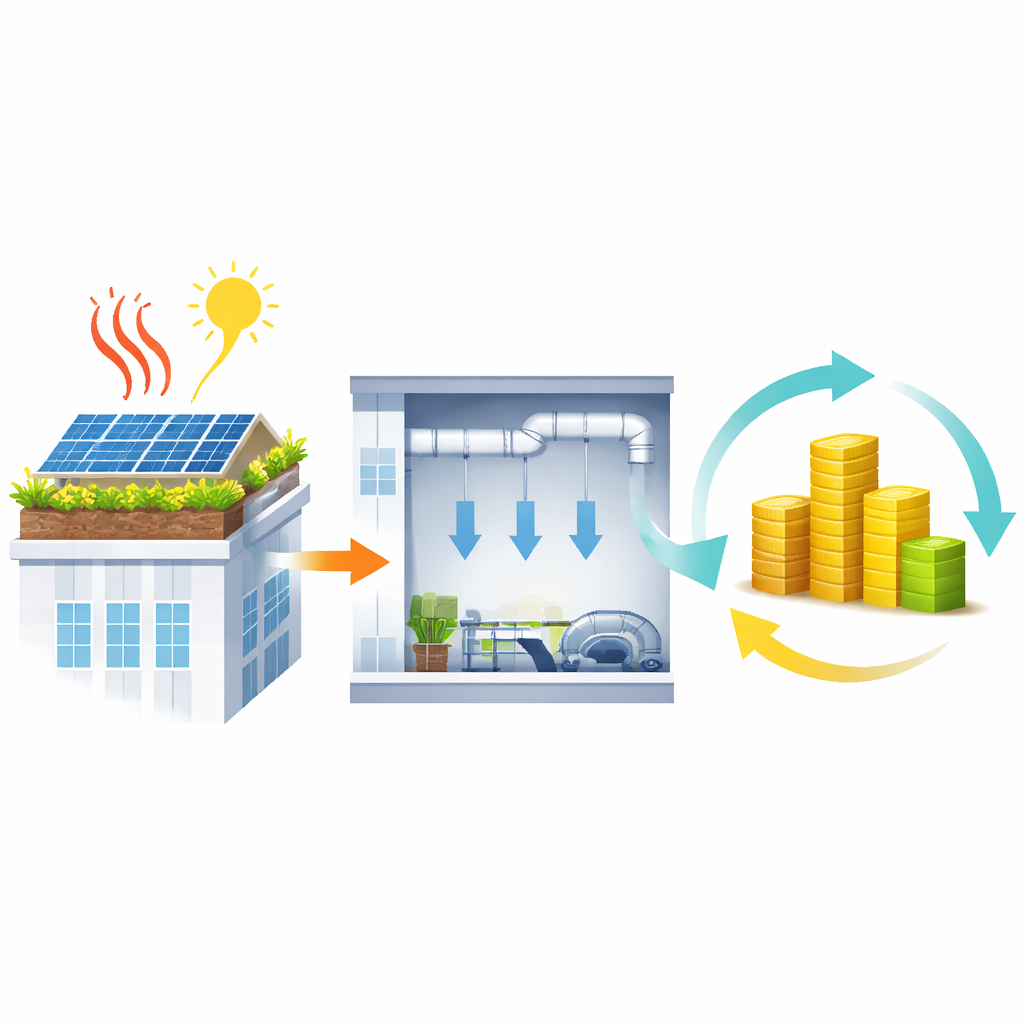
Dealing with real‑world uncertainties
Because no building operates under perfectly fixed conditions, the team also asked how weather shifts, construction quality, and occupant behavior might change the outcomes. They used a statistical method called Monte Carlo simulation, running the model 1,000 times while slightly varying temperatures, sunlight, material properties, and how many people and devices were active inside. This produced a spread of possible energy and cost results instead of a single number. The analysis showed that the biggest source of uncertainty was how much sun the building actually receives over time, followed by how people use the spaces and how well the insulation and other materials perform in practice. Even with these uncertainties, the reductions in energy use across all retrofit scenarios remained strong and statistically significant.
What this means for hot‑climate cities
For a non‑specialist reader, the key message is that existing office buildings in hot climates do not have to be energy guzzlers. By combining common‑sense steps—better insulation and windows—with nature‑based cooling from a planted roof and clean power from rooftop solar, this study’s test building cut its net electricity use by more than 90% at a cost that pays back within a few years. While the work centers on a single office in one Saudi city, it suggests a practical path for many hot‑weather buildings: treat the roof as both a garden and a power plant, tighten up the building shell, modernize lights and air‑conditioning, and plan upgrades using detailed simulations that account for uncertainty. Done together, these measures can move large portions of the existing building stock much closer to climate‑friendly, near‑net‑zero operation.
Citation: Bashir, F.M., Alhamami, A.H., Nasrallah, E. et al. Achieving near-net-zero energy in hot climates through synergistic retrofit interventions and uncertainty quantification. Sci Rep 16, 13297 (2026). https://doi.org/10.1038/s41598-026-43683-6
Keywords: near net zero buildings, hot climate retrofits, green roofs, rooftop solar, building energy efficiency