Clear Sky Science · en
Finite-size effects on lamellar morphology and crystallinity in a crystallizable FENE–LJ polymer model
Why tiny boxes matter for plastic crystals
Computer models are a powerful way to peek inside plastics as they solidify into ordered and disordered regions, but the virtual “box” used in these simulations can quietly distort what we see. This study asks a simple but important question: how big does that box need to be so that the layered crystal patterns seen in many plastics look and behave like they would in a real material, not a shrunken digital toy world? 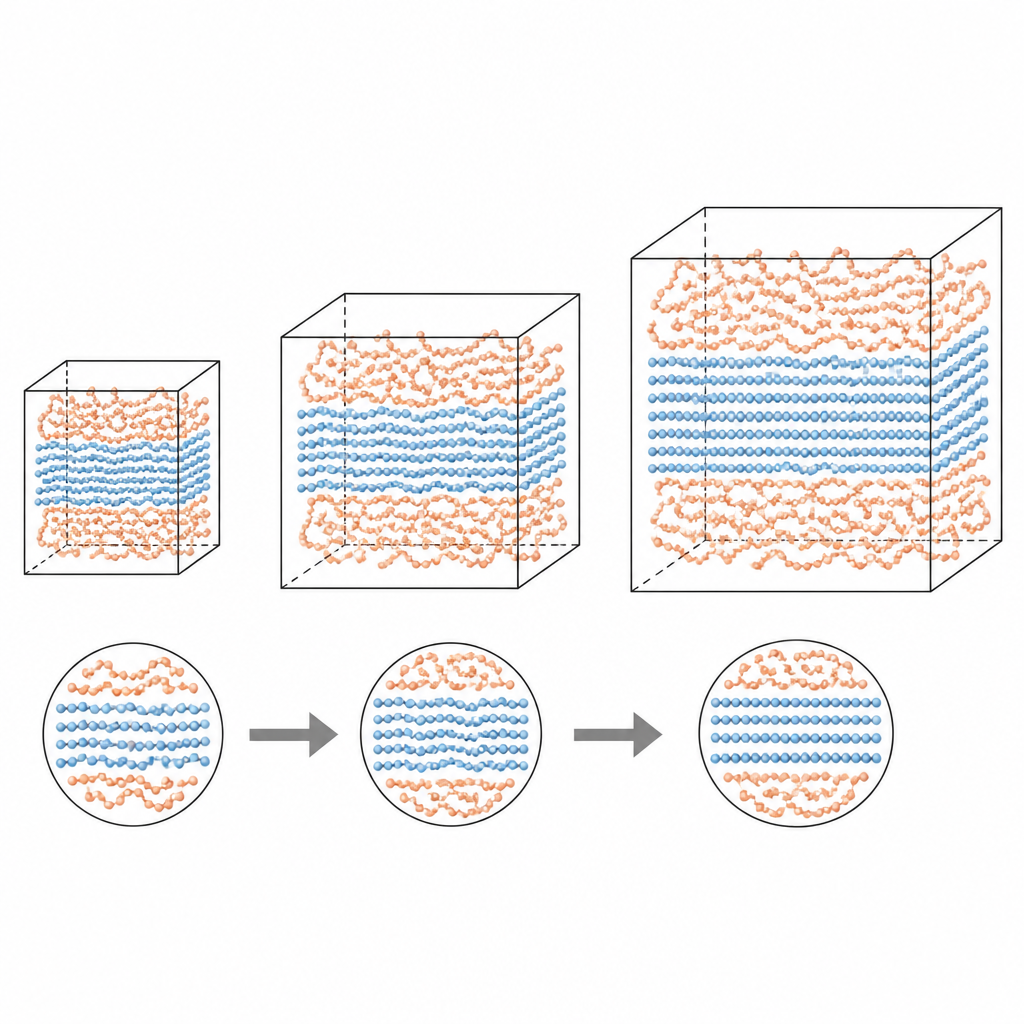
Layered patterns inside everyday plastics
Many common plastics do not freeze into a uniform solid. Instead, they form a semicrystalline structure made of thin crystalline sheets separated by softer, tangled regions. These repeating stacks, called lamellae, strongly influence how a plastic bends, stretches, and breaks. Capturing these lamellae in a computer requires simplified models, where long chains are represented as strings of beads that attract and repel each other. The model used here is a stripped-down version that keeps only the essential spring-like links between beads and a generic attraction between them, yet still forms layered crystal regions on its own.
Building digital layers without breaking the bank
Simulating lamellae from scratch by cooling a liquid of very long chains would take enormous computer time. Instead, the authors used a clever construction method: they first prescribed how thick the crystalline and amorphous layers should be and how dense each part is, then arranged chains so that some bridge across layers while others loop back at the interfaces. They prepared several starting structures with low, medium, or high crystal content and placed them in boxes that were one, two, three, or four lamellar periods wide, all under periodic boundaries that tile space like a wallpaper pattern. The systems were then allowed to relax at constant temperature and pressure so the layer spacing could adjust naturally.
When average properties look fine but details are wrong
The team first checked familiar bulk measures such as energy, overall density, pressure, and the spacing between layers. All of these settled to almost the same values regardless of how wide the box was, suggesting at first glance that the system size did not matter much. Even the radial distribution function, which tracks how likely particles are to sit at certain distances from each other, looked nearly identical across different setups. However, these averages hid an important story. When the authors directly measured how many beads sat in ordered crystalline environments versus disordered ones, they found a strong dependence on box width, even though the density contrast between crystal and amorphous regions was small.
How cramped space distorts crystal growth
In boxes that were too narrow, the crystal content behaved in an artificial way. If the starting structure was very crystalline, small boxes pushed the chains into staying more ordered than they should, because there was not enough lateral space to host all the messy loops and bridges that naturally appear in amorphous regions. If the starting structure was weakly crystalline, the same tight boxes slowed down the natural increase in order, because chains could not move and refold easily. Larger boxes relieved these packing stresses, and samples with different starting structures all drifted toward a similar intermediate level of crystallinity that appeared to be the most stable state for this model at the chosen temperature. 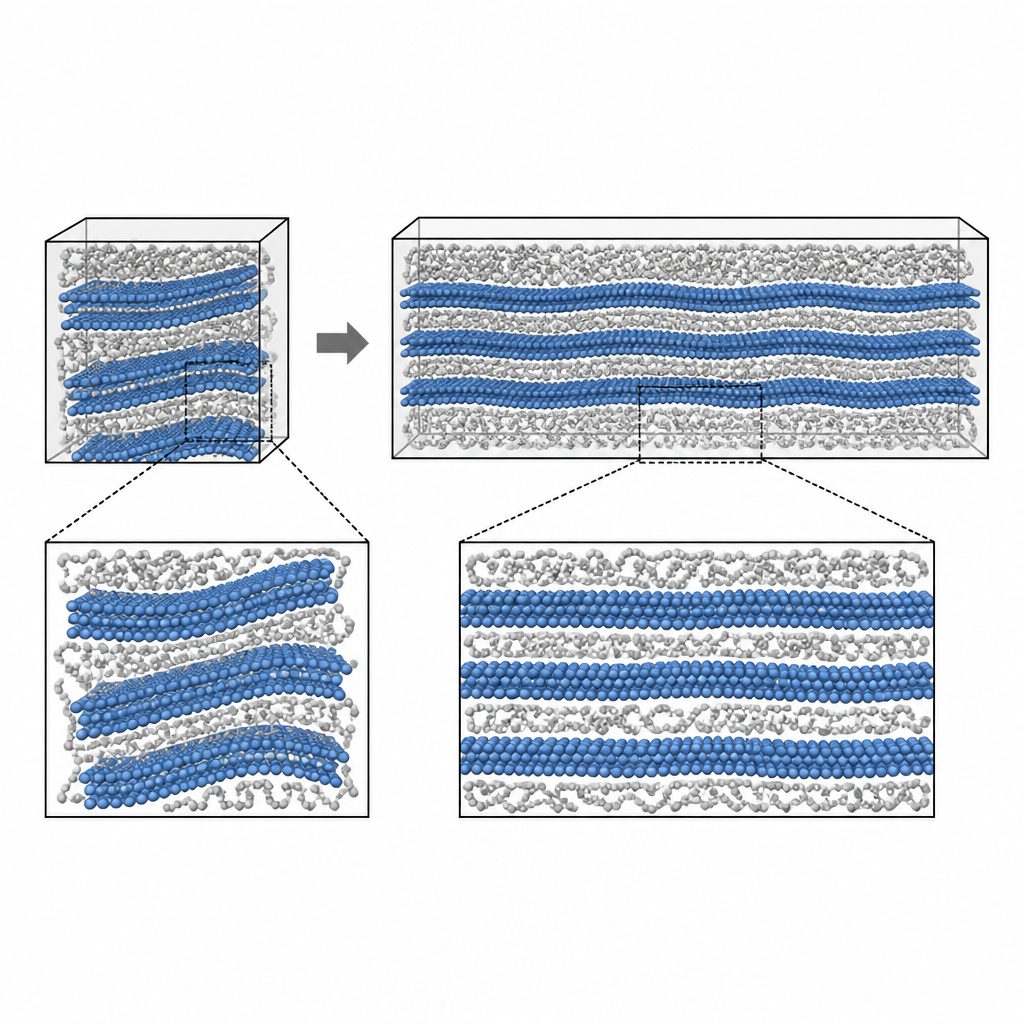
Subtle shape flaws reveal hidden size effects
Looking at the shapes of the layers themselves revealed another kind of size effect. When only one, two, or three periods of the lamellar pattern fit inside the box, the crystalline chains tended to tilt relative to the direction normal to the layers. These tilt patterns did not go away even when the overall crystal content and other bulk measures looked healthy. The authors argue that real lamellae like to gently undulate because of stresses at the boundaries between ordered and disordered regions. If the box is too small laterally, these natural ripples cannot fit, and the layers collectively tilt instead. Only when the box was large enough to host at least four full periods did the tilt vanish, leaving flatter but gently wavy layers and realistic chain arrangements with many loop and tie segments.
Practical takeaways for simulating plastics
For researchers who use coarse-grained models to study crystallizing polymers, this work delivers a clear message: it is not enough for a simulation to reproduce average density or energy. To capture realistic lamellar morphologies in this minimal bead–spring model, the simulation box must span more than three natural layer periods in the lateral directions, and the starting crystal content must be chosen so that the structure can relax efficiently. Under these conditions, the lamellae develop stable crystallinity and natural interface shapes that more faithfully represent real semicrystalline plastics, offering a reliable digital laboratory for exploring how such materials form, melt, and transport molecules.
Citation: Takano, F., Hiratsuka, M. & Takahashi, K.Z. Finite-size effects on lamellar morphology and crystallinity in a crystallizable FENE–LJ polymer model. Sci Rep 16, 15368 (2026). https://doi.org/10.1038/s41598-026-43668-5
Keywords: polymer crystallization, lamellar structure, molecular dynamics, finite-size effects, coarse-grained model