Clear Sky Science · en
Smart beamforming and deep-learning reader for RFID systems in edge IoT
Why tiny wireless tags matter
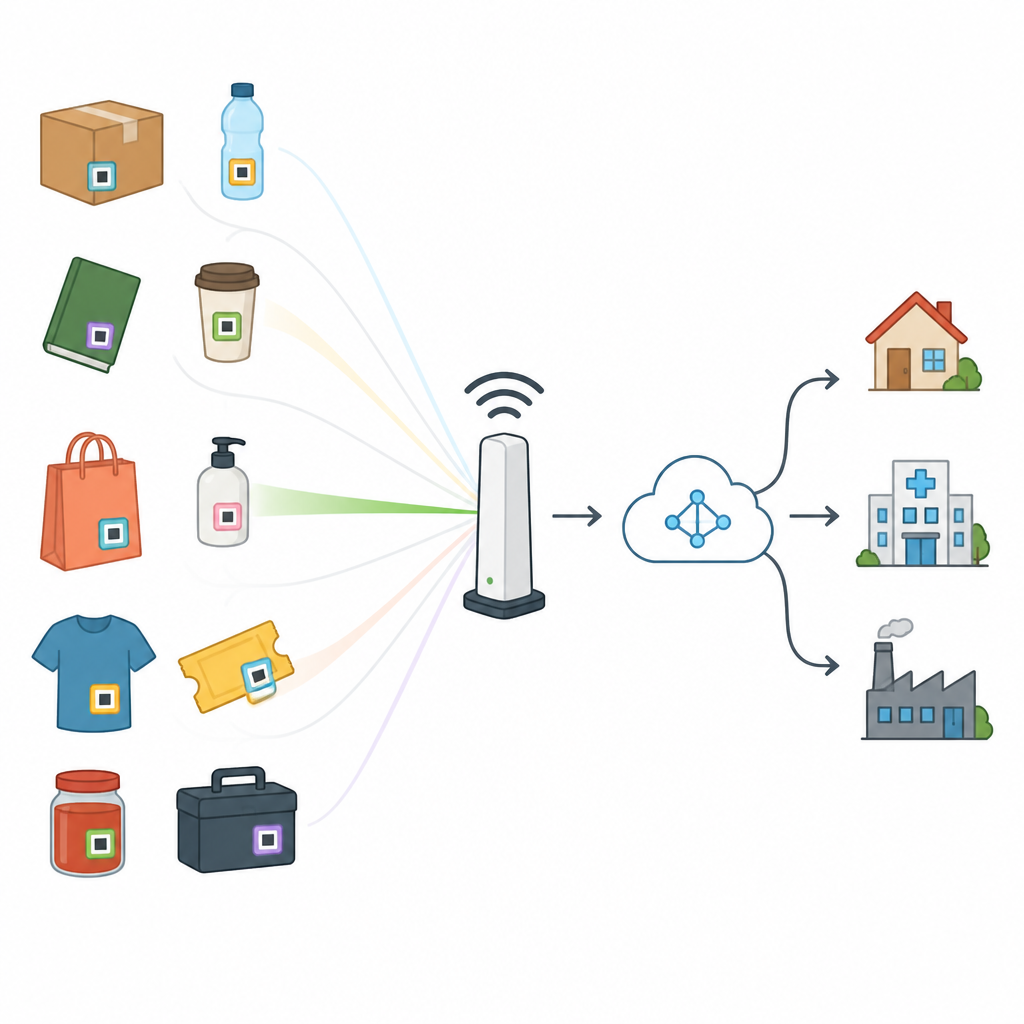
Imagine every package, ticket, or medical vial carrying a paper-thin label that needs no battery or chip, yet can still be read reliably in a busy warehouse or hospital. This paper explores how to make such simple tags work smoothly in the noisy, crowded world of 5G and the Internet of Things by giving more "smarts" to the reader instead of the tag itself.
From simple labels to smart surroundings
Radio-frequency identification, or RFID, already powers contactless cards and warehouse tracking. Classic RFID tags use tiny chips, which add cost and limit how cheaply and widely they can be used. Chipless RFID removes the chip and instead encodes information in how a patterned metal surface reflects radio waves, a bit like a finely tuned mirror. This approach promises ultra-low-cost, even disposable tags that can be printed onto packaging, tickets, or clothing. The challenge is that these faint reflections must be picked out of a cluttered environment, where noise, awkward angles, and bending of the tag can easily scramble the signal.
A dense code on a tiny tag
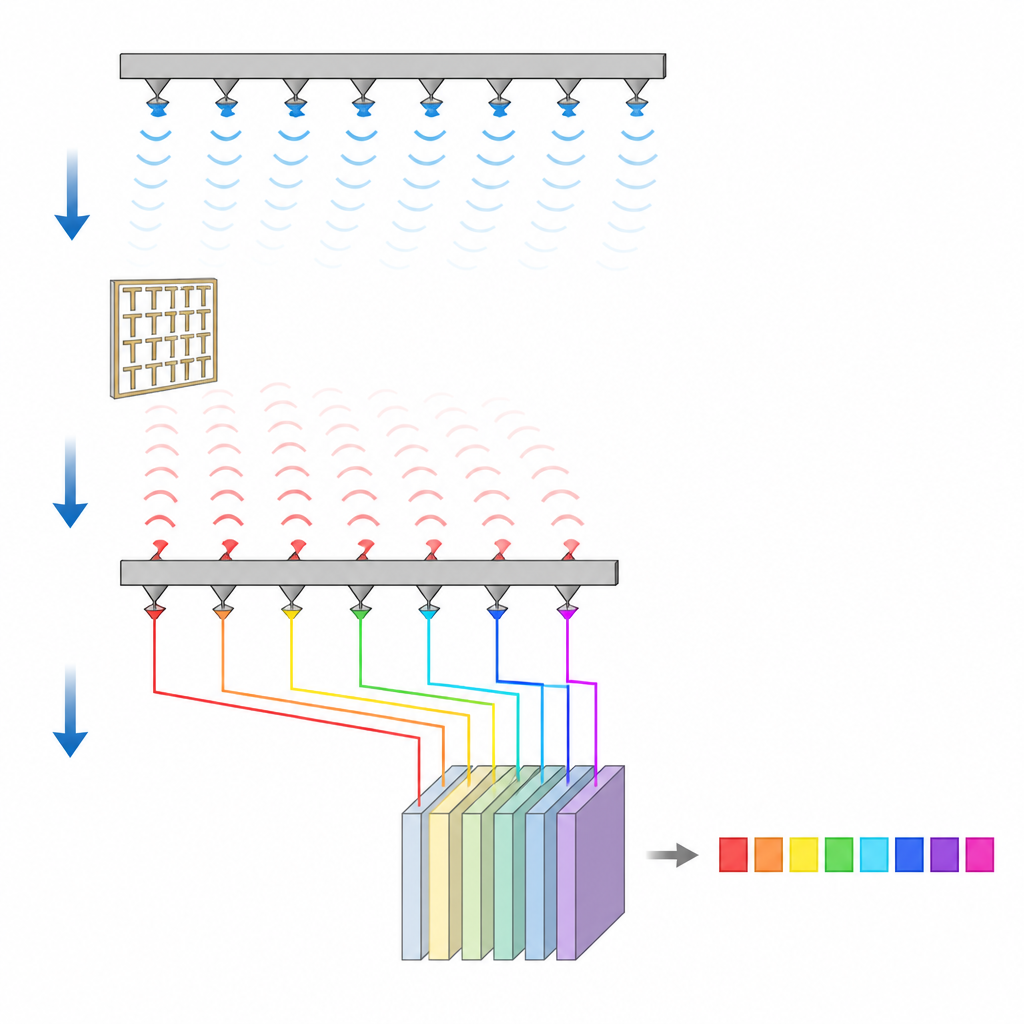
The authors design a compact chipless tag that fits within about the size of a small sticker, yet stores 24 bits of data, enough for millions of unique IDs. The tag is built as an array of T-shaped metal strips on a commercial circuit board material. Each strip acts like a tiny radio "tuning fork" that removes a narrow slice from the reflected spectrum at a specific frequency, creating a dip, or notch. By deciding which notches are present or absent across the 4 to 6 gigahertz band, the tag forms a digital code. The layout carefully spaces 24 of these notches roughly 80 megahertz apart so they remain distinct, while clever positioning of the strips limits unwanted coupling between neighbors. Measurements in an anechoic chamber confirm that the real tag closely matches simulations, with all 24 notches visible and stable even when the tag is slightly bent or rotated.
Shaping radio waves with smart antennas
Instead of relying on a single antenna, the reader in this study is conceived as a small row of antennas that act together to steer a focused beam of radio energy. By adjusting how the signals from each antenna add up, the reader can concentrate power on one tag and listen mainly in that direction, like cupping a hand around the ear. Modeling shows that a four-antenna array used for both transmit and receive can boost the useful signal by about 10 to 12 decibels compared with a single horn. This gain nearly doubles the practical read range from around 30 centimeters to roughly 60 centimeters under similar conditions, and it also helps suppress reflections from nearby objects and other tags.
Letting artificial intelligence read the code
On top of this focused radio front end, the authors add a lightweight deep-learning decoder running at the network edge. Instead of manually searching for each notch and applying fixed thresholds, they feed the entire corrected spectrum from 4 to 6 gigahertz into a one-dimensional convolutional neural network. This model learns, from thousands of measured examples, how real tag responses look under noise, small frequency shifts, and changing angles. It directly outputs the 24-bit code in one step. Compared with a more traditional machine-learning approach based on hand-crafted notch features, the neural network raises the accuracy of reading individual bits from about 93 percent to about 96 percent, and up to about 98 percent when combined with the beam-steered reader. The chance of recovering the entire 24-bit code without a single error also climbs, from roughly 73 percent with the older method and single antenna to about 86 percent with both deep learning and beamforming.
Toward smart, low-cost connected objects
For non-specialists, the core message is that the future of object tracking may lie in very simple, even disposable tags paired with increasingly smart readers. By co-designing the physical pattern on the tag, the focused antenna array on the reader, and the deep-learning software that interprets the signal, this work shows a path to reliable, high-capacity identification without chips or batteries on the item itself. Such systems could one day blend into 5G edge networks to track goods, support smart packaging, or monitor medical supplies, while keeping the object-side hardware as cheap and passive as a printed label.
Citation: Mekki, K., Slimene, M.B., Neffati, S. et al. Smart beamforming and deep-learning reader for RFID systems in edge IoT. Sci Rep 16, 15720 (2026). https://doi.org/10.1038/s41598-026-43657-8
Keywords: chipless RFID, beamforming, deep learning, 5G IoT, wireless identification